Peter Ostroff
A Voice for Beverly Hills — Past, Present, and Future
Planning Commission re: 8844 Burton Way
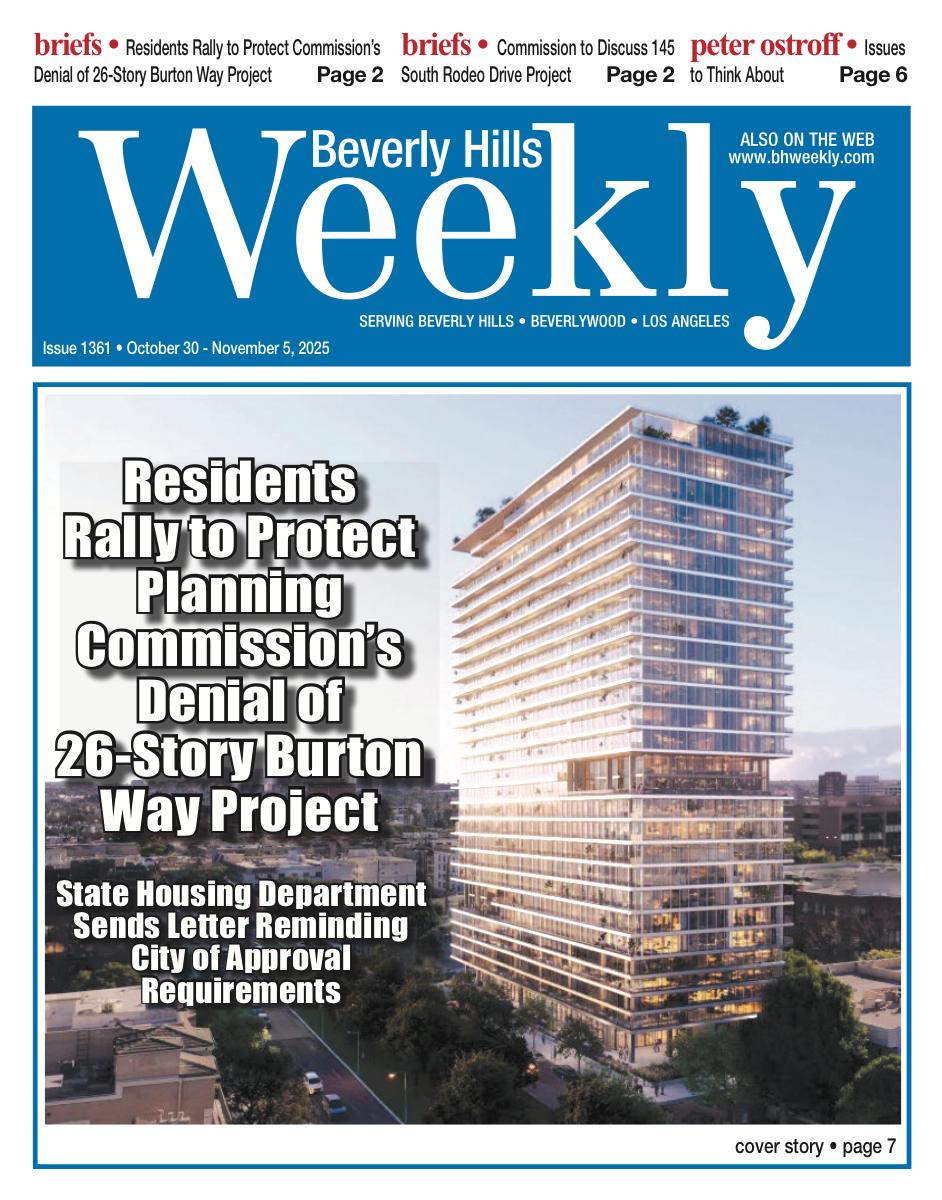
In an open letter to the Beverly Hills Planning Commission, Peter Ostroff expresses strong opposition to the proposed 26-story residential project at 8844 Burton Way, arguing that it offers significantly fewer affordable units than previously proposed and poses serious health and safety risks to the community. He urges the Commission to deny the application, emphasizing that the project is unnecessary and out of scale for the neighborhood, driven by greed rather than genuine affordable housing needs.
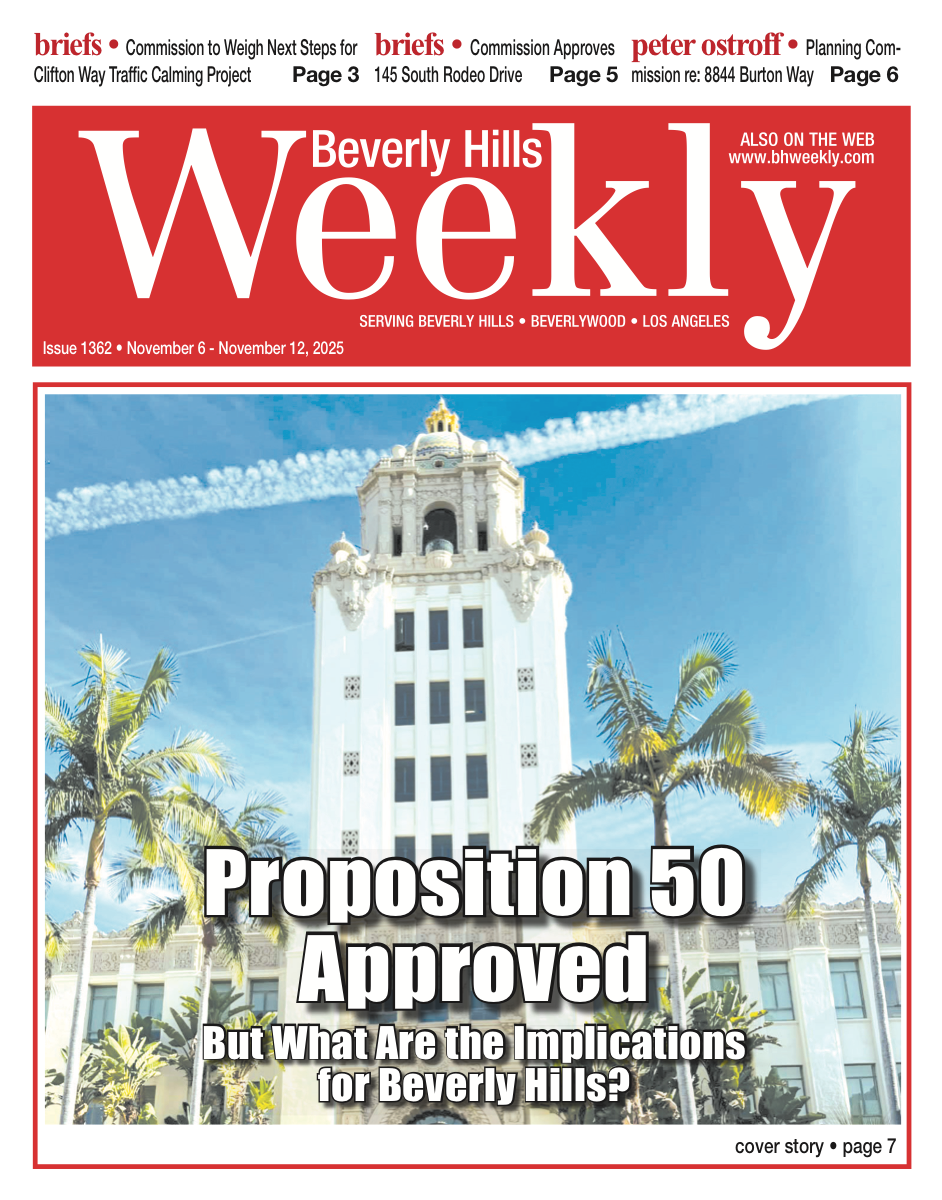
The following is an open letter to the Beverly Hills Planning Commission. This pertains to the proposed Builder’s Remedy/State Density Bonus project at 8844 Burton Way (8844) and other projects that present similar issues.
In view of the fact that the next Planning Commission hearing relating to 8844 was set on very short notice for November 5 and this open letter would not appear in the Weekly until the November 6, issue, I have sent it to the members of the Planning Commission in advance of this publication.
Dear Chair Wolfe and other members of the Planning Commission:
I am writing to let you know my thoughts on the application for your approval of a massive “residential” structure at 8844 Burton Way (8844).
I know that you are under tremendous pressure to approve given the arguments by the applicant’s talented counsel and by a recent letter from the California Housing and Community Development Department (HCD). I urge that you resist that pressure.
The nature and background of this project are central to my analysis.
These thoughts may be relevant to other revised Builder’s Remedy projects that present similar issues but have not come before you yet.
The key self-defeating feature of the 8844 application before you is that it proposes to provide far fewer affordable units (twenty-two [22] instead of forty [40]) in a much larger building (twenty-six [26] stories instead of twenty [20]) than this applicant proposed for this site a short time ago.
California’s Builder’s Remedy law was amended effective January 1, 2025 by AB1893. That amendment lowered requirements for affordable housing but retained the provision that, with some limitations, Builder’s Remedy projects are subject to the City’s written development standards unless exempted from complying with those standards by concessions or waivers. Because there is no basis for waiving the limitations on building height to allow a 26 story building, the application should be denied.
Allow me to explain.
The initial application for this project, consisted of the Preliminary Application submitted on or about December 15, 2023 and was followed by a Development Plan Review application filed on or about March 25, 2024. (The Initial Applications). These Initial Applications proposed a twenty (20) story, two hundred (200) unit project with forty (40) affordable units. The forty (40) affordable units were the minimum that were required by Builder’s Remedy law at the time for a two hundred (200) unit building.
Those Initial Applications were revised on or about March 12, 2025 and the applicant now seeks approval for a 200 unit building but has increased the height to from twenty (20) to twenty-six (26) stories and reduced the number of affordable units from forty (40) units to merely twenty-two (22).
There is a one word explanation for the proposed height increase: Greed.
Importantly, the application requests that you grant four concessions to vary from Beverly Hills rules and nine waivers of Beverly Hills rules. Not coincidentally, twenty-two (22) affordable units were the minimum required after the enactment of
AB 1893 referenced above for approval of a 200 unit building. The application for a 200 unit building with a height of twenty-six (26) stories/over 300’ tall offering the bare minimum number of affordable units is now before you.
I respectfully request that you deny this application for three independently dispositive reasons.
First, the applicant has requested that the City grant four concessions for permissions to vary from City zoning laws and rules and nine waivers of zoning laws.
An applicant is entitled to up to five concessions (plus up to two additional concessions under AB1893) which it claims result in “identifiable and actual cost reductions to provide for affordable housing costs or rents of a project’s affordable housing units.” Further, a Builder’s Remedy applicant is entitled to an unlimited number of waivers from development standards that “have the effect of physically precluding the construction of a development at the densities allowed or with the concessions permitted.” If concessions and waivers were irrelevant to Builder’s Remedy projects as some have argued, such a provision for extra concessions in the case of Builder’s Remedy projects would not have been included.
The applicant is principally relying on the Builder’s Remedy law as modified by AB 1893, particularly as it pertains to the minimum number of affordable units. Notably, even prior to the enactment of AB 1893, the Builder’s Remedy law allowed a City to apply local development standards subject to concessions and waivers.
See California Government Code Section
65589.5(f)(1,2).
A developer providing affordable units is entitled to request concessions or waivers of development standards that would otherwise limit, among other things, project density or height.
We know, from the earlier application that committed to provide forty (40) units in a twenty (20) story building on this 8844 site, that the applicant cannot credibly claim that it is not financially or physically feasible to provide a mere twenty-two (22) units unless it is entitled to build a twenty-six (26) story structure.
In order for the City to grant or deny requests for waivers and concessions, the City bears a burden to show, in substance, that they are not necessary to provide the affordable housing that is offered. Often, that is an insurmountable burden because the City does not have access to and cannot demand that the developer demonstrate, for example, that any of the concessions or waivers are necessary to make the project financially or structurally feasible. Absent such evidence, it is difficult for the City to carry its burden of proof and at least present a prima facie case that the waivers and/ or concessions sought are unnecessary.
This situation is different from other proposals that you have reviewed.
Here, the City can carry its burden to show, based on the evidence that the applicant has put in the record, that the extraordinary height is not necessary to make the project financially or physically feasible.
Specifically, two of the waivers sought by the applicant are that the City waive the applicable five story/55’ height limit (prescribed by both the zoning rules and General Plan) to allow a building that is twenty-six (26) stories/309’ tall with only twenty-two (22) affordable units.
But we know, based on the applicant’s Initial Applications, that it could financially and physically provide forty (40) affordable units in a twenty (20) story building.
Therefore, the applicant clearly doesn’t need an additional six stories to provide only slightly more than half of what it proposed to include in a building six stories shorter.
For that reason alone, the applicant is not entitled to the two requested waivers relating to building height and for that reason the application should be denied.
Moreover, if the applicant needed only twenty (20) stories to provide forty (40) affordable units, it is highly unlikely that twenty (20) stories would be needed to provide the twenty-two (22) affordable units now on offer. Using simple arithmetic, reducing forty (40) affordable units originally proposed for the twenty (20) story building to twenty-two (22) affordable units now proposed should allow a reduction of the number of stories required to eleven (11) without compromising financial or physical feasibility.
It is possible that other concessions or waivers that this applicant is now seeking, such as extending the length of the building or reducing various setbacks, are more aggressive than what would have been needed for the twenty (20) story building.
That information was not available to me but I urge you to inquire into it. To the extent that there are such instances, those requests should also be denied for the same reason (they are not needed for financial or physical feasibility).
Second, the construction of a twenty-six (26) story building in this location poses very serious threats to the residents of the area and the City. Various provisions of the California Government Code and the Health & Safety Code also bear on this issue. Those require denial of applications that pose specific and identifiable adverse impacts on health and safety.
The Commission has received evidence of numerous adverse impacts stemming from the height of the building, unhealthy omissions from the open above ground parking structure that faces existing residences, fire and seismic issues, hazards to numerous elderly residents in the vicinity including two nearby assisted living residences, access to health care at CSMC and other nearby locations.
Other members of the public have identified threats and hazards that this proposal presents. You should give all of these serious consideration.
The Commission also identified the improper concentration of the affordable units and their placement in undesirable locations. While the applicant insisted that it was not financially feasible to locate the twenty-two (22) affordable units in locations in the building other than initially proposed, it has subsequently changed that tune (and further undermining its credibility) and submitted a variety of proposals for moving them notwithstanding their insistence that relocation was not possible.
Who knows where the applicant’s shifting contradictory contentions will settle.
Taken in their totality, these issues require denial of the project.
Third, our Commissioners are not required to and should not subordinate their own judgment about the rules to the opinions of others. The applicant is entitled to its opinions about the law as is HCD (whose input may be discounted as apparently the agency was not informed of the important prior application by the applicant who sought the agency’s letter) and, for that matter, the Beverly Hills City Attorney.
The task of parsing through the maze of the Housing Accountability Act as amended and further amended is an unusually challenging one. If one looks hard enough, one will find a provision that supports almost everything save for whether the earth is flat. The easy path is to grant the application and avoid litigation and hope that market factors will prevent the insertion of this monolith into a residential neighborhood. But you should not allow that complexity to feel constrained to follow easy answers from advocates who seek to tell you what is required by applicable law.
After all, according to basic principles of jurisprudence, what is or is not the law is simply a prediction about what a particular court will decide about a specific issue.
And Yogi Berra taught us that “predictions are risky, especially when they are about the future.”
Mr. Berra likely would have noted that principle is particularly applicable in the case of the muddled maze that is the Housing Accountability Act.
As a former Planning Commissioner, I learned a great deal about land use in Beverly Hills. Personally, I regard this proposed structure as so grotesquely out of scale and scope for our community that I cannot believe that construction of this giant building which is demonstrably unnecessary to provide a mere 22 affordable units is what our state legislature intended.
For that reason, coupled with the others stated above, I could not vote to approve this project. I hope that you agree.
Sincerely,
Peter Ostroff

Peter Ostroff is a long-time Beverly Hills resident of over 50 years who retired in 2017 after a 50-year career as a trial lawyer. He was born in Washington, D.C. in 1942. He graduated from Washington University (St. Louis, Mo) in 1964 with a B.A. degree in political science and economics. He graduated from the University of Chicago Law School in 1967 with a J.D. degree. He taught law at Monash University Law School in Melbourne, Australia in 1968. He became a member of the Illinois Bar in 1967 and the California Bar in 1969, He clerked for Hon. Shirley M. Hufstedler of the United States Court of Appeal 1969-70, practiced law with Nossaman, Waters, Scott, Krueger & Riordan and successor firms from 1970 to 1980 and with Sidley Austin from 1980 until 2017. During his full time law practice years he was a Committee Chair and Member of the Council of the American Bar Association, Litigation Section and was President of the Association of Business Trial Lawyers. Since 2018, he has served on the Beverly Hills Planning Commission. In addition to his work on the Commission, Peter has chaired the BHUSD 7-11 Surplus Property Committee and contributed to planning efforts for the District Offices site on S. Lasky Drive and future uses of the Hawthorne School property. He also served as Co-Chair of the Citizens Advisory Committee for the City's Climate Adaptation and Action Plan. He has been married to Anne Y. Ostroff since 2002, has two children, Nick Ostroff and Natalie Anne Cookson and has two grandchildren, Elliott Cookson and Emma Anne Cookson. Some family information is collected under Family Tree in this website. Since April 2024, he has written a weekly column for the Beverly Hills Weekly The columns are collected in this website.
petero@ostroff.laMore from the Archive

Baseball Requiem/8844 Update
The article highlights the recent success of the Los Angeles Dodgers, who won the World Series for the second consecutive year, while also addressing the denial of a controversial 26-story apartment building proposal in Beverly Hills due to concerns about the developer's credibility and the project's impact on the residential neighborhood. Additionally, it mentions a personal anecdote about a Bat Mitzvah celebration and upcoming local holiday events.
Use to Think About
The article discusses the challenges and changes facing Beverly Hills, particularly regarding new development projects and housing legislation that have sparked resident concerns about neighborhood transformations. It emphasizes the need for informed and accountable candidates in the upcoming City Council and Board of Education elections to navigate these issues effectively and engage the community in meaningful discussions.

Flagship v. Cheval Blanc
The article compares the recently approved LVMH Louis Vuitton flagship project, designed by Frank Gehry, with the rejected Cheval Blanc luxury hotel project, highlighting that while the flagship will be architecturally impressive and less controversial, it will generate significantly lower economic benefits for Beverly Hills compared to the high-end hotel. The author expresses a preference for the Cheval Blanc, noting that many objections to it have since been addressed.