Peter Ostroff
A Voice for Beverly Hills — Past, Present, and Future
Use to Think About
The article discusses the challenges and changes facing Beverly Hills, particularly regarding new development projects and housing legislation that have sparked resident concerns about neighborhood transformations. It emphasizes the need for informed and accountable candidates in the upcoming City Council and Board of Education elections to navigate these issues effectively and engage the community in meaningful discussions.
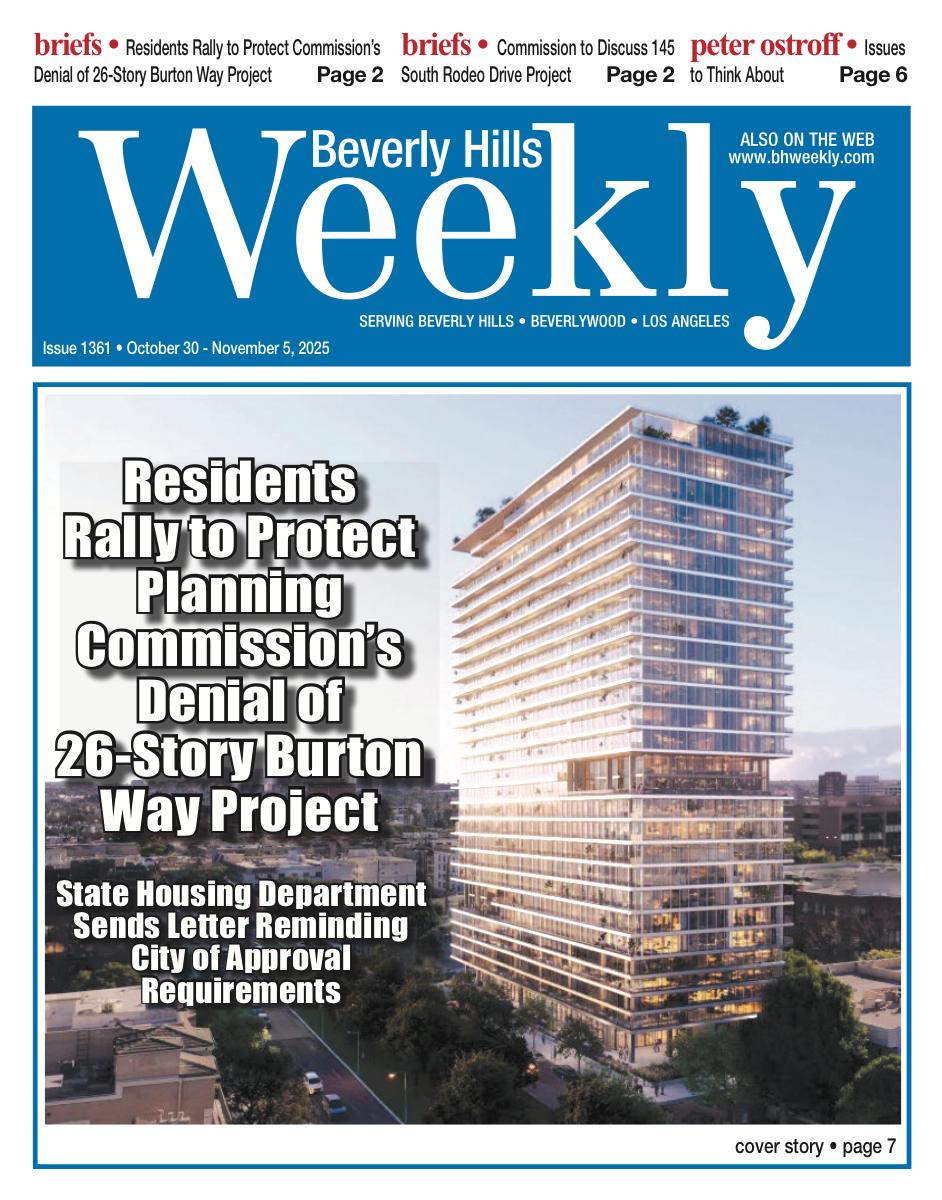
Issues to Think About
There are a number of issues that are facing our City now and I want to comment on some of them.
One of the first things that I learned during my time on the Planning Commission is that most of our residents love our city and their neighborhoods and no one wants anything to change. But change is inevitable. While our little bubble surrounded by one of the world’s largest cities has, to a large degree, been preserved, we are not encased in aspic. We are facing change in every aspect of our local lives and our challenge is to shape and mold the changes in a positive direction.
Let’s take stock for a moment. The glass is more than half full. We have exciting new developments underway. The Saks project will revitalize part of Wilshire Boulevard that has been hit hard by the demise of large department stores. The LVMH project will add luster and glamour to Rodeo Drive that is an economic engine that supports our unparalleled city services. The One Beverly Hills project is a massive undertaking that very few entities could attempt and will greatly enhance the City’s appeal to travelers from all parts of the world. Most cities would be happy to have any one of these projects but we have all three.
Yet there is discontent. Residents are concerned about the prospect of oversized multi-family residential buildings proposed for their neighborhoods where local zoning rules are overridden by state Builder’s Remedy and Density Bonus legislation. The result is that several outsized projects are being granted entitlements. If these are actually constructed, they will transform, not in a good way, the neighborhoods where they are sited. I continue to hold the view that, entitled or not, few, if any, of the Builder’s Remedy projects will be constructed without significant changes. This is because costs of construction financing, permanent financing and construction itself make these projects uneconomic under current conditions. Nonetheless, the mere prospect of these projects has understandably caused great stress to our neighbors who are most directly affected.
A byproduct of that stress is that accusations are being made that the City Council and/or the Planning Commission and/or Planning Staff were negligent or worse in not obtaining certification of Housing Element of our General Plan in time to preclude the opening of a window for the filing of applications for Builder’s Remedy projects.
These accusations arise out of a complete misunderstanding of what actually happened. In short, the state imposed requirements for vast vast increases in the number of housing sites that Beverly Hills and every other city or county in the state must identify in order to obtain certification.
In the case of Beverly Hills, the increase was 1000x, from three residential units to over three thousand. No one, not the cities, not the counties and not the state Housing and Community Development (HCD) had a clue as to what was really required or how to meet the requirements. It was a brand new “ballgame” with rules that were made up as we went along.
Notably, as of Fall, 2024, after the Beverly Hills Housing Element had been certified, 162 jurisdictions in California required to have certified housing elements still had not been found in compliance. As recently as October 25, 2025, there were 73 jurisdictions not in compliance.
Preparation of the Housing Element was a massive undertaking made more difficult by the fact that HCD’s rules were a constantly changing moving target. The Housing Element that was ultimately adopted by the City Council in March 2024 and certified by HCD in May 2024 included a detailed treatment of potential new housing sites on a parcel by parcel basis. It is a monster of 462 pages and includes a parcel by parcel analysis of every parcel in the City. My guess is that those who level the criticisms have never looked at let alone read this work. A glance would be sufficient to show that the criticisms are misplaced and wrong.
When I hear these criticisms, my reaction is to ask: Where were you?
***
Along these lines, in 2026, we will have two important elections in our city. In June, we will elect three members of the City Council. The terms of Lester Friedman, John Mirisch and Sharona Nazarian will be up. In November, we will elect two members of the Board of Education. The terms of Judy Manouchehri and Rachelle Marcus are up. While some incumbents are likely to run for re-election, there is no certainty that they will be re-elected. Further, there will be at least two or three seats for which no incumbent will be on the ballot. In order for democracy to work and to ensure a thorough debate of issues and ideas, we must have a campaign in which a number of candidates have thrown their “hats” in the ring. According to the grapevine, not many prospective candidates have committed to run for either the Council or the Board. Where are you when we need you?
I am hopeful that there will be a number of candidates for both of these governing bodies. And while I am at it, I thought that it would be useful to identify the characteristics that we should be looking for in the candidates.
It is important to understand that both the City Council and the Board of Education are, in essence, “committees”. When a committee is in charge of something, no one is in charge. Yet accountability, elusive at best in a committee form of government, should be a prime objective.
I don’t pretend to have a perfect answer to how to achieve this objective but a starting point, in my view, is to assign to one or two members of the Council or Board (Brown Act principles preclude more than that and complicate the quest for accountability) principal responsibility for specific tasks (e.g. finance for both, public works or community development or public safety in the case of the Council; high school or middle school or elementary schools in the case of the Board). The selection of a superintendent is the most important task for the Board of Education and accountability for that cannot be delegated.
Similarly, members of the Council and the Board should have temperaments that facilitate collegial debate and decision making. They must understand that they are role models and that belligerence (you know who you are) has no place in public meetings.
Political agendas also have no proper place on either the Council or the Board. Our current City Council members understand and practice these principles. I cannot say the same for all members of the current Board of Education.
For City Council, we need people who have some familiarity with how city government works. Participation in Team Beverly Hills is a good starting point. Experience on one or more city commissions is useful as is active participation in trying to influence issues before the City Council. A basic understanding of City government revenues and expenses is very useful. Residence in the City for a number of years is also helpful.
Participation on the Council offers rewards and requires a great deal of work. We want candidates who want to do the job, not simply have the job and all the photo ops that seem to go with it. And we want candidates who are willing to represent all of our residents, not just a subset.
For the Board of Education, more specialized and focused education, training and experience is vital. Degrees from institutions of higher learning is almost a basic requirement. Beyond that, a fundamental understanding of how elementary and secondary education is currently conducted and how it differs from the way it was conducted when most adults were in school is critical. For example, the use of computer technology is now an essential component of education. Similarly, an understanding of the challenges presented by artificial intelligence and the impact of this technology on trust between students and teachers is vital.
I am hopeful that we will have a number of well qualified candidates in the upcoming campaigns and a robust debate of the issues. I shall do my best to identify such candidates and hope that you will as well.

Peter Ostroff is a long-time Beverly Hills resident of over 50 years who retired in 2017 after a 50-year career as a trial lawyer. He was born in Washington, D.C. in 1942. He graduated from Washington University (St. Louis, Mo) in 1964 with a B.A. degree in political science and economics. He graduated from the University of Chicago Law School in 1967 with a J.D. degree. He taught law at Monash University Law School in Melbourne, Australia in 1968. He became a member of the Illinois Bar in 1967 and the California Bar in 1969, He clerked for Hon. Shirley M. Hufstedler of the United States Court of Appeal 1969-70, practiced law with Nossaman, Waters, Scott, Krueger & Riordan and successor firms from 1970 to 1980 and with Sidley Austin from 1980 until 2017. During his full time law practice years he was a Committee Chair and Member of the Council of the American Bar Association, Litigation Section and was President of the Association of Business Trial Lawyers. Since 2018, he has served on the Beverly Hills Planning Commission. In addition to his work on the Commission, Peter has chaired the BHUSD 7-11 Surplus Property Committee and contributed to planning efforts for the District Offices site on S. Lasky Drive and future uses of the Hawthorne School property. He also served as Co-Chair of the Citizens Advisory Committee for the City's Climate Adaptation and Action Plan. He has been married to Anne Y. Ostroff since 2002, has two children, Nick Ostroff and Natalie Anne Cookson and has two grandchildren, Elliott Cookson and Emma Anne Cookson. Some family information is collected under Family Tree in this website. Since April 2024, he has written a weekly column for the Beverly Hills Weekly The columns are collected in this website.
petero@ostroff.laMore from the Archive

BHUSD Initiative/Hoops/Builder's Remedy Docket
The Beverly Hills Unified School District is restructuring its College and Career Counseling Department to enhance academic support and college readiness for students, with dedicated counselors for different grade levels and a focus on wellness resources. Additionally, several new housing projects under California's Builder's Remedy are set to be reviewed by the Planning Commission, though concerns about inadequate parking and the potential impact on established neighborhoods persist.
Unique Favoritism/Board Under Fire
The article discusses the controversy surrounding a proposed exception to a new ordinance in Beverly Hills that would allow landmarked properties to be rented out for shorter terms, raising concerns of favoritism toward a specific property owner. Additionally, it critiques the Board of Education's handling of a recent decision regarding the display of Israeli flags in schools, highlighting community outrage and the need for open, accountable discourse on leadership issues within the district.
OBH Closing Argument
In a letter to the Beverly Hills City Council, Peter Ostroff expresses strong opposition to the One Beverly Hills developer's request for $550 million in tax-exempt bonds, arguing that it represents a "bait and switch" tactic that poses significant financial risks to the city and its residents. He emphasizes the need for thorough analysis and public accountability before proceeding with such a substantial financial commitment, highlighting widespread resident outrage and concerns about potential liabilities.