Peter Ostroff
A Voice for Beverly Hills — Past, Present, and Future
Baseball Requiem/8844 Update
The article highlights the recent success of the Los Angeles Dodgers, who won the World Series for the second consecutive year, while also addressing the denial of a controversial 26-story apartment building proposal in Beverly Hills due to concerns about the developer's credibility and the project's impact on the residential neighborhood. Additionally, it mentions a personal anecdote about a Bat Mitzvah celebration and upcoming local holiday events.

There are a number of interesting and challenging things going on in and around the Beverly Hills bubble.
Most importantly, as some of you may have noticed, our Dodgers just won the World Series for the second time in a row. This is the first time in 25 years that there has been a repeat winner. And now the Dodgers go for a “three-peat” that is even more challenging than a “mere” repeat. I may not be able to resist the temptation to make a prediction on that as we approach the season opener in March (never mind that I was wrong when I predicted that they would not win again this year).
The regular season had highs and lows (seemingly more of the latter) and most of the post-season seemed easy. But then the Dodgers met the talented Blue Jays (Canada’s team) and played an electrifying seven game
World Series. The Dodgers seemed on the brink of defeat a number of times but resisted, fought back and won.
For a day or two, I was very happy but then the reality set in – we will be without baseball for four or five months. As much of a sports junkie as I am, I don’t care that much for the sports that are played in the interim (NFL, NBA, NHL, NCAA football and hoops) so darkness seems likely to settle in.
For those of you who are similarly depressed, I will share my self-help remedies (none of which involve pharmaceutical or alcoholic products as tempting as they may be).
First, I can turn to some of my favorite baseball books. These include
Tom Boswell’s “Why Time Begins on Opening Day” [which captures my world view in a short phrase], Daniel Okrent’s “Nine Innings: The Anatomy of Baseball as seen Through the
Playing of a Single Game” [a 300 page examination of a June, 1982 game between the Brewers and the Orioles which, as you can imagine, gets into some detail].
Then there is a starter book, “Baseball in the Big Leagues” written in 1910 by Johnnie Evers, a former player and manager of the Chicago Cubs.
Mr. Evers, of course, was part of the
Chicago Cubs infield at the turn of the 19th Century that included Joe Tinker and Frank Chance. They were immortalized in the famous 1910 poem “Baseball’s Sad Lexicon” by Franklin P. Adams from the standpoint of a
New York Giants fan that included the lines:“These are the saddest of possible words: ‘Tinker to Evers to Chance.’”
In the introduction, Mr. Evers noted more than 115 years ago; “The game is the most highly developed, scientific and logical form of pastime or contest evolved by man, and the ultimate evolution of the one universal game.” And this was more than 60 years before the designated hitter was introduced in 1973!
Fortunately, there are also great
Dodgers specific books including “The
Boys of Summer” about the Brooklyn Dodgers of the 1950’s, “The Last Innocents” about the Los Angeles Dodgers of the 1960’s and my favorite, Molly
Knight’s “The Best Team Money Can Buy” about the 2016 Dodgers.
But reading alone cannot fill the void so it is important to attend a real sporting event or two in person. But what?
In furtherance of this objective, Nick
Ostroff and I will be going in early
January to Sydney to see the Cricket (kinda like baseball) Test Match between Australia and England and then to Melbourne for the Australian Open Tennis.
And, before we know it, time will begin again.
***
On November 5, the Beverly Hills
Planning Commission voted 3-2 to deny the Builder’s Remedy application of developer Crescent Heights to construct a twenty-six [26] story, 200 unit apartment building with twenty-two [22] “affordable” units of which 14 would be for extremely low income residents and 8 would be for moderate income residents. The site is 8844 Burton Way and abuts a residential neighborhood with much smaller buildings and heavily trafficked Burton Way.
Previously, Crescent Heights had submitted a slightly less aggressive application to construct a twenty [20] story, 200 unit building on the site including forty [40] “affordable” units.
The members of the Planning Commission had varying opinions about the application but one common theme that was commented on by several of the Commissioners was that they had serious concerns about the applicant’s credibility. I share those concerns and note that when one of the representatives was questioned about prior inconsistent statements and actions he consistently responded with lengthy (and, I might add, unusually loud) word salads and double talk.
Nonetheless, we are told that, under the law, dishonesty alone is somehow not a proper legal basis for rejection.
It is fair to observe that sometimes the law is an ass.
Now, the denial will be appealed by the applicant to the City Council. This bears watching for several reasons. It is very large at twenty-six [26] stories and is on a thoroughfare that is largely residential, not one of our major commercial boulevards. Most of the other Builder’s Remedy applications in Beverly Hills do not seem likely to result in any actual construction because the applicants apparently lack development experience or because of current market conditions or both. In fact, at least four of the Beverly Hills properties which have attained entitlements because of the Builder’s Remedy laws are being listed for sale as is a fifth which does not yet have entitlements.
The 8844 applicant is different. On its sophisticated website, Crescent
Heights “modestly” states: “Crescent
Heights is the nation’s leading urban real estate firm, specializing in the development, ownership, and operation of architecturally distinctive mixeduse high-rises in major cities across the
United States.” Imagine that!
Certainly, Crescent Heights, unlike most of the other builder’s remedy applicants, has the experience and wherewithal to construct this project.
Of course, it is not immune to the market conditions but we should not rely solely on those to protect us from the insinuation of this massive building into our midst.
Now that the Planning Commission has done its part, we must look to the City Council for protection. A key factor that should be emphasized is that the applicant has proposed a much taller building (six more stories) with far fewer affordable units (22 instead of 40) than its recent prior application.
As Commissioner Myra Demeter said to the applicant: “You are asking for much more from us and giving us much less [than your previous application].” The applicant’s counsel loudly asserted that the prior application is “Irrelevant.” But, last I checked, as talented as counsel seems to be, he is not the judge who, in the event that there is litigation, will be the one to decide what is relevant and what is not.
FYI, in my opinion, it is far from irrelevant.
I think that the prior application shows clearly that the applicant does not need all of the height requested to provide even the twenty-two (22) affordable units now on offer, let alone the forty (40) previously proposed.
Certainly, the applicant has contended and will contend that market conditions have changed so much in the last few months that the increase in height and reduction of units is needed to make the project feasible. But whether that justifies a 30% height increase and a nearly 50% decrease in affordable units will be for the jury, not applicant’s counsel, to decide.
I expect that our residents, including those who live near this project site, will make their views known to the City Council. Further, there are several legal issues that must be resolved.
Given the complexity of the California
Housing Accountability Act, that will be challenging. That is because the
Act has been frequently modified to the point that it is as opaque as the balcony walls that the developer objects to; and there is as yet precious little appellate court guidance.
As we go along, I intend to offer my thoughts on the balance of the rights of the developer and the rights of the residents.
***
On Saturday November 8, I attended a wonderful event, the Bat Mitzvah of Cultural Heritage Commission
Chair Lori Greene Gordon. As you may know, Lori is a few years past the customary Bat Mitzvah age but this fulfilled a long-held ambition for her.
When she had her first Bat Mitzvah, she was not allowed to read from the
Torah. This constraint always troubled her and on Saturday she corrected it with a beautiful performance. It stirred great admiration from a large group of friends and tremendous pride from her talented and beautiful daughters, Victoria and Natalie. Guests that I know from the Beverly Hills bubble included City Councilmember John Mirisch and his fiance Yamani Caliwara, City Treasurer Howard Fisher and Francine Fisher, Commissioner Maralee
Beck, Commissioner Terri Smooke and Michael Smooke, Commissioner Sandi Pressman and our MWD representative, Dr. Barry Pressman.
***
Tonight, Nov. 13, the annual Rodeo
Drive Holiday Lighting Celebration will be held from 5 to 8p. This year’s theme, Enchanted Holiday Dreams, was inspired by Tchaikovsky’s The Nutcracker Ballet.

Peter Ostroff is a long-time Beverly Hills resident of over 50 years who retired in 2017 after a 50-year career as a trial lawyer. He was born in Washington, D.C. in 1942. He graduated from Washington University (St. Louis, Mo) in 1964 with a B.A. degree in political science and economics. He graduated from the University of Chicago Law School in 1967 with a J.D. degree. He taught law at Monash University Law School in Melbourne, Australia in 1968. He became a member of the Illinois Bar in 1967 and the California Bar in 1969, He clerked for Hon. Shirley M. Hufstedler of the United States Court of Appeal 1969-70, practiced law with Nossaman, Waters, Scott, Krueger & Riordan and successor firms from 1970 to 1980 and with Sidley Austin from 1980 until 2017. During his full time law practice years he was a Committee Chair and Member of the Council of the American Bar Association, Litigation Section and was President of the Association of Business Trial Lawyers. Since 2018, he has served on the Beverly Hills Planning Commission. In addition to his work on the Commission, Peter has chaired the BHUSD 7-11 Surplus Property Committee and contributed to planning efforts for the District Offices site on S. Lasky Drive and future uses of the Hawthorne School property. He also served as Co-Chair of the Citizens Advisory Committee for the City's Climate Adaptation and Action Plan. He has been married to Anne Y. Ostroff since 2002, has two children, Nick Ostroff and Natalie Anne Cookson and has two grandchildren, Elliott Cookson and Emma Anne Cookson. Some family information is collected under Family Tree in this website. Since April 2024, he has written a weekly column for the Beverly Hills Weekly The columns are collected in this website.
petero@ostroff.laMore from the Archive
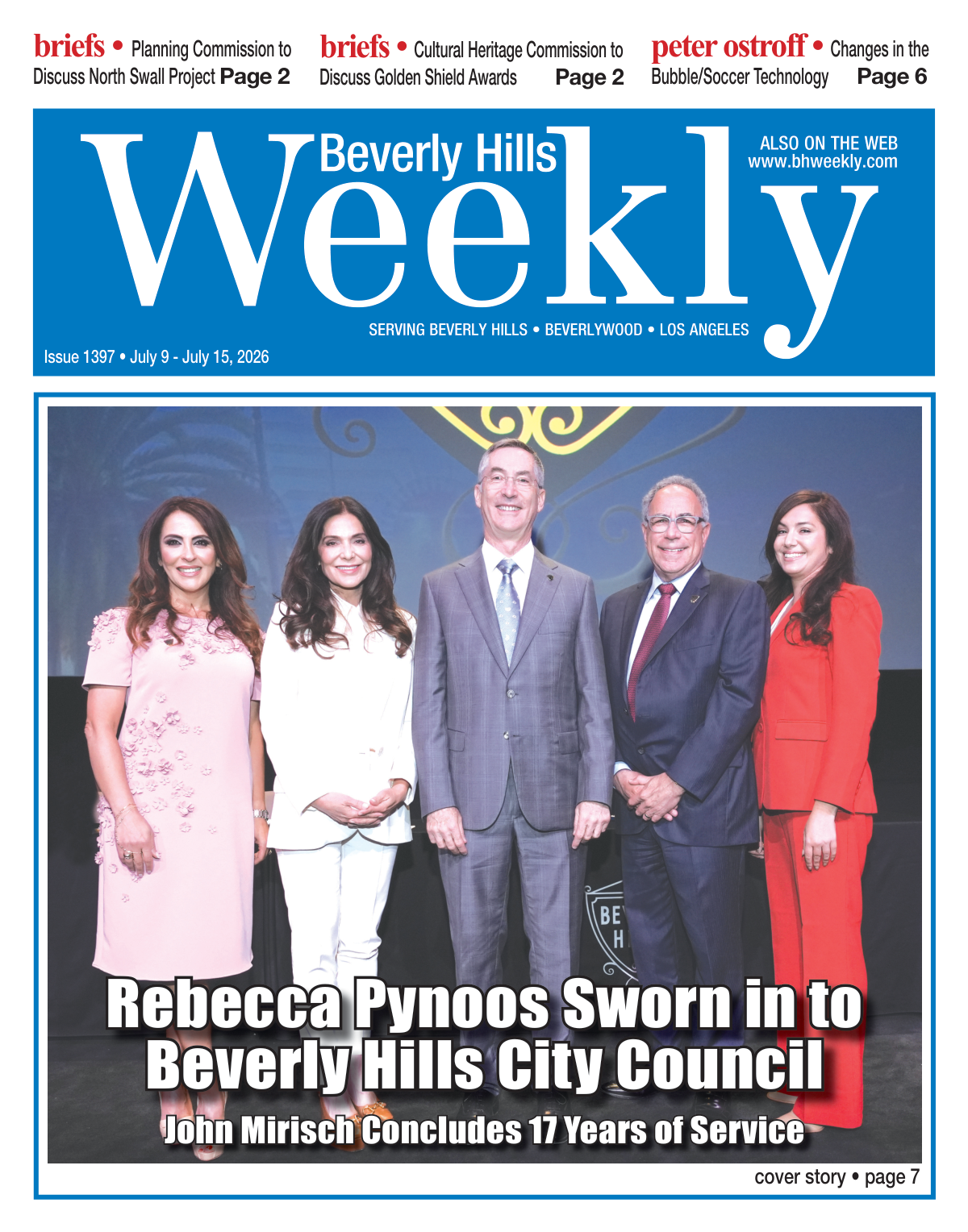
Changes in the Bubble/Soccer Technology
Peter reflects on Beverly Hills leadership transitions, including Ryan Gohlich as City Manager, Captain Max Subin as Police Chief, and Rebecca Pynoos joining the City Council after John Mirisch’s service. He also critiques FIFA’s connected-ball offside technology and corrects a prior note about the Millennium Project’s ministerial approval path under AB 2011.
Planning Commission re: 8844 Burton Way
In an open letter to the Beverly Hills Planning Commission, Peter Ostroff expresses strong opposition to the proposed 26-story residential project at 8844 Burton Way, arguing that it offers significantly fewer affordable units than previously proposed and poses serious health and safety risks to the community. He urges the Commission to deny the application, emphasizing that the project is unnecessary and out of scale for the neighborhood, driven by greed rather than genuine affordable housing needs.
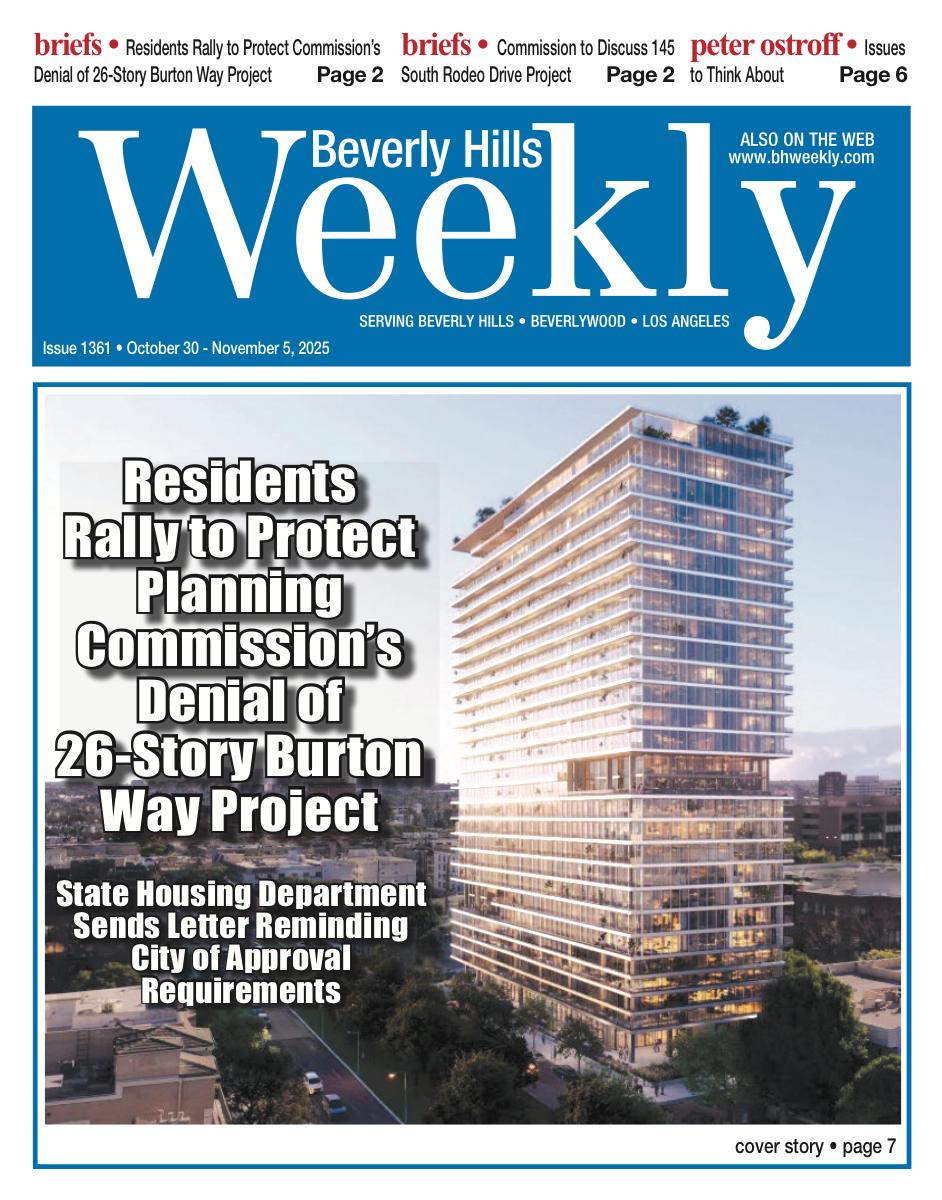
Use to Think About
The article discusses the challenges and changes facing Beverly Hills, particularly regarding new development projects and housing legislation that have sparked resident concerns about neighborhood transformations. It emphasizes the need for informed and accountable candidates in the upcoming City Council and Board of Education elections to navigate these issues effectively and engage the community in meaningful discussions.