Peter Ostroff
A Voice for Beverly Hills — Past, Present, and Future
In Search of a Housing Approach
The article discusses the ongoing housing crisis in California, particularly in Los Angeles County, highlighting the urgent need for more housing and criticizing state government strategies that focus on social engineering rather than effective solutions. It argues that simply removing local obstacles to housing development is insufficient, as high costs and bureaucratic inefficiencies continue to hinder the construction of affordable units, and calls for a more pragmatic approach to address these challenges.

“Affordability” is on everyone’s mind as we finish the first quarter of the 21st Century and housing seems to be at the epicenter of the issue. Astonishing to me is the fact that there are at least 75,000 people unhoused in Los Angeles County notwithstanding vast resources that are thrown at the issue.
In many parts of the state and region and Los Angeles County, much more housing is needed. This is a tremendous problem with tragic results. Statement of the problem is simple: Much more housing is needed. And the solution is also simple: build housing. Rather than address the entirety of the problem, our state government has focused on only one cause of the problem and undermined even those efforts by distracting and counterproductive social engineering tactics.
Also problematic is the fact that the strategies employed including the anti-free enterprise Regional Housing Needs Assessment allocations foolishness are worse than ineffective because they cause divisive disruptions in almost every community.
Let me explain.
When cataloguing the absurdities of the efforts of the State of California to address the so-called “housing crisis” it is difficult to know where to begin.
The undermining of local control of land use alone is not a strategy as much as it is an abdication of responsibility. A state-wide problem cannot be solved at the local or even county or regional level. Between 2010 and 2020, there were more than three times the number of new residents in California than there were dwelling units constructed.
The Regional Housing Needs Assessment (RHNA) is part of a social engineering overlay that resulted in an allocation to our little city of more than 3100 new housing sites ¾ of which were to be “affordable” (in an area of a less than six square miles where there is close to zero undeveloped land). This target is impossible for Beverly Hills and the targets for many other cities is equally impossible.
Notably, at the end of 2024, several years into the eight year RHNA cycle, permits for only twenty-three “affordable” units had been issued (and, to my knowledge, none had broken ground). None have been issued in 2025. Many other localities are burdened with similar dictates.
Beverly Hills is trying hard to comply with impossibilities. City planners Cindy Gordon and Chloe Chen and others are devoting substantially efforts to the task.
To date, the only consequence of numerous state laws which usurp any semblance of local control has been to override obstacles to entitlements. There is no doubt that municipal NIMBYism has made development of housing at all levels, not just the excruciatingly low “affordable” price points, more difficult.
But NIMBYism is only one factor and doubling down on removing all local obstructions has been futile and is becoming counter-productive.
Futility: Entitlements are only the beginning of housing construction. High costs of land, financing and construction, uncertainties about the economy and a shortage of very high end purchasers who can, in effect, subsidize the construction of “affordable” units remain as obstacles that preclude development.
Counter-productive: Entitlements and upzoning always result in increasing the apparent value of the properties affected.
I have expressed my opinion that few if any of the Beverly Hills Builder’s Remedy projects will be built. And now we see that several of these generously entitled projects, once approved, are on the market for unbelievably high asking prices.
While addressing NIMBYism may be necessary to promote housing construction, it is far from sufficient. At least equally important are costs of land, financing, construction, materials etc. that make investment in housing construction very challenging.
Yet our legislators do little more than demand that our local governments get out of the way or be punished or both.
The recently enacted SB 79 which upzones properties near Metro stations and other transit facilities is unlikely to generate much development interest but invariably increases the theoretical value of the properties making development even more costly. Now the Our Planning Department is scrambling to transfer some of the additional density from single family neighborhoods near the Metro to Wilshire and/or LaCienega Blvds.
I wonder whether the owners of affected single family homes really object to the upzoning of their properties which, at least on paper, increases the property value. Similarly, the transferees of some of the upzoning also see increases in their property value. On both ends, the upzoning increases the cost of development and makes construction of “affordable” units that much less likely.
And then when upzoning and removal of local obstacles to entitlement do not result in development of units, our legislators simply do more of the same by increasing the level of upzoning and reducing the number of affordable units to qualify for the upzoning. The proposed builder’s remedy project at 8844 Burton Way is a case in point.
Initially, it was proposed as a 20 story building with 40 “affordable” units. While that application was pending, the legislators changed the rules so the proposal is for a 26 story building with only 22 “affordable” units. This is a classic example of ignoring the rule: “When you are in a hole, STOP DIGGING.” And the state’s efforts are further undermined by trying to further other social policies that distract from the already difficult task of getting housing built. For example, these social objectives include: promoting a mix of housing types and affordability levels, affirmatively furthering fair housing, reducing income level segregation, balancing jobs and housing and encouraging infill development.
Laudable, I suppose, but they get in the way.
The fact that the state persists in making more rules without actually doing something useful is a function of the quest of our state legislators to be heroes at bargain prices.
In any event, enough has been done to remove local NIMBY obstacles to entitlements, it is time to address the other obstacles.
According to Shelterforce, a publication that focuses on construction of affordable housing, California needs 1.2 million additional units of affordable housing over the next 10 years to meet the current demand. That would require building 120,000 units per year (and not losing any we already have).
Can this be done? Of course it can but when development costs are high and there are large numbers of our fellow citizens cannot afford those costs, we cannot simply rely on the free market unburdened by those bothersome NIMBYs.
Rather, the state must simply build housing or do things that will reduce the costs of construction or rehabilitation.
That may result in some additional housing.
I recognize that large scale public housing projects often create more problems than they solve but smaller scale projects can be successful.
One of the best tools for getting affordable housing actually built by private developers is the federal Low Cost Housing Tax Credits program. This program, which is administered in California by the California Tax Credit Allocation
Committee, actually works. Qualifying builders of low cost housing (which is defined similarly to California “affordable” housing and is required in similar proportion to market rate units) obtain federal tax credits. These credits can be sold to investors and, in essence, receive equity capital that covers a substantial part of construction costs. To the extent that funds are available, and developers compete for them, low cost housing is actually constructed. At present, there are insufficient credits available to do more than fund a small proportion of the applicants. As projects with qualifying amounts of low cost units are often unprofitable, developers often undertake these projects and rely on LIHTCs and similar programs for their entire profit.
But projects that otherwise do not “pencil out” actually get built.
Notably, Cities with very high land costs and, high construction costs like Beverly Hills often have few or no LIHTC developments because the federal/ state credits alone may not cover elevated construction and land acquisition costs without substantial additional subsidies.
The ridiculous RHNA allocations ignore this huge impediment in aid of the social engineering objectives.
There is, in my view, little prospect that there will be much in the way of increased subsidies from the state of California given the current budget constraints.
There is some hope on the way at the federal level.
The recently enacted One Big Beautiful Bill Act includes substantial additional funds for LIHTC projects.
Further, California Senator Adam Schiff has very recently introduced legislation entitled Housing BOOM (Building Occupancy Opportunity for Millions)
Act. This will, if enacted, triple the amount of federal funding for LIHTC and, in addition, provide substantial funding for grants and low cost loans to developers of affordable housing.
I am hopeful that such legislation will progress so that many more projects that include affordable and market rate housing will actually be built in locations that make sense, all things considered. And, as I believe that I mentioned, that we concentrate on getting housing built and leave the commendable social policies for another day once we can get roofs over the heads of our fellow citizens.
***
The high divided politically motivated
Board of Education on Tuesday ignored without comment its own by-laws, its historical practice and principles of good government by refusing to select Dr.
Amanda Stern as Vice President. (See page 8).
The ByLaws of the Beverly Hills Board of Education, Section 9100, provide: “The Board shall each year elect one of its members to be vice president and one of its members to be clerk. Selection of the vice president shall be determined by rotation based on how long each member has served on the Board during their current term on the Board.
If two or more have the same term of service then they shall serve as vice president in descending order of the number of votes received in their most recent election and for this purpose an appointed member shall be treated as having zero votes. Immediately after serving as vice president, the elected member shall serve one year as president of the Board.
This member shall be one who previously has not served in office, during the current term, unless all the Board's members have previously served in office.
No Board member shall serve more than one consecutive year in the same office. “The election of Board officers shall be conducted during an open session of the annual organizational meeting.”
Dr. Stern is the member who received the most votes in the most recent election and should by the express terms of the bylawshave been elected Vice President.
Some members of the Board claimed that Dr. Stern had disclosed confidential
Board information to unnamed members of the press. To the extent that pretext for a purely political decision was a reference to me, while I never reveal my sources, I state unequivocally that I have never discussed confidential or closes session information of any type with Dr. Stern.
People Mentioned

Peter Ostroff is a long-time Beverly Hills resident of over 50 years who retired in 2017 after a 50-year career as a trial lawyer. He was born in Washington, D.C. in 1942. He graduated from Washington University (St. Louis, Mo) in 1964 with a B.A. degree in political science and economics. He graduated from the University of Chicago Law School in 1967 with a J.D. degree. He taught law at Monash University Law School in Melbourne, Australia in 1968. He became a member of the Illinois Bar in 1967 and the California Bar in 1969, He clerked for Hon. Shirley M. Hufstedler of the United States Court of Appeal 1969-70, practiced law with Nossaman, Waters, Scott, Krueger & Riordan and successor firms from 1970 to 1980 and with Sidley Austin from 1980 until 2017. During his full time law practice years he was a Committee Chair and Member of the Council of the American Bar Association, Litigation Section and was President of the Association of Business Trial Lawyers. Since 2018, he has served on the Beverly Hills Planning Commission. In addition to his work on the Commission, Peter has chaired the BHUSD 7-11 Surplus Property Committee and contributed to planning efforts for the District Offices site on S. Lasky Drive and future uses of the Hawthorne School property. He also served as Co-Chair of the Citizens Advisory Committee for the City's Climate Adaptation and Action Plan. He has been married to Anne Y. Ostroff since 2002, has two children, Nick Ostroff and Natalie Anne Cookson and has two grandchildren, Elliott Cookson and Emma Anne Cookson. Some family information is collected under Family Tree in this website. Since April 2024, he has written a weekly column for the Beverly Hills Weekly The columns are collected in this website.
petero@ostroff.laMore from the Archive

Baseball Requiem/8844 Update
The article highlights the recent success of the Los Angeles Dodgers, who won the World Series for the second consecutive year, while also addressing the denial of a controversial 26-story apartment building proposal in Beverly Hills due to concerns about the developer's credibility and the project's impact on the residential neighborhood. Additionally, it mentions a personal anecdote about a Bat Mitzvah celebration and upcoming local holiday events.
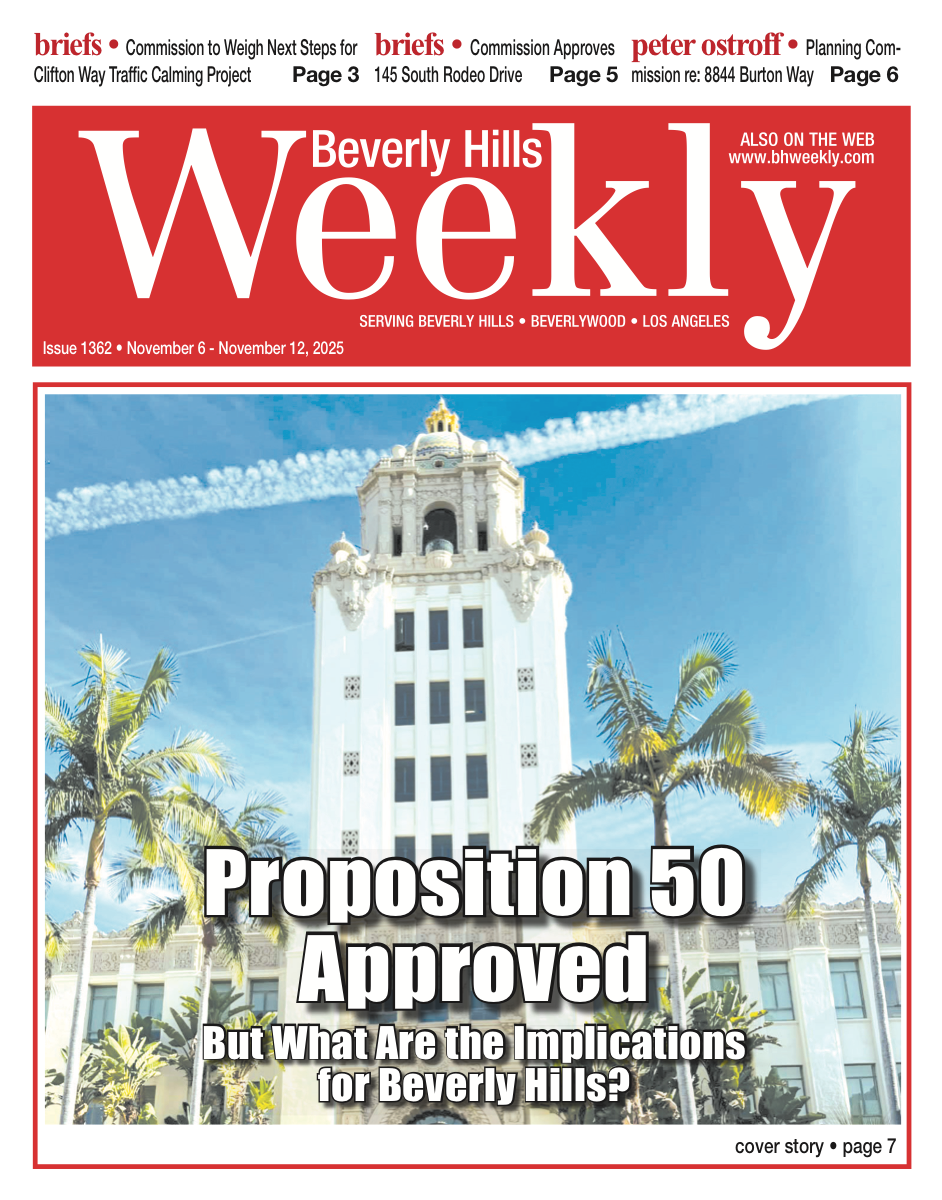
Planning Commission re: 8844 Burton Way
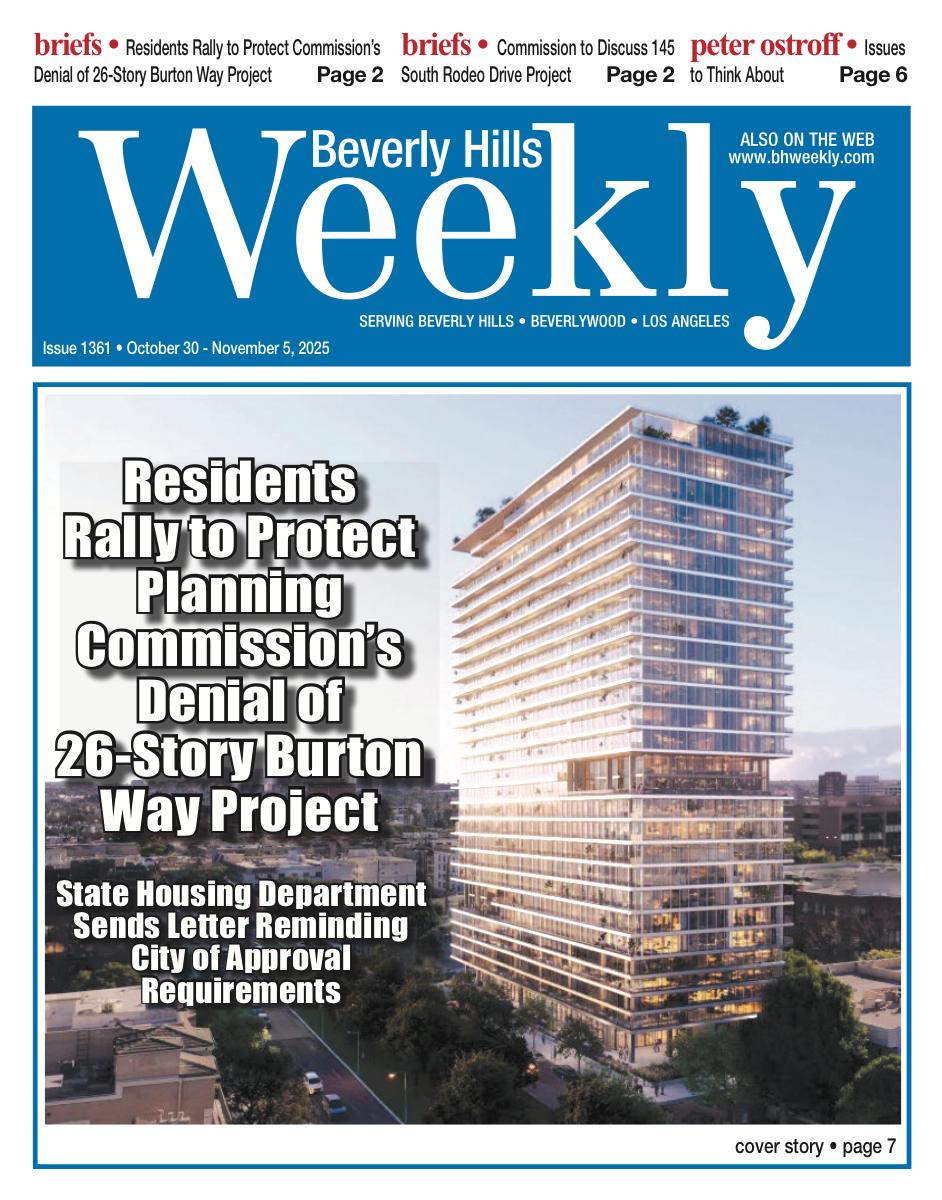
In an open letter to the Beverly Hills Planning Commission, Peter Ostroff expresses strong opposition to the proposed 26-story residential project at 8844 Burton Way, arguing that it offers significantly fewer affordable units than previously proposed and poses serious health and safety risks to the community. He urges the Commission to deny the application, emphasizing that the project is unnecessary and out of scale for the neighborhood, driven by greed rather than genuine affordable housing needs.
Use to Think About
The article discusses the challenges and changes facing Beverly Hills, particularly regarding new development projects and housing legislation that have sparked resident concerns about neighborhood transformations. It emphasizes the need for informed and accountable candidates in the upcoming City Council and Board of Education elections to navigate these issues effectively and engage the community in meaningful discussions.