Peter Ostroff
A Voice for Beverly Hills — Past, Present, and Future
Unique Favoritism/Board Under Fire
The article discusses the controversy surrounding a proposed exception to a new ordinance in Beverly Hills that would allow landmarked properties to be rented out for shorter terms, raising concerns of favoritism toward a specific property owner. Additionally, it critiques the Board of Education's handling of a recent decision regarding the display of Israeli flags in schools, highlighting community outrage and the need for open, accountable discourse on leadership issues within the district.
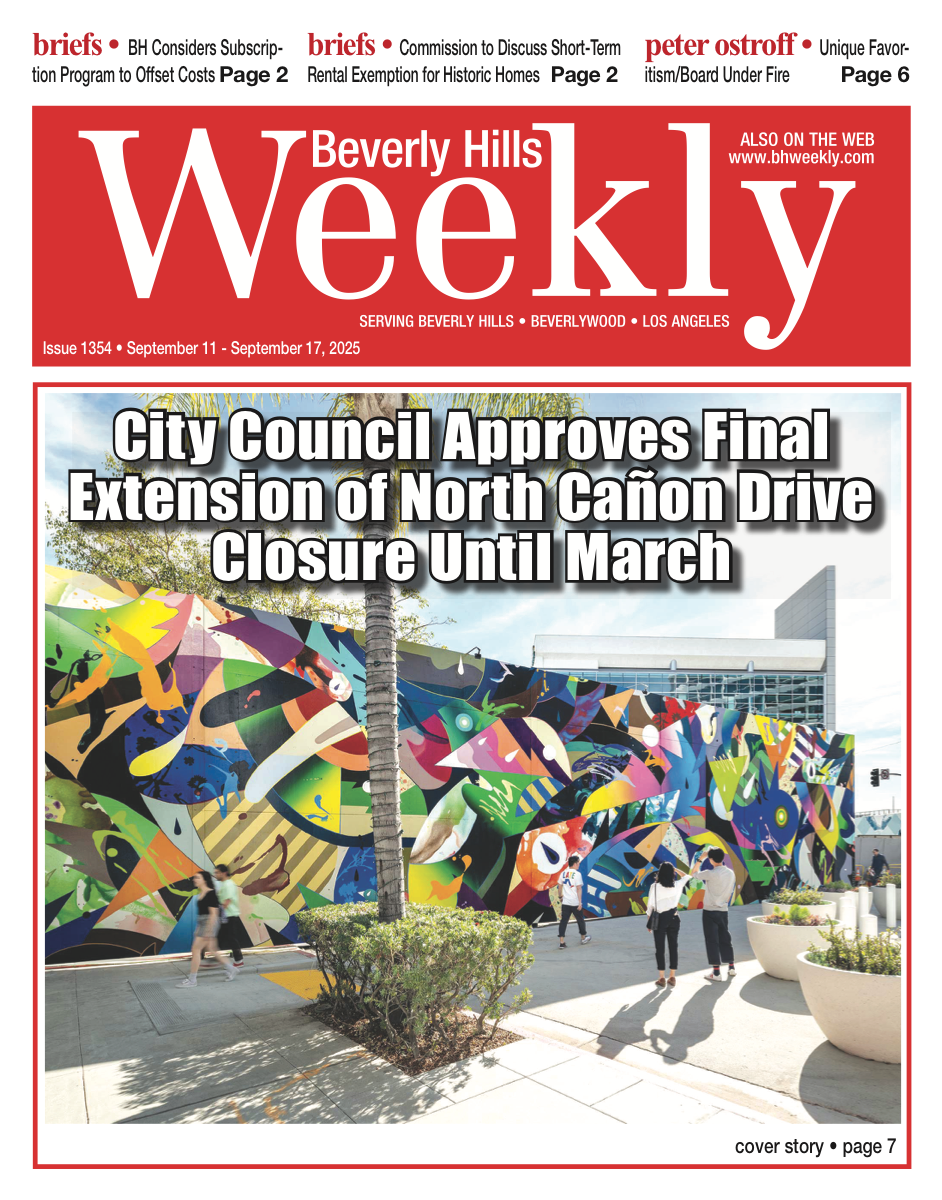
Unique Favoritism/Board Under Fire
On Wednesday September 2, I made a rare (for me) speaking appearance at a Commission meeting. It was a meeting of the Cultural Heritage Commission and the subject was a discussion of the proposed exception from the newly enacted requirement that leases of single and multi-family residences in the City be for a minimum of 12 months. The occasion was to obtain the CHC recommendation on whether to allow landmarked residences to lease for much shorter periods based on a contention that landmarked residents needed the revenue from short term rentals to offset expenses for maintenance of the properties. This issue will be presented to the Planning Commission for its recommendation at its meeting on September 11 and then go to the City Council for action.
Planning staff had prepared a draft ordinance that would carve out this exception by allowing rentals of ADUs for periods of not less than two days and requiring that the owners of the property be present during the rentals. It is not at all clear than the Council had directed the preparation of a draft ordinance but there it is.
For me, there are several issues. First, short term rentals are inherently subject to abuse by short term tenants who have little understanding of or interest in the customs and norms of the City or interest in becoming part of the City. Now that the Council has resolved that issue by enacting an ordinance which precludes any rentals of less than 12 months, a major issue for me is one of fairness. Why should owners of landmarked properties have the ability to enter into leases with shorter terms when other property owners cannot? The proposed rationale is that landmarked properties are expensive to maintain. This is undoubtedly true but it is also true of all properties. Most importantly, no facts or evidence or even arguments have been offered to suggest that landmarked properties are more expensive to maintain than non-landmarked properties. Two of the four participating members of the Cultural Heritage Commission were persuaded by the fact that it is simply unfair to allow a landmarked property owner to indulge in rentals for less than one year while their neighbors cannot do so.
Two of the Commissioners felt that giving this special benefit to the owners of landmarked properties was simply unfair. Two of the Commissioners felt that this exception would be a good thing because it might incentivize owners of properties eligible for landmarked status to seek that status. The notion that this is a sensible way to incentivize owners of worthy residences to agree to “landmark” their homes is, in my view, baseless. There is absolutely no evidence to support this notion. Rather, for those who will agree to landmark their homes, that agreement arises solely out of a sense that such preservation is good for our City. An interest in indulging in short term rentals of an ADU or otherwise is actually contrary to the higher purpose as it will subject the property to extra wear and tear that will diminish its attractiveness.
Setting aside whether future incentives have anything to do with currently existing landmarked residences, there are two problems with that. First, of the 18 landmarked residences, only one has sought this exception. Further, do we really want others to seek landmarked status because they want to engage in short term rentals. Of course, the argument is offered that this really doesn’t make much difference because there is only one property that might be used as a short term rental property. But this overlooks the fact that as ownerships change, interest in short term rentals could also change.
It is impossible to ignore the fact that, as Cultural Heritage Commission Chair Lori Gordon pointed out, this exception is really for only one person. This is unadorned and undue favoritism extended for one person. It is not inappropriate to note that, at least in this instance, it is nice to have friends in high places. But we should stop it. There are those who point out that the person is under financial stress at present and needs income from short term rentals to “stay in” their house. That may be true but it is not the City’s problem and it is inappropriate, to say the least, for Councilmembers to use their power to direct City resources and rules to solve that problem. If they want to solve this person’s problem, they should feel free to do so but using their own resources, not the City’s.
If the Council is inclined to create some exception for landmarked properties: It should be limited to ADUs or guest houses while the owner is present; The rental periods should be for no less than 30 days; and All revenues from rentals shorter than 12 months should be used solely for maintenance of the exterior of the landmarked residence and its landscaping.
***
Our Board of Education is increasingly under fire, mostly deservedly due to self-inflicted wounds. In the wake of the debacle centered around the flag of the State of Israel, community outrage is directed that certain members of the Board of Education. A new anonymous website/publication, called Beverly Hills Watch, has been launched.
I should say at the outset that there is no place in principled public discourse for anonymous criticism or name-calling. I am bringing this Beverly Hills Watch to your attention in the hope that its authors will emerge from the shadows and participate in a discussion that is, in my view, unquestionably important particularly if it leads to constructive improvement in the leadership of BHUSD.
In its introduction, it states: “On August 29, 2025, a “special” (read: crisis) meeting of the Beverly Hills United School District’s five-member Governing Board (the “Board”) was called to address a single burning issue: how to undo the damage caused by the Board’s three-member conservative majority, which had just voted to require that every school in the district display Israeli flags for the entire month of May in the name of “combating antisemitism.” That vote, taken at a regularly-scheduled Board meeting three days earlier, triggered an outpouring of criticism and threats against BHUSD on a scale so frightening that the District Superintendent, Dr. Alex Cherniss, was forced to quickly overrule the Board in the name of student and staff safety.
“While the vitriol aimed at the Board’s decision was unprecedented in both severity and scope, it was eminently foreseeable. From its very inception, the Board’s resolution dangerously conflated semitism with Zionism and created the appearance that BHUSD was mandating unwavering support for the state of Israel. While the Board members who passed the measure (Judith Manouchehri, Sigalie Sabag, and Russell Stuart) claimed that was not their intent, they were expressly warned ahead of time by the objecting Board members (Rachelle Marcus and Dr. Amanda Stern), as well as numerous community members, that their flag mandate was all but guaranteed to be received with hostility.
“Having paid these warnings no apparent mind, the Board majority was ill-prepared for what came next.
“Plunging Beverly Hills into controversy is unfortunately nothing new for these three Board members, none of whom have any background in education,,,Still, for their bungling to tarnish Beverly Hills’ reputation on a national scale, as has occurred in this case, is an extraordinary and almost impressive feat of self-harm.”
The posting goes on to take direct aim at the three Board members who have attracted its ire: “Judith Manouchehri, Sigalie Sabag, and Russell Stuart simply do not know how and cannot be trusted to responsibly govern BHUSD . The enormity of their unforced errors, the frivolity with which they were undertaken, and the disregard they have shown for those who question their orthodoxies are categorically disqualifying. Never before has the Beverly Hills community been so grievously harmed by misplaced faith in those who swore to lead the district with sober, rational minds. No change can restore confidence in leadership that displays such flawed judgment and unwillingness to learn.
“Our district deserves better.”
Whether you agree or disagree with these sentiments, it seems self-evident to me that these issues be discussed broadly and openly. And that means that there is no place for anonymity. The website is well-written and offers some persuasive arguments, bearing in mind that there are two sides to every story. Whoever is responsible should identify themselves and their objectives. It may be that there is fear of retaliation but hopefully those fears can be overcome
Beyond that, there should be a statement of purpose. Is the objective to counsel the Board members or remove them? Simply criticizing will accomplish nothing beyond further divisive entrenchment.

Peter Ostroff is a long-time Beverly Hills resident of over 50 years who retired in 2017 after a 50-year career as a trial lawyer. He was born in Washington, D.C. in 1942. He graduated from Washington University (St. Louis, Mo) in 1964 with a B.A. degree in political science and economics. He graduated from the University of Chicago Law School in 1967 with a J.D. degree. He taught law at Monash University Law School in Melbourne, Australia in 1968. He became a member of the Illinois Bar in 1967 and the California Bar in 1969, He clerked for Hon. Shirley M. Hufstedler of the United States Court of Appeal 1969-70, practiced law with Nossaman, Waters, Scott, Krueger & Riordan and successor firms from 1970 to 1980 and with Sidley Austin from 1980 until 2017. During his full time law practice years he was a Committee Chair and Member of the Council of the American Bar Association, Litigation Section and was President of the Association of Business Trial Lawyers. Since 2018, he has served on the Beverly Hills Planning Commission. In addition to his work on the Commission, Peter has chaired the BHUSD 7-11 Surplus Property Committee and contributed to planning efforts for the District Offices site on S. Lasky Drive and future uses of the Hawthorne School property. He also served as Co-Chair of the Citizens Advisory Committee for the City's Climate Adaptation and Action Plan. He has been married to Anne Y. Ostroff since 2002, has two children, Nick Ostroff and Natalie Anne Cookson and has two grandchildren, Elliott Cookson and Emma Anne Cookson. Some family information is collected under Family Tree in this website. Since April 2024, he has written a weekly column for the Beverly Hills Weekly The columns are collected in this website.
petero@ostroff.laMore from the Archive

BHUSD Initiative/Hoops/Builder's Remedy Docket
The Beverly Hills Unified School District is restructuring its College and Career Counseling Department to enhance academic support and college readiness for students, with dedicated counselors for different grade levels and a focus on wellness resources. Additionally, several new housing projects under California's Builder's Remedy are set to be reviewed by the Planning Commission, though concerns about inadequate parking and the potential impact on established neighborhoods persist.
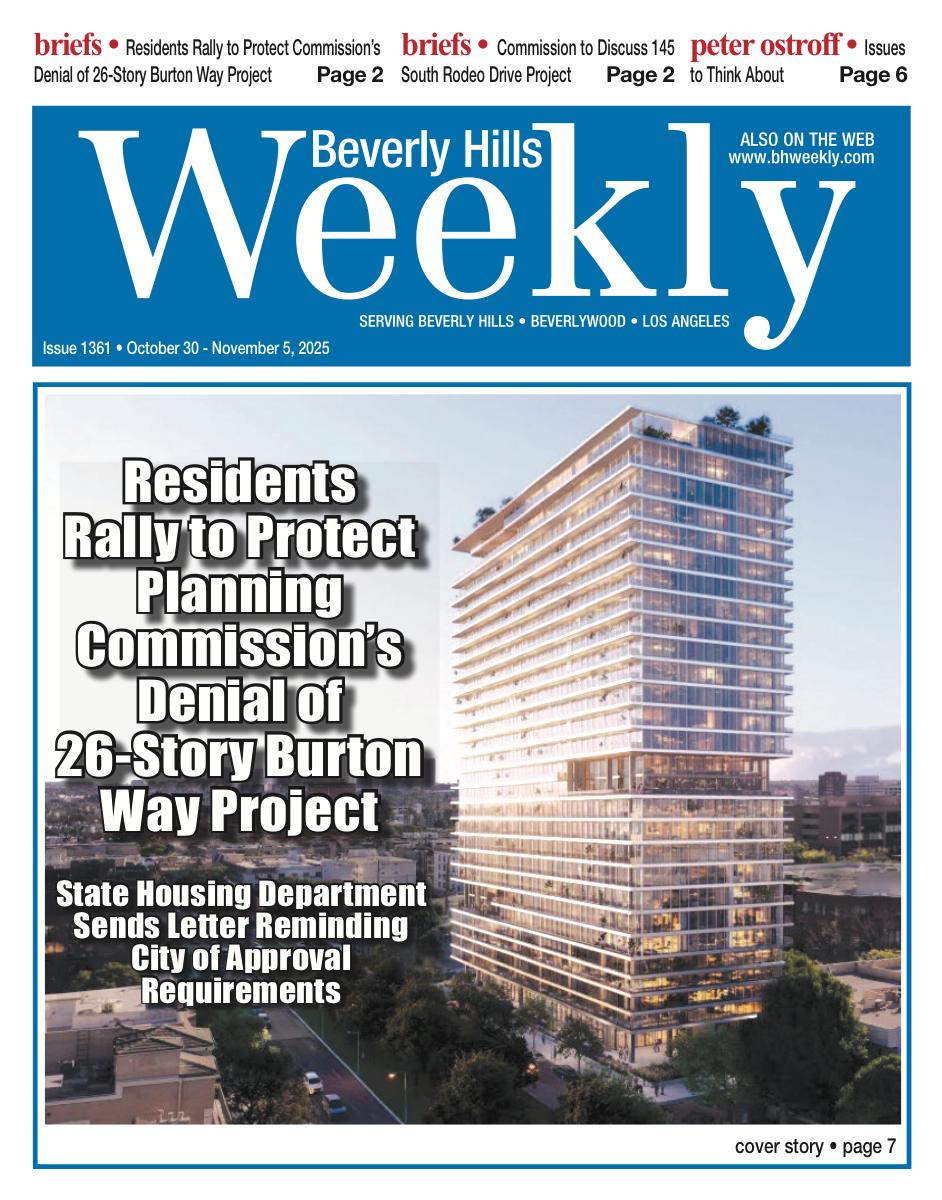
Use to Think About
The article discusses the challenges and changes facing Beverly Hills, particularly regarding new development projects and housing legislation that have sparked resident concerns about neighborhood transformations. It emphasizes the need for informed and accountable candidates in the upcoming City Council and Board of Education elections to navigate these issues effectively and engage the community in meaningful discussions.

Builder's Remedy/New Housing Law/Political Violence
The article discusses Leo Pustilnikov's aggressive pursuit of five "builder's remedy" housing projects in Beverly Hills, emphasizing his strategy to increase project size in response to city opposition. It also highlights the recent California legislation (SB 79) that further diminishes local control over land use, allowing for increased height and density of housing near transit stations, and reflects on the troubling rise of political violence in the U.S., advocating for civil discourse and human connection.