Peter Ostroff
A Voice for Beverly Hills — Past, Present, and Future
The Sky is Not Falling
Residents of Beverly Hills are expressing concern over state laws that diminish local control over land use and facilitate housing development, leading to potential changes in their community's character. However, despite the aggressive push for housing, current economic conditions and high construction costs may hinder developers' ability to follow through on proposed projects, suggesting that immediate fears may be overstated.
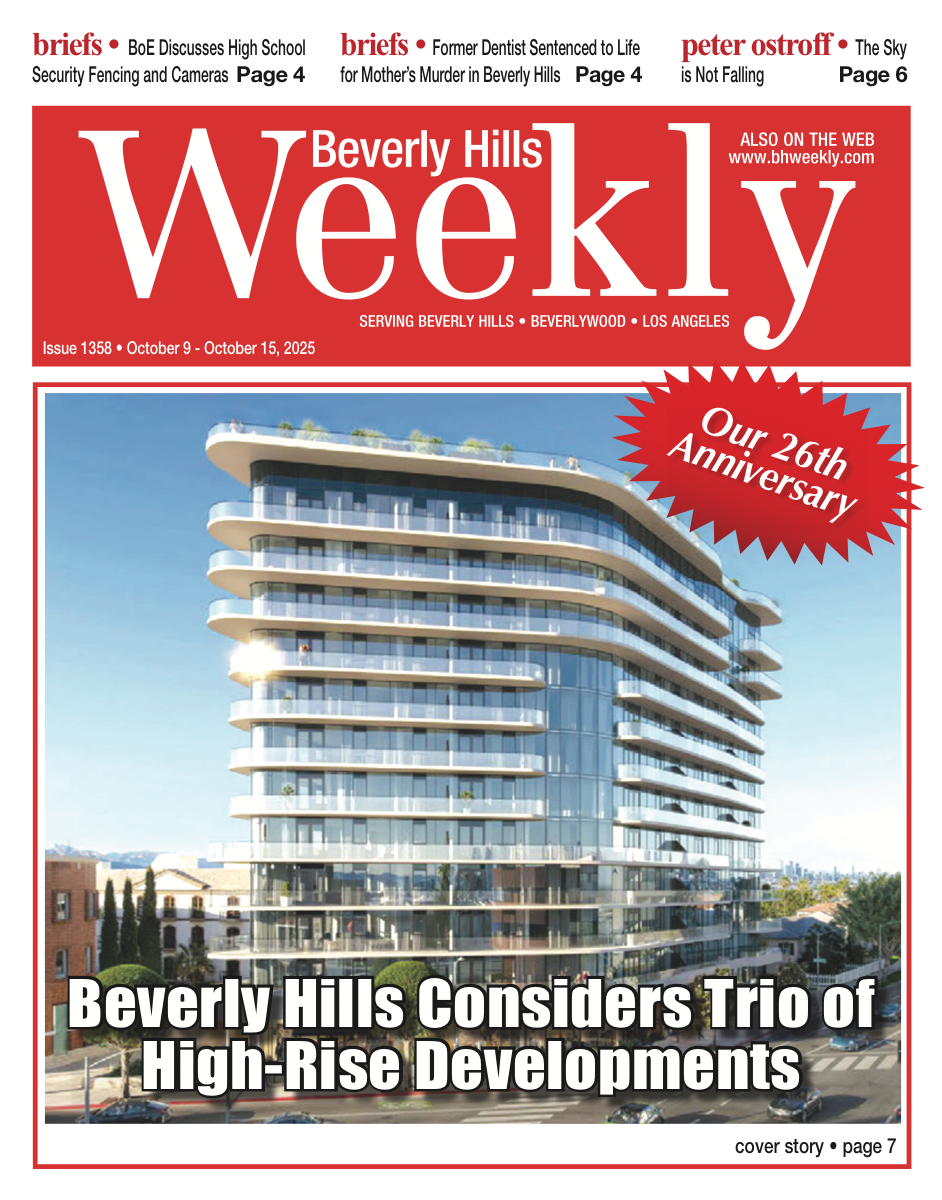
Many City residents have lamented in recent years the increasingly aggressive measures that the State has taken to eliminate local control over land use and incentivize housing construction including, but by no means limited to, “affordable” housing.
The shortage of housing at all price points was caused by many decades in which population growth and job growth in certain parts of the state have far outpaced construction of housing units.
For Beverly Hills, the numerous state laws to incentivize housing construction, have among other things, eliminated the local development standards that have preserved our “village” low rise environment. We can no longer enforce rules limiting heights of multi-family developments to 35’ or 45’ or that have precluded construction of multi-family or high rise development in or adjacent to areas zoned for single family residences.
Consequently, we have observed numerous “big” buildings proposed and approved for areas that had been previously protected by our now superseded zoning rules. Frustratingly, we watch while gnashing our teeth as City Commissions and the City Council tell us that even though an application seeks to construct something forbidden by our local rules, they are constrained by state law to give their approval.
We have watched with great anxiety while it appears that our neighborhoods will be transformed beyond recognition by the State Density Bonus laws or by Builder’s Remedy which grant lots of rights and free stuff to developers.
All of this is true.
But my purpose today is to tell you that the sky is not falling.
It is not time to fret – at least not yet.
When the mixed use ordinance passed allowing residential development in areas previously reserved for low rise commercial development, no growth residents predicted that developers were ready to pounce on these areas with outsized projects. In fact, for several years, there were zero applications for residential entitlements in the mixed use overlay zone. As of today, virtually no construction has been commenced.
With the exception of the massive One Beverly Hills project, no multi-family residential projects are under construction in the City. One very experienced developer characterized that project as a “high wire act undertaken by a company with all the money in the world.”
So, what about all of those Builder’s Remedy projects and state density bonus projects that we have heard about? Isn’t it true that state laws have virtually ended local control over land use?
Yes it is true that the City has far less control over property development than it did a few years ago. State laws have successfully focused on eliminating barriers to development created by local governments. And that is why, numerous projects glide almost unobstructed through the entitlement process despite strong resident opposition.
But there is more to development than entitlements.
Specifically, developers must perceive to make a return on their investment that will justify deploying resources into property development rather than other opportunities from simply acquiring existing properties or other types of investment or putting their money on black in Las Vegas.
And under current conditions with interest rates being substantially higher than in recent years and, I am told, construction costs 15 to 20% higher than two or three years ago, projects simply don’t pencil out. Tariff uncertainties don’t help. These are formidable barriers to development not created by local governments.
Further and ironically, the ostensible objective of creating “affordable” housing is another barrier in the City and other communities with higher land costs that demand development of luxury residential projects. Both Builder’s Remedy and state density bonus rules require that the prescribed number of affordable units be on-site. Most developers are concerned that the inclusion of low income residents will deter buyers who can afford the increasingly high prices or rents that recovery of development costs require.
This is exemplified by a recent enactment by the City of Santa Monica of a program that allows developers to build affordable units off-site or pay fees to buy their way out of inclusion requirements. This is intended to “unlock” entitled developments that have been stalled by current market conditions. Maybe it will facilitate some of construction of housing but it does little to alter the challenging conditions that are far beyond the capability of most cities to affect.
We should also bear in mind that most, if not all, of the proposed builder’s remedy projects are not what the applying developers want or intend to build but, rather, appear to be stalking horses intended to create leverage when they bargain with the City for approvals of something that they want to build.
And bargain, they will. Some of these developers are well-represented by very competent counsel and some of them relish litigation. Me too. As you may know, I believe that litigation is what made this country great. Seriously, lawyers matter and we should employ the best and fight fire with fire. Of course, we should scrupulously adhere to compliance with the state laws that are intended to preclude local obstacles to development. But in most cases, the builder’s remedy applicants are using the projects presented to create leverage to obtain entitlements that they are not entitled to. Ergo, just call their bluffs and just say “no” backed up by aggressive, knowledgeable trial lawyers.
My message to my fellow residents who watch in dismay as projects that are inconsistent with our zoning rules are expeditiously entitled is that there are many practical obstacles not created by our zoning rules between entitlement and construction and few developers, if any, will overcome those obstacles.
***
Last Saturday, October 4 was a fabulous day for baseball junkies like me. It was the opening day of the MLB League Division Series with four games, staggered through the day for 12 hours starting at 10a. These involved the very best eight teams pitted against each other in the beginning of four fraught best of five series. The four winners would advance to the best of seven MLB League Championship series and the two winners would advance to the World Series.
The first two games were blow outs with the Milwaukee Brewers pounding the Chicago Cubs and the Toronto Blue Jays trashing the New York Yankees.
To digress for a moment, I grew up a fan of the hapless Washington Senators (Washington was first in war, first in peace and last in the American League) of “Damn Yankees” fame. I have never forgotten the inspirational lyrics from a song from that great 1950’s era musical: “When your luck is batting zero, get your chin up off the floor. Mister you can be a hero, there’s nothing to it but to do it Ya Gotta Have Heart.”
So there is almost nothing better than seeing the Yankees lose.
But there is one thing better: A Dodgers come from behind win. And that’s what we got against the powerful Philadelphia Phillies probably the most talented team in baseball on their home field. But it wasn’t easy The best player in baseball history, Shohei Ohtani, the Dodgers’ starting pitcher and designated hitter, had a rocky six innings as the starting pitcher and left with the Dodgers trailing and, even worse, struck out four times. But wait, the Dodgers magic from two guys named “Hernandez” with key hits and a lights out relief pitching performance from Roki Sasaki gave the Dodgers a win.
And for those of you who question calling the championship of a quintessential American game a “World Series” I wish to remind you that Kike Hernandez is from Puerto Rico, Teoscar Hernandez is from the Dominican Republic and, of course, Ohtani and Sasaki are from Japan as is Yoshinobu Yamamoto who will pitch for the Dodgers in this playoff series.
By the time that you read this, the Dodgers and Phillies will have played two more games. My crystal ball is broken and, while I have not entirely gone out of the prediction business, I do not know how this series will turn out.
But I do know that last Saturday was a special day and that the Dodgers and their fans have got plenty of heart.

Peter Ostroff is a long-time Beverly Hills resident of over 50 years who retired in 2017 after a 50-year career as a trial lawyer. He was born in Washington, D.C. in 1942. He graduated from Washington University (St. Louis, Mo) in 1964 with a B.A. degree in political science and economics. He graduated from the University of Chicago Law School in 1967 with a J.D. degree. He taught law at Monash University Law School in Melbourne, Australia in 1968. He became a member of the Illinois Bar in 1967 and the California Bar in 1969, He clerked for Hon. Shirley M. Hufstedler of the United States Court of Appeal 1969-70, practiced law with Nossaman, Waters, Scott, Krueger & Riordan and successor firms from 1970 to 1980 and with Sidley Austin from 1980 until 2017. During his full time law practice years he was a Committee Chair and Member of the Council of the American Bar Association, Litigation Section and was President of the Association of Business Trial Lawyers. Since 2018, he has served on the Beverly Hills Planning Commission. In addition to his work on the Commission, Peter has chaired the BHUSD 7-11 Surplus Property Committee and contributed to planning efforts for the District Offices site on S. Lasky Drive and future uses of the Hawthorne School property. He also served as Co-Chair of the Citizens Advisory Committee for the City's Climate Adaptation and Action Plan. He has been married to Anne Y. Ostroff since 2002, has two children, Nick Ostroff and Natalie Anne Cookson and has two grandchildren, Elliott Cookson and Emma Anne Cookson. Some family information is collected under Family Tree in this website. Since April 2024, he has written a weekly column for the Beverly Hills Weekly The columns are collected in this website.
petero@ostroff.laMore from the Archive
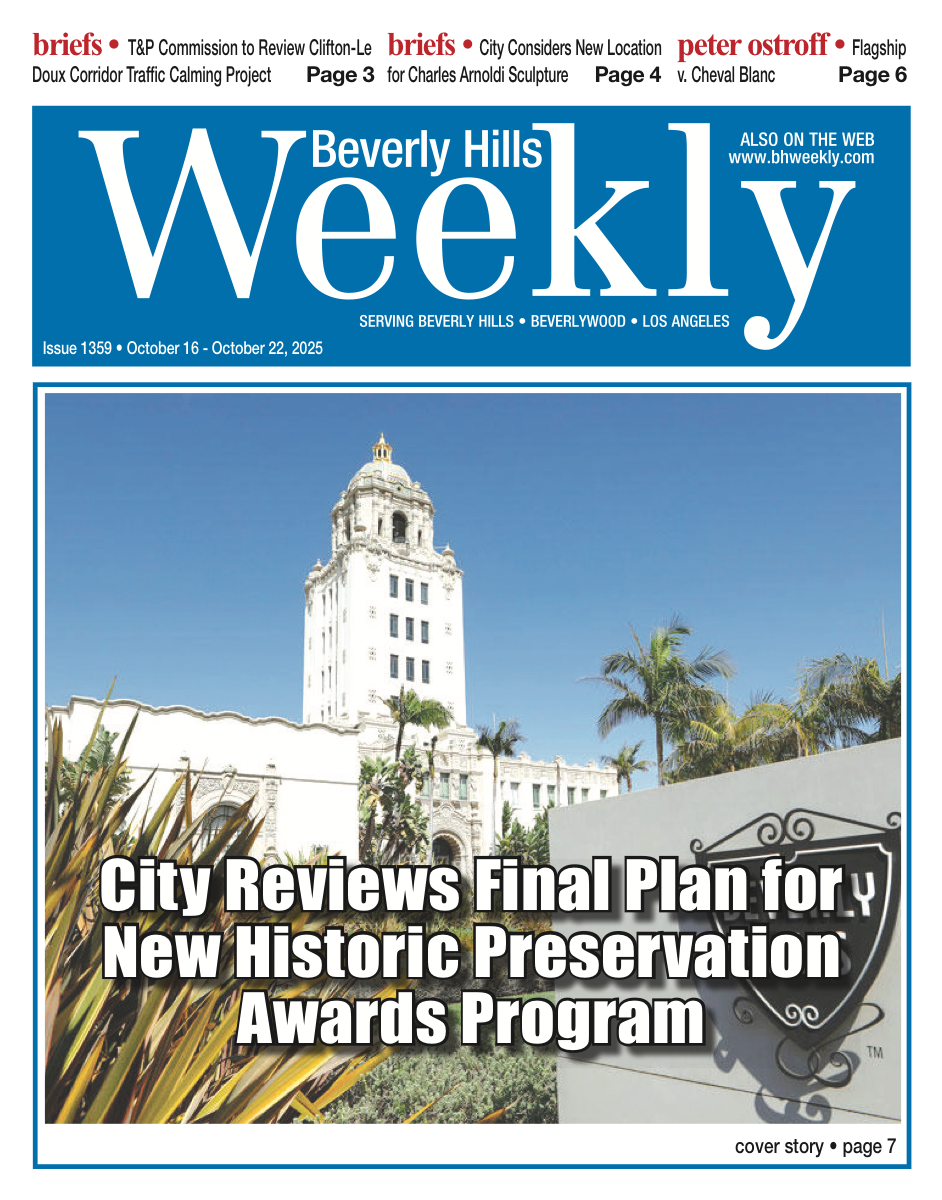
Flagship v. Cheval Blanc
The article compares the recently approved LVMH Louis Vuitton flagship project, designed by Frank Gehry, with the rejected Cheval Blanc luxury hotel project, highlighting that while the flagship will be architecturally impressive and less controversial, it will generate significantly lower economic benefits for Beverly Hills compared to the high-end hotel. The author expresses a preference for the Cheval Blanc, noting that many objections to it have since been addressed.
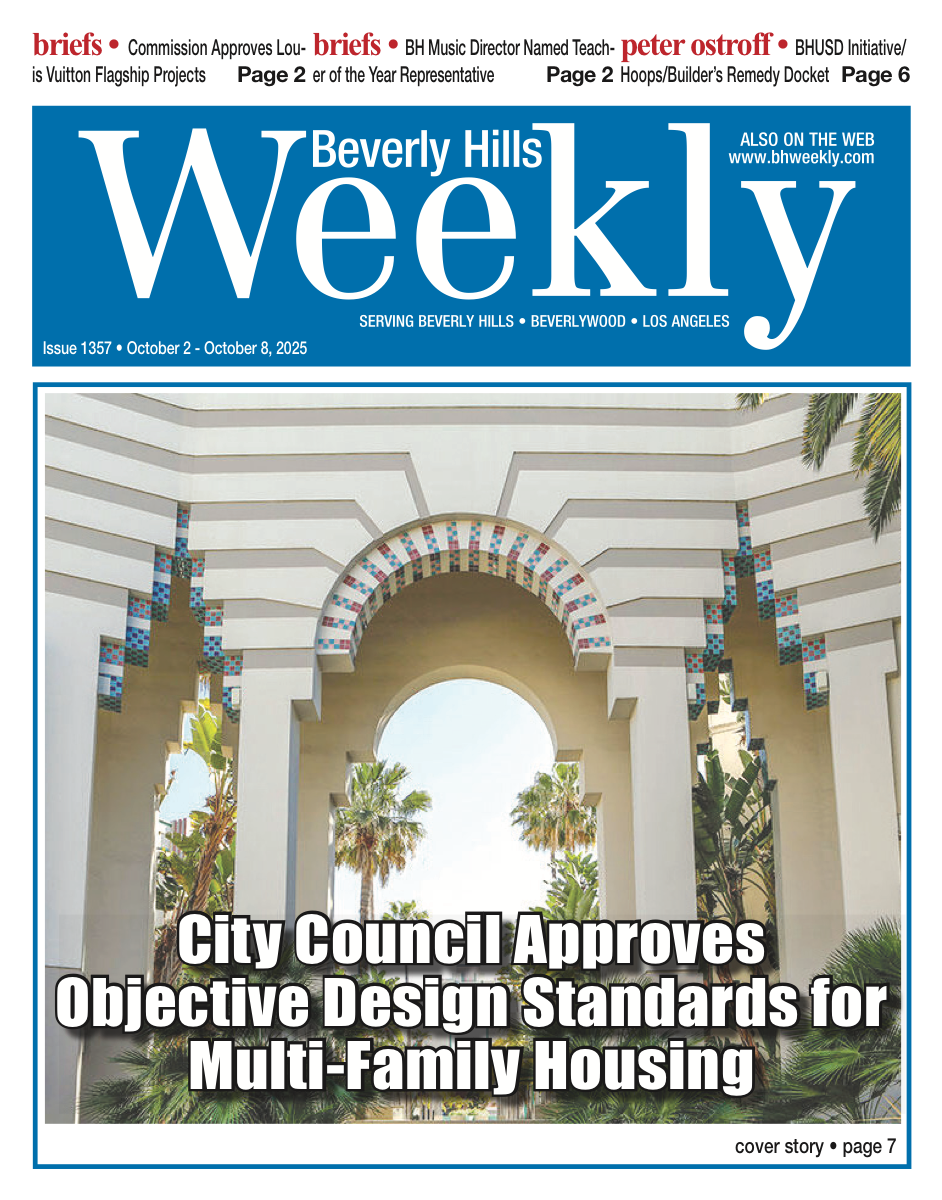
BHUSD Initiative/Hoops/Builder's Remedy Docket
The Beverly Hills Unified School District is restructuring its College and Career Counseling Department to enhance academic support and college readiness for students, with dedicated counselors for different grade levels and a focus on wellness resources. Additionally, several new housing projects under California's Builder's Remedy are set to be reviewed by the Planning Commission, though concerns about inadequate parking and the potential impact on established neighborhoods persist.
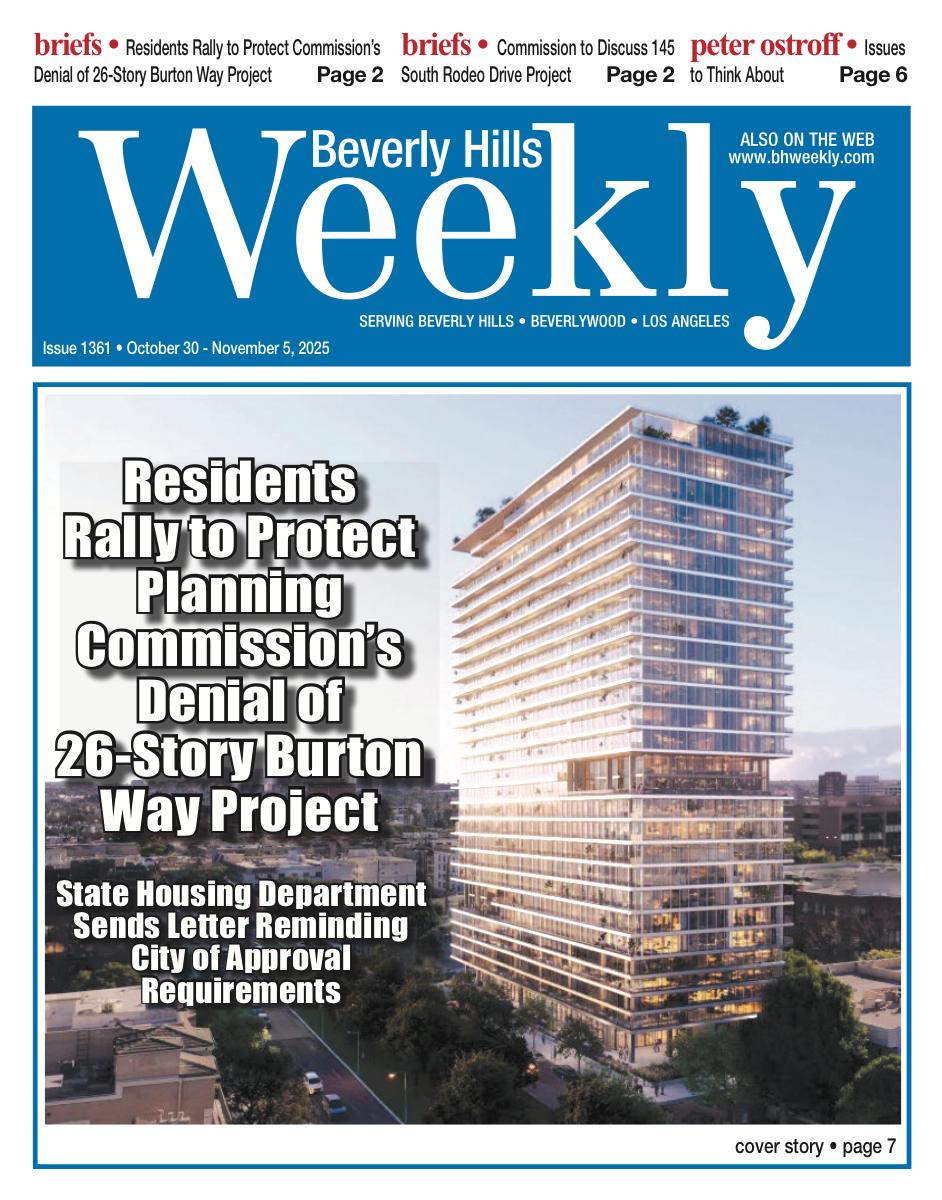
Use to Think About
The article discusses the challenges and changes facing Beverly Hills, particularly regarding new development projects and housing legislation that have sparked resident concerns about neighborhood transformations. It emphasizes the need for informed and accountable candidates in the upcoming City Council and Board of Education elections to navigate these issues effectively and engage the community in meaningful discussions.