Peter Ostroff
A Voice for Beverly Hills — Past, Present, and Future
Projects without Management
The article critiques the management practices of the City government, highlighting the lack of accountability and transparency that leads to stalled projects and unmet expectations, such as the fiber to the premises initiative and water independence efforts. The author emphasizes the need for individual responsibility and regular reporting to improve outcomes, using current issues like public transit access and pedestrian safety as examples of ongoing challenges that require better oversight.
Listen to this article
ElevenLabs · Burt Reynolds™
While for the most part our City government operates well, I have observed that there are instances where better management, follow-up and accountability are needed.
My premise is better management leads to better results. In our public sector better management requires individual responsibility/accountability, transparency and regular reporting and monitoring.
A fundamental characteristic of government by a city council, which is essentially a five person committee, is that no one is really in charge or accountable to ensure that policies are implemented or things happen as planned. Once decisions are made, no one person is identified to implement the decision and no one person has the responsibility to manage it through to completion or make progress reports to ensure that the project is on track. As a result, projects can take on a life of their own and proceed even though changing conditions should have required a halt or slip through the cracks or be quietly dropped.
All without public knowledge.
I emphasize that the glass is far more than half full but that doesn’t mean that I must ignore the important instances in which the high expectations of our residents are not met. This is to discuss some of those instances as examples that we may learn from and even offer a suggestion or two.
Examples in the recent past are the fiber to the premises project which was very costly to the City and the efforts to obtain certification of the Revised Housing Element. No one person was in charge, no one person was accountable and active management did not occur. Relatedly, decisions are made by the city manager’s office or at a department head level under cover of darkness and not publicly monitored or reported.
The fiber to the premises debacle and revised housing element difficulties are in the past and there is no market for spilled milk but we can learn from them as we address important projects/issues that currently exist but are floundering.
Some currently existing issues are: 1) efforts to reduce our reliance on the
Metropolitan Water District (MWD) for our water; 2) access of residents to and from the new Metro subway stations; and 3) efforts to calm traffic and increase pedestrian safety on Coldwater Canyon Drive.
Water Independence
Around fifty years ago, the City ceased using local well water and since then has relied entirely on water from the MWD and that has served us well. In recent years, MWD has faced increasing challenges regarding its sources of water. Accordingly, we have recognized the importance of developing independent water sources of our own, principally underground well water.
In 2020, the City commissioned a study from consulting firm Hazen and Sawyer and they in conjunction with representatives from the Department of Public Works and the Public Works Commission. I am informed by former Public Works Commission Chair Chuck Alpert that the City paid Hazen and Sawyer $1.8M for its services not counting the efforts of city staff.
This resulted in an Integrated Water Resources Master Plan (IWRMP) that committed to reduce the City’s reliance on imported water from MWD from 80% in 2020 to 57% by the end of 2025. The City Council adopted that commitment.
I am informed that, in fact, in 2025, the City relied on imported water for between 80% and 90% of our water needs. I am certain that there are reasons that the planned new sources have not been achieved, even though substantial efforts may have been made. But we do not know because, no one is in charge of implementing the
IWRMP and, more importantly, in five years there has been no report to the City Council regarding the progress to 57% reliance on imported water.
This is a BH Public Works Department issue. No one person is in charge to make this happen and there have been zero progress reports to the City Council.
Micro Transit
For more than a decade, we have known that we would have two subway stations in the City. We have also known that Metro does not provide parking at its stations and that there was little if any parking adjacent to the stations. While there was lots of chatter about providing so-called first and last mile transportation to and from residents’ homes and the stations, no progress has been made. This is also a BH Public Works Department issue.
Here are some of the details.
The possibility of implementing a system for enhancing transit within the City was addressed by the Climate Adaptation and Action Plan Committee (CAAP) of which I was co-chair because a substantial amount of greenhouse gas emissions came from car trips within the City. It was also recognized that we needed to provide a way for residents to travel to and from the subway stations.
Over my objection, study and potential implementation was delegated to the Public Works Department and the Traffic and Parking Commission. I was concerned that nothing good could come of that. Money was spent on consultants and a fixed route system that covered nothing more than a small part of the southeast part of the City and cost $3.5M/year was proposed. The City Council killed this promptly approximately three years ago.
Nothing happened for more than a year until November 2024 when an RFP was issued for an on demand system. Responses were received in January 2025.
Again, nothing was done for another year until January 2026 when a proposal was presented to a Council Traffic and Parking Commission Liaison for an on demand system without any clearly defined purpose. The cost was $3.1M for a two year pilot project. The Liaison properly rejected this proposal with a direction to put it on a City Council agenda for a burial in March.
In my view, this proposal was not well received because it was not well defined.
But the issue of how to get Beverly Hills residents to and from their homes to the subway station has not gone away. And there is still time.
The opening of the D line extension to the La Cienega station has been delayed many times. It is unlikely that service will commence before May, 2026 or later. A focused flexible subsidized on demand service that is limited to taking residents and people who work in the City to and from the station is needed. There is no parking available at the station and without an on demand service to and from, it will be very difficult for most of our residents even to try the new subway.
Coldwater Canyon Crosswalk For more than five years, residents of the Hillside neighborhood on or in the vicinity of Coldwater Canyon have been trying to work with the Department of Public Works and City Engineer to find a way to improve traffic and pedestrian safety. From the City’s northern border at Monte Cielo Drive to the fire station nearly one mile to the south, there is no place even for pedestrians to safely cross Coldwater Canyon Drive.
The residents suggested traffic signals, stop signs and speed bumps to slow traffic and curb high speed passing. These were all rejected by the City representatives.
Finally, City Engineer Daren Grilley presented a proposal for a crosswalk to a Council Study Session on November 19,
2024. There was a lengthy discussion of potential locations. Most residents favored cross-walks but not in front of their own homes. At the conclusion of the Council discussion, City Manager Nancy Hunt Coffey in summarizing,directed Mr. Grilley to find the “least impactful” location and report back your conclusion to the Council.
In August, 2025, as I had heard nothing, I contacted Mr. Grilley. He told me then that as a location that no one objected to could not be found, the idea was dropped.
In other words, the Council directed Public Works to do two things: 1) Find the “least impactful” location; and 2) Report back.
Neither was done.
Who made the decision to drop it? I can’t get a straight answer to that one.
Who decided that it was not necessary to make a public report to the Council? Ditto.
Incoming City Manager Ryan Gohlich told me a few days ago that he would bring the issue back to the Council.
I discuss these examples to illustrate what happens when no individual is accountable, there is no oversight and there is no public monitoring and no transparency.
I am hopeful that we will have better management and better results going forward.
People Mentioned
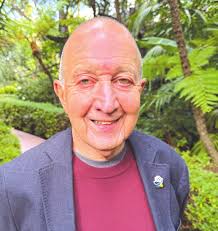
Peter Ostroff is a long-time Beverly Hills resident of over 50 years who retired in 2017 after a 50-year career as a trial lawyer. He was born in Washington, D.C. in 1942. He graduated from Washington University (St. Louis, Mo) in 1964 with a B.A. degree in political science and economics. He graduated from the University of Chicago Law School in 1967 with a J.D. degree. He taught law at Monash University Law School in Melbourne, Australia in 1968. He became a member of the Illinois Bar in 1967 and the California Bar in 1969, He clerked for Hon. Shirley M. Hufstedler of the United States Court of Appeal 1969-70, practiced law with Nossaman, Waters, Scott, Krueger & Riordan and successor firms from 1970 to 1980 and with Sidley Austin from 1980 until 2017. During his full time law practice years he was a Committee Chair and Member of the Council of the American Bar Association, Litigation Section and was President of the Association of Business Trial Lawyers. Since 2018, he has served on the Beverly Hills Planning Commission. In addition to his work on the Commission, Peter has chaired the BHUSD 7-11 Surplus Property Committee and contributed to planning efforts for the District Offices site on S. Lasky Drive and future uses of the Hawthorne School property. He also served as Co-Chair of the Citizens Advisory Committee for the City's Climate Adaptation and Action Plan. He has been married to Anne Y. Ostroff since 2002, has two children, Nick Ostroff and Natalie Anne Cookson and has two grandchildren, Elliott Cookson and Emma Anne Cookson. Some family information is collected under Family Tree in this website. Since April 2024, he has written a weekly column for the Beverly Hills Weekly The columns are collected in this website.
petero@ostroff.laMore from the Archive
The Sensational South/Metro/Mr. Kole
The article discusses a town hall meeting focused on zoning issues and proposed multifamily residential projects in Beverly Hills, highlighting community efforts to advocate for residents' interests in the "Sensational South." It also addresses the upcoming subway service and security concerns, while emphasizing the need for better transportation solutions and facilities to encourage local residents to utilize the new transit system.
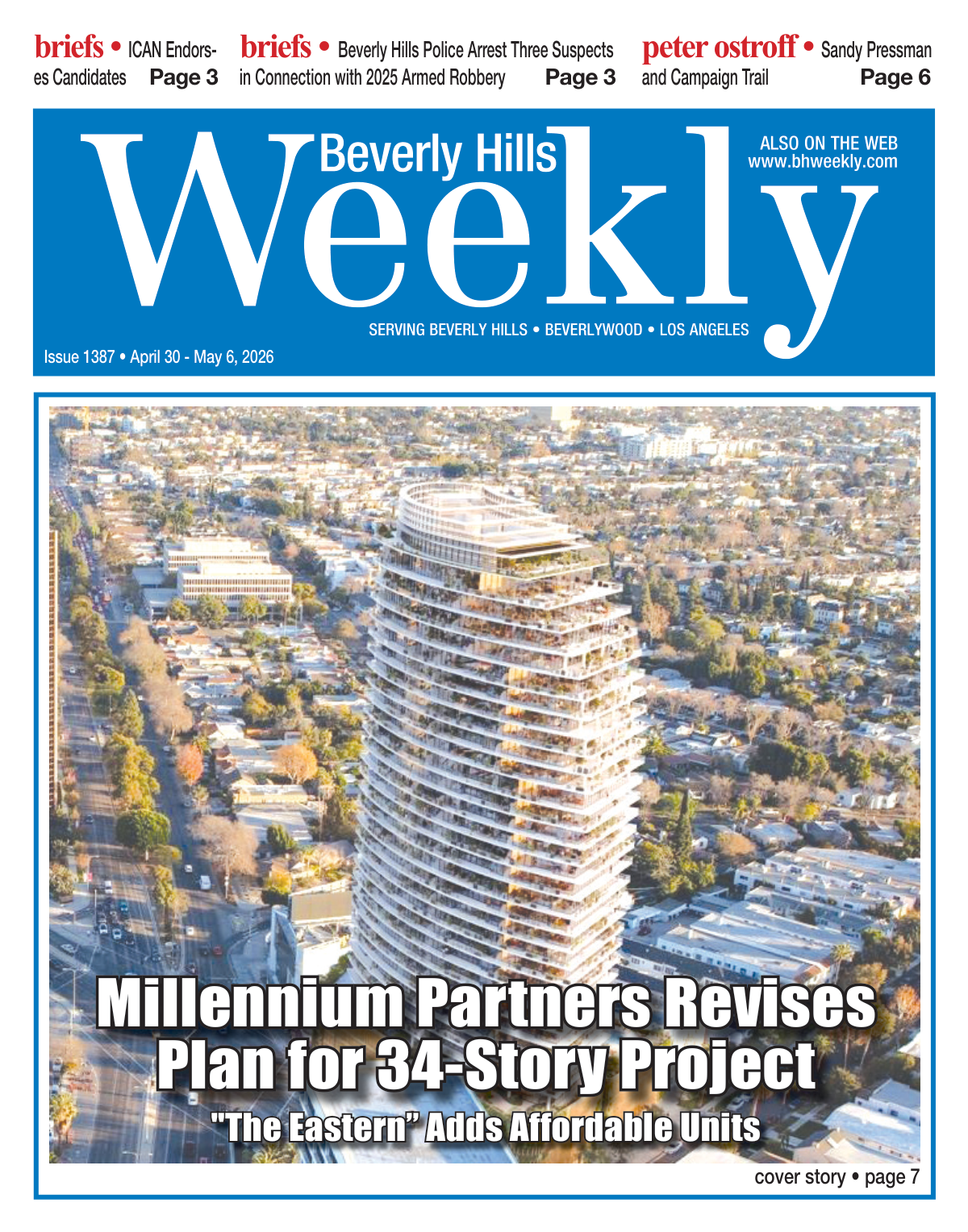
Sandy Pressman and Campaign Trail
The Rotary Club of Beverly Hills has announced Sandy Pressman as its new President, emphasizing her commitment to promoting "comfort and culture" and enhancing the guest speaker program. Meanwhile, the article discusses the local political landscape, highlighting candidates for City Council and their endorsements, as well as concerns about the disconnect between a booming stock market and a struggling economy influenced by global conflicts and trade policies.

Election Update/Metro to LACMA
The article discusses the ongoing Beverly City Council election results, where incumbents Sharona Nazarian and Lester Friedman are likely to be re-elected, while the third seat remains contested between Rebecca Pynoos and Andy Licht, with final results pending. Additionally, it highlights a positive experience using the new Metro system to visit the David Geffen Galleries at LACMA, while also addressing security concerns related to fare evasion on the subway.