Peter Ostroff
A Voice for Beverly Hills — Past, Present, and Future
Does the City Need a Bookend?
A proposed 34-story mixed-use project, "The Eastern," aims to replace a strip mall at 8300 Wilshire with 249 residential units and retail space, serving as an eastern gateway for Beverly Hills. While the project promises benefits like affordable housing and revitalization, it raises concerns about height, density, and potential traffic issues, prompting mixed reactions from city commissioners regarding its appropriateness and impact on the city's character.

Does the City Need a Bookend?
A 34-story, 400-foot-tall condominium/mixed-use project with 249 residential units has been proposed for 8300 Wilshire at the far eastern boundary of Beverly Hills, replacing a single-story strip mall now at that location.
This is a major project, characterized by the developer as one that will provide an eastern gateway “bookend” to pair with the One Beverly Hills western gateway bookend now under construction. Accordingly, it is called “The Eastern.”
Given its size and complexity, I thought it would be useful to provide a detailed description and articulate the pros and cons as I see them now.
[SPOILER ALERT: given the unknowns and variables and the likelihood of some changes, I cannot and should not now say whether I am for or against it. This will undoubtedly change but for now I shall endeavor to maintain neutrality.]
⸻
What is The Eastern?
The building is proposed just west of the southwest corner of Wilshire and San Vicente. The net square footage of the property is 38,113 sq ft, currently occupied by a small strip mall called the Landmark Center. It is owned by Antignas Wilco LLC and Lanier Too LLC, and the applicant is MPLA Wilshire LLC.
The project is located in the City’s Mixed Use Overlay Zone, which extends along Wilshire Blvd from Rexford on the west to the City’s eastern border and includes parts of La Cienega Blvd, Robertson Blvd, and Olympic Blvd.
The proposal includes:
• Ground floor retail
• 473 parking spaces (below and above grade)
• 249 residential units:
• 11 “affordable” apartments for very low income residents
• 11 “affordable” apartments for moderate income residents
• 227 market rate condominium units
• Total size: 434,780 sq ft, including 10,174 sq ft for restaurants
The condos will average ~1,400 sq ft, smaller than other new Beverly Hills condos. Estimated average sale price: $3M. Maximum monthly rents for affordable apartments depend on income category:
• Very low income (2-bed, 3-person household): ~$1,105/mo (less utilities)
• Moderate income (2-bed, 3-person household): ~$2,431/mo (less utilities)
⸻
What are the paths to Beverly Hills land use entitlements?
There are four potential paths: By Right, Builder’s Remedy, State Density Bonus, and Specific Plan. Here’s a simplified summary:
By Right:
Fully compliant with City zoning/building rules — no discretionary review. Used mostly for single-family homes. Not applicable here.
Builder’s Remedy:
For applications submitted before adoption of a General Plan Housing Element. Must include at least 20% affordable units (now reduced to 15%). For 249 units, that’s 50 units at 20% or 38 at 15% — much more than the 22 proposed. The developer did not choose this route.
State Density Bonus:
Provides bonuses for projects with affordable units.
• Base density: 1 unit per 550 sq ft → 38,113 ÷ 550 = ~70 units.
• With bonuses: up to 140 units + more via waivers/concessions.
• Here, the applicant aims to boost this to 249 units and a height of 400’ with waivers.
• City Inclusionary Housing Ordinance requires 10% low-income units: so 25 units needed for 249 units — but only 11 low-income units proposed.
Specific Plan:
Allows alteration of zoning/density/height/etc. City Council must find that public interest requires the change. Usually includes a Development Agreement with a large “public benefit” fee.
Example: One Beverly Hills paid $100 million to the City. A Specific Plan can be overturned by Referendum (as happened with Cheval Blanc).
⸻
Commissioners’ Reactions
Alan Block:
“I don’t believe a 400-foot, 34-story structure is appropriate on this small parcel of land. One Beverly Hills had much more land and public benefit including 3 acres of park-like space. The Eastern offers less than 10% affordable units — not enough.”
Lori Greene Gordon:
“I am concerned about the precedent.”
Andy Licht:
“A 34-story building here would disrupt the city’s character, overwhelm infrastructure, and compromise its unique, low-rise charm.”
Joe Shooshani:
“We must meet RHNA quotas. The location is suitable, far enough from the core. I support redesignating east of La Cienega for high-rises (15+ stories). This sacrifice benefits the city overall, while preserving other neighborhoods.”
⸻
Advantages & Disadvantages
Potential Advantages:
• A beautiful building and eastern gateway.
• Offers ample parking (current law can’t require any).
• Proximity to Metro stations (La Cienega/Wilshire: 0.3 mi; Fairfax/Wilshire: 0.7 mi).
• 22 affordable units — more than any other project to date.
• Revitalizes the city’s eastern edge.
• Supports the Connect Beverly Hills walkability plan.
• Via a Development Agreement, could generate significant funds for the City.
Potential Disadvantages:
• Would be the tallest building in Beverly Hills; could overshadow nearby areas.
• Site is earmarked in the Housing Element for up to 69 affordable units — but only 22 are planned → shortfall of 47.
• Adds traffic to an already congested corridor.
• Sets a precedent: If this Density Bonus/waiver combo allows a 400’ tower with only 22 affordable units, how can the City deny similar proposals? Could create a new “Wilshire Corridor” from Rexford to San Vicente.
⸻
Final Thought
So, that’s a lot to consider.
What do you think?

Peter Ostroff is a long-time Beverly Hills resident of over 50 years who retired in 2017 after a 50-year career as a trial lawyer. He was born in Washington, D.C. in 1942. He graduated from Washington University (St. Louis, Mo) in 1964 with a B.A. degree in political science and economics. He graduated from the University of Chicago Law School in 1967 with a J.D. degree. He taught law at Monash University Law School in Melbourne, Australia in 1968. He became a member of the Illinois Bar in 1967 and the California Bar in 1969, He clerked for Hon. Shirley M. Hufstedler of the United States Court of Appeal 1969-70, practiced law with Nossaman, Waters, Scott, Krueger & Riordan and successor firms from 1970 to 1980 and with Sidley Austin from 1980 until 2017. During his full time law practice years he was a Committee Chair and Member of the Council of the American Bar Association, Litigation Section and was President of the Association of Business Trial Lawyers. Since 2018, he has served on the Beverly Hills Planning Commission. In addition to his work on the Commission, Peter has chaired the BHUSD 7-11 Surplus Property Committee and contributed to planning efforts for the District Offices site on S. Lasky Drive and future uses of the Hawthorne School property. He also served as Co-Chair of the Citizens Advisory Committee for the City's Climate Adaptation and Action Plan. He has been married to Anne Y. Ostroff since 2002, has two children, Nick Ostroff and Natalie Anne Cookson and has two grandchildren, Elliott Cookson and Emma Anne Cookson. Some family information is collected under Family Tree in this website. Since April 2024, he has written a weekly column for the Beverly Hills Weekly The columns are collected in this website.
petero@ostroff.laMore from the Archive
BHUSD Shocker / Homeless Count
The article discusses the unexpected resignation of BHUSD Superintendent Dr. Michael Bregy, highlighting the need for the Board of Education to address the circumstances surrounding his departure while focusing on finding a suitable replacement to improve the district's academic performance. Additionally, it covers the annual Los Angeles Homeless Count, where volunteers, including the author, found a surprisingly low number of unhoused individuals in their assigned area, raising questions about the effectiveness and scientific accuracy of the counting process.
Builder’s Remedy or Density Bonus: Pick Your Poison
The article discusses the City Council's dilemma regarding the approval of multi-family housing projects that exceed local zoning laws due to California's Density Bonus and Builder’s Remedy policies. As the Council considers offering streamlined approvals to negotiate smaller projects, it faces pressure from the state to meet affordable housing quotas, which could significantly alter the character of the city while only providing a limited number of affordable units.
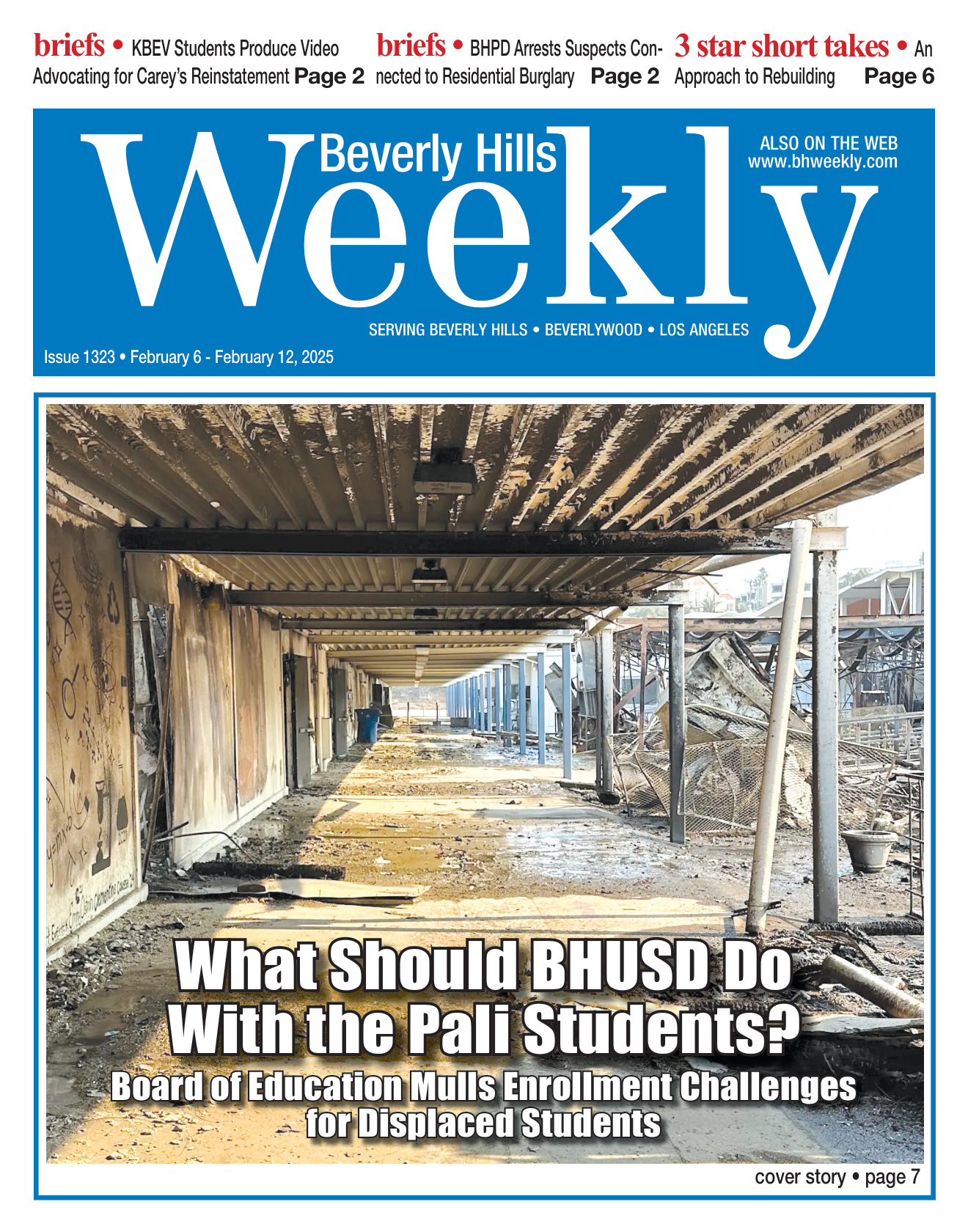
An Approach to Rebuilding
Peter Ostroff emphasizes the need for comprehensive planning in the wake of the devastating fires in the Palisades and Altadena, arguing that this presents a unique opportunity to rethink and redevelop the affected areas for better housing and safety, rather than merely restoring what was lost. He advocates for the State of California to utilize its power of eminent domain to facilitate this redevelopment, ensuring that future communities are designed to minimize risks from natural disasters while addressing the ongoing housing crisis.