Peter Ostroff
A Voice for Beverly Hills — Past, Present, and Future
BHUSD Shocker / Homeless Count
The article discusses the unexpected resignation of BHUSD Superintendent Dr. Michael Bregy, highlighting the need for the Board of Education to address the circumstances surrounding his departure while focusing on finding a suitable replacement to improve the district's academic performance. Additionally, it covers the annual Los Angeles Homeless Count, where volunteers, including the author, found a surprisingly low number of unhoused individuals in their assigned area, raising questions about the effectiveness and scientific accuracy of the counting process.

BHUSD Shocker / Homeless Count
By Peter Ostroff
⸻
BHUSD Shocker
Late in the day on Friday, February 21, I was very surprised to receive a copy of a letter signed by all five members of the Board of Education (the Board) announcing that Superintendent Dr. Michael Bregy had “resigned” effective on Monday, February 24. (See brief on page 3.)
I was very surprised for several reasons. In August 2024, the School Board had unanimously approved a three-year extension of Dr. Bregy’s contract even though his then-existing contract ran until mid-2025. Although I stay informed about BHUSD, I had no inkling that Dr. Bregy’s eight-year tenure was possibly coming to an early end. Finally, the departure of a Superintendent in the middle of the academic year is always an unusual event.
Naturally, I wanted to find out what had happened and made numerous inquiries and learned nothing useful. Those who know aren’t talking and those who are talking don’t know. Ultimately, I concluded that it did not matter. What matters now is expressing appreciation to Dr. Bregy for his many years of service in a very challenging position and, most importantly, finding the very best candidate to fill this position going forward. I am hopeful that the Board will leave no stone unturned and get the best possible advice and assistance to identify the right person and move expeditiously so that the new superintendent will be on board well in advance of the 2025-26 academic year.
While I understand the Board’s silence about just what happened, some explaining will have to be done. This is because the first question that any qualified candidate will ask during the interview process will be the following:
“Dr. Bregy resigned in the middle of the academic year after eight years of service just six months after you had given him a generous contract extension. What happened?”
And the Board or its representatives will have to answer that question. A statement to the effect that we don’t discuss personnel issues will not satisfy anyone that we should consider hiring. They have to know what they are getting into.
I am hopeful that the Board has prepared an answer but, as I have stated above, I don’t know what it is. However, I am prepared to offer my suggestion:
“Dr. Bregy served BHUSD well for a number of years. Nonetheless, academic performance of the District was not improving.
In recent months, several specific issues arose.
In the wake of the Presidential election, racial tensions among groups of students became heightened and some felt that this situation was not handled well.
In a somewhat related incident, popular BHHS media teacher Romeo Carey who supervised the student-run broadcasting service KBEV was suspended pending an investigation. This highly controversial situation (more than 900 members of the BHUSD community signed a petition demanding his reinstatement) was not concluded in a timely fashion.
Most recently, in the wake of the horrendous Palisades fire, the District’s handling of the potential enrollment of Palisades High students in BHHS managed to alienate all concerned.
The Board and Dr. Bregy concluded that their communication had deteriorated, their views were not aligned and this led to his resignation.”
Whatever the actual backstory may be, this explanation is not an unfair one and should serve to highlight both the importance of improving academics, some current issues and the reason for the mid-year departure.
My conclusion is that the details of the departure are not important. The identification of an educator as Superintendent who will restore BHUSD to the level of academic excellence that we properly demand is all that matters.
⸻
Homeless Count
Every year, the Los Angeles Homeless Service Authority (LAHSA) conducts the “Greater Los Angeles Homeless Count” to survey the number of the unhoused in the region. The expressed objective, among other things, is to improve LAHSA’s ability to serve and assist the homeless population. It is not at all clear to me how this objective is accomplished.
LAHSA is, according to its website, “the lead agency in the Los Angeles Continuum of Care, which is the regional planning body that coordinates housing and services for homeless families and individuals in Los Angeles County. LAHSA coordinates and manages Federal, State, County and City funds for programs that provide shelter, housing and services to homeless persons in Los Angeles City and County.”
Tremendous public resources are provided to and distributed by LAHSA. The agency was established in 1993 and last year distributed more than $800M mostly to non-profit organizations. Typically, these organizations are dedicated to finding pathways to permanent housing. LAHSA covers the entirety of Los Angeles County other than the cities of Long Beach, Pasadena and Glendale which have their own homeless agencies.
The Homeless Count is conducted annually by hundreds of volunteers and provides a point-in-time snapshot of the number of individuals who are unhoused. The results of the count show that the number of unhoused individuals has decreased over recent years while the shelter count has increased.
This year the count occurred from February 18 through 20. When I learned of the opportunity to volunteer, I signed up because I wanted to experience firsthand just what is being done and was assigned to Los Angeles Mid-City West.
The entire process from start to finish was very professionally managed. Prior to the Count, the volunteers watch two training videos that explain just what to count and what not to count and how to record observations through an app for data collection.
However, it was apparent from the outset that we were engaged in a process that could not be considered scientific by any measure. The timing of the Count is the same each year, early evening at approximately 8pm during weekdays to accomplish apples-to-apples comparisons from one year to the next. But most of the stores and restaurants in our area were open and the streets were full of people going about their business. It would have been impossible to determine which of them were homeless.
After watching videos, I was directed to come to the volunteer assembly site at the CBS Television parking lot at 200 N. Fairfax Ave in Los Angeles at 8:00pm on Tuesday, February 18. The volunteers are assigned to three-person teams to conduct the count in a specific area. The teams include a driver, a navigator and a counter who would record our observations on the app.
My team included Mike, an employee of the City of Los Angeles, and Adrienne, a young psychiatrist. Both were veterans of the Homeless Count. Mike had participated in three or four in this Mid-City area and Adrienne had participated in several while completing her medical training in New York City. As I was the rookie, I was assigned the easiest job of driver. All I had to do was follow navigator Mike’s direction while Adrienne handled the challenging data entry job using the app.
We were assigned a zone of the district, roughly one square mile partly in the City of Los Angeles, partly in the City of West Hollywood, from Beverly Blvd on the south, Santa Monica Blvd on the north, La Cienega Blvd on the west and Kilkea Ave on the east. Our job was to drive up and down each street and alley and count the unhoused that we observed. We were firmly instructed that we should not engage with or disturb any individual in any way.
At around 8:15pm we were sent on our way driving north on Fairfax and then west on Beverly. As we were getting started, I asked my veteran teammates for their estimates on the over/under as to how many unhoused we would observe. Neither would venture a guess but I thought that the number would be between ten and fifteen.
For the next ninety minutes, we drove slowly approximately fifteen miles and covered every street and alley in our zone including, unavoidably, some more than once as we sought to cover the entirety of the territory.
Bottom line – my estimate of ten to fifteen unhoused persons was wildly off the mark. We saw exactly ONE unhoused person who was camping in the space in an alley between an apartment building and the trash container. He smiled and waved as we passed. To bolster our count, we also identified one camper van that was a possible shelter.
When we returned to the assembly point to submit our results, we learned that our experience was typical as other teams reported seeing either no unhoused or, at most, one or two.
I draw no conclusions except to note that our area was generally well-lit, streets and alleys alike, and involved commercial areas that were lively in the early evening. There were no tents or encampments and no freeway underpasses which often serve as shelters.
And then my reward: I was presented with a LAHSA Certificate of Appreciation “for [my] commitment to improving our communities by assisting the homeless.”
I will be there next year!!

Peter Ostroff is a long-time Beverly Hills resident of over 50 years who retired in 2017 after a 50-year career as a trial lawyer. He was born in Washington, D.C. in 1942. He graduated from Washington University (St. Louis, Mo) in 1964 with a B.A. degree in political science and economics. He graduated from the University of Chicago Law School in 1967 with a J.D. degree. He taught law at Monash University Law School in Melbourne, Australia in 1968. He became a member of the Illinois Bar in 1967 and the California Bar in 1969, He clerked for Hon. Shirley M. Hufstedler of the United States Court of Appeal 1969-70, practiced law with Nossaman, Waters, Scott, Krueger & Riordan and successor firms from 1970 to 1980 and with Sidley Austin from 1980 until 2017. During his full time law practice years he was a Committee Chair and Member of the Council of the American Bar Association, Litigation Section and was President of the Association of Business Trial Lawyers. Since 2018, he has served on the Beverly Hills Planning Commission. In addition to his work on the Commission, Peter has chaired the BHUSD 7-11 Surplus Property Committee and contributed to planning efforts for the District Offices site on S. Lasky Drive and future uses of the Hawthorne School property. He also served as Co-Chair of the Citizens Advisory Committee for the City's Climate Adaptation and Action Plan. He has been married to Anne Y. Ostroff since 2002, has two children, Nick Ostroff and Natalie Anne Cookson and has two grandchildren, Elliott Cookson and Emma Anne Cookson. Some family information is collected under Family Tree in this website. Since April 2024, he has written a weekly column for the Beverly Hills Weekly The columns are collected in this website.
petero@ostroff.laMore from the Archive
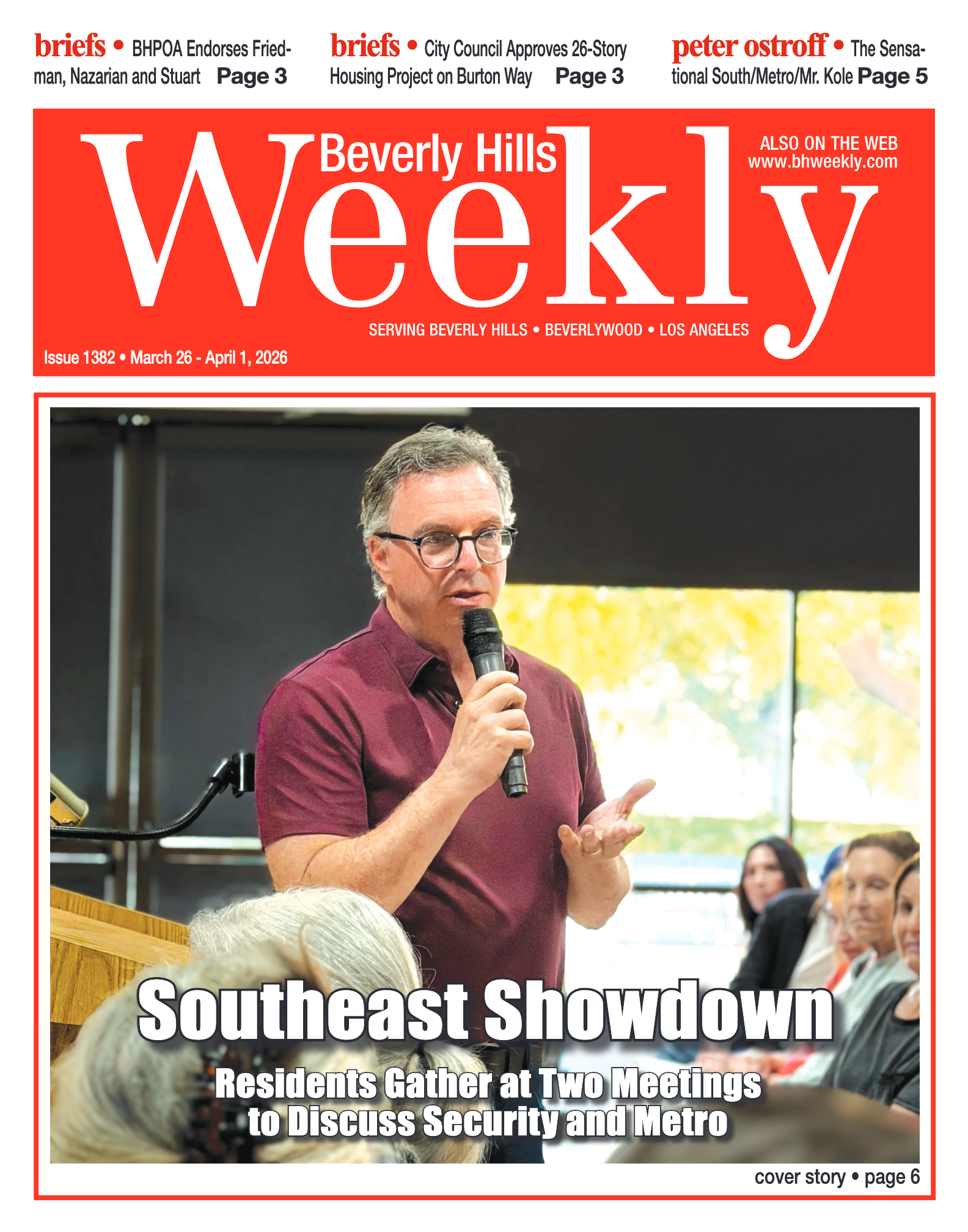
The Sensational South/Metro/Mr. Kole
The article discusses a town hall meeting focused on zoning issues and proposed multifamily residential projects in Beverly Hills, highlighting community efforts to advocate for residents' interests in the "Sensational South." It also addresses the upcoming subway service and security concerns, while emphasizing the need for better transportation solutions and facilities to encourage local residents to utilize the new transit system.
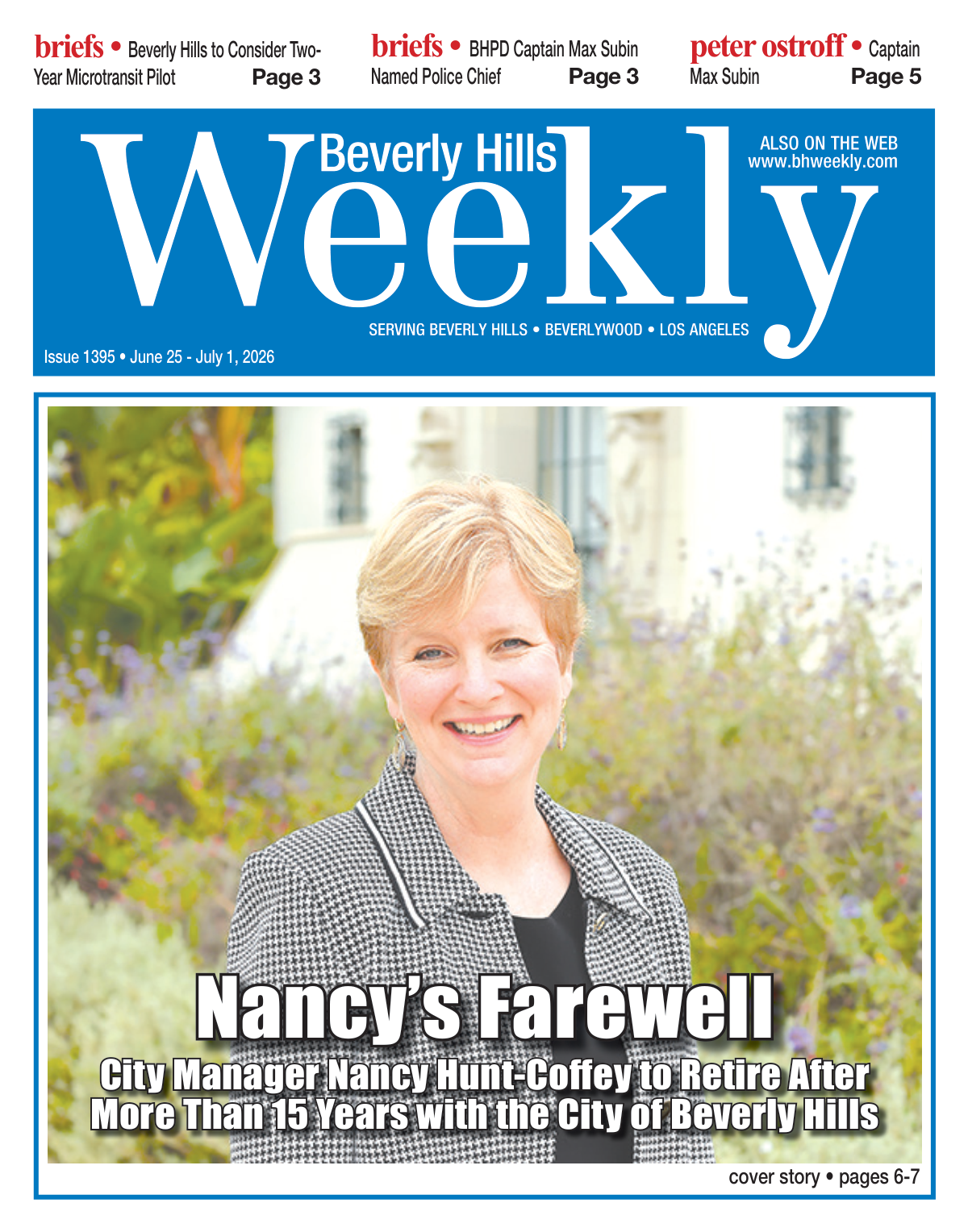
Captain Max Subin / Seoul/Mongolia June 2026
City Manager Ryan Gohlich announced the promotion of Captain Max Subin to Chief of the Beverly Hills Police Department, marking the first internal appointment in years; Subin, a well-respected member of the department since 1999, emphasizes community safety and aims to enhance departmental operations. Meanwhile, a travelogue details a recent trip to Mongolia, highlighting its rich history, cultural experiences, and the challenges posed by rapid urban growth and infrastructure development.
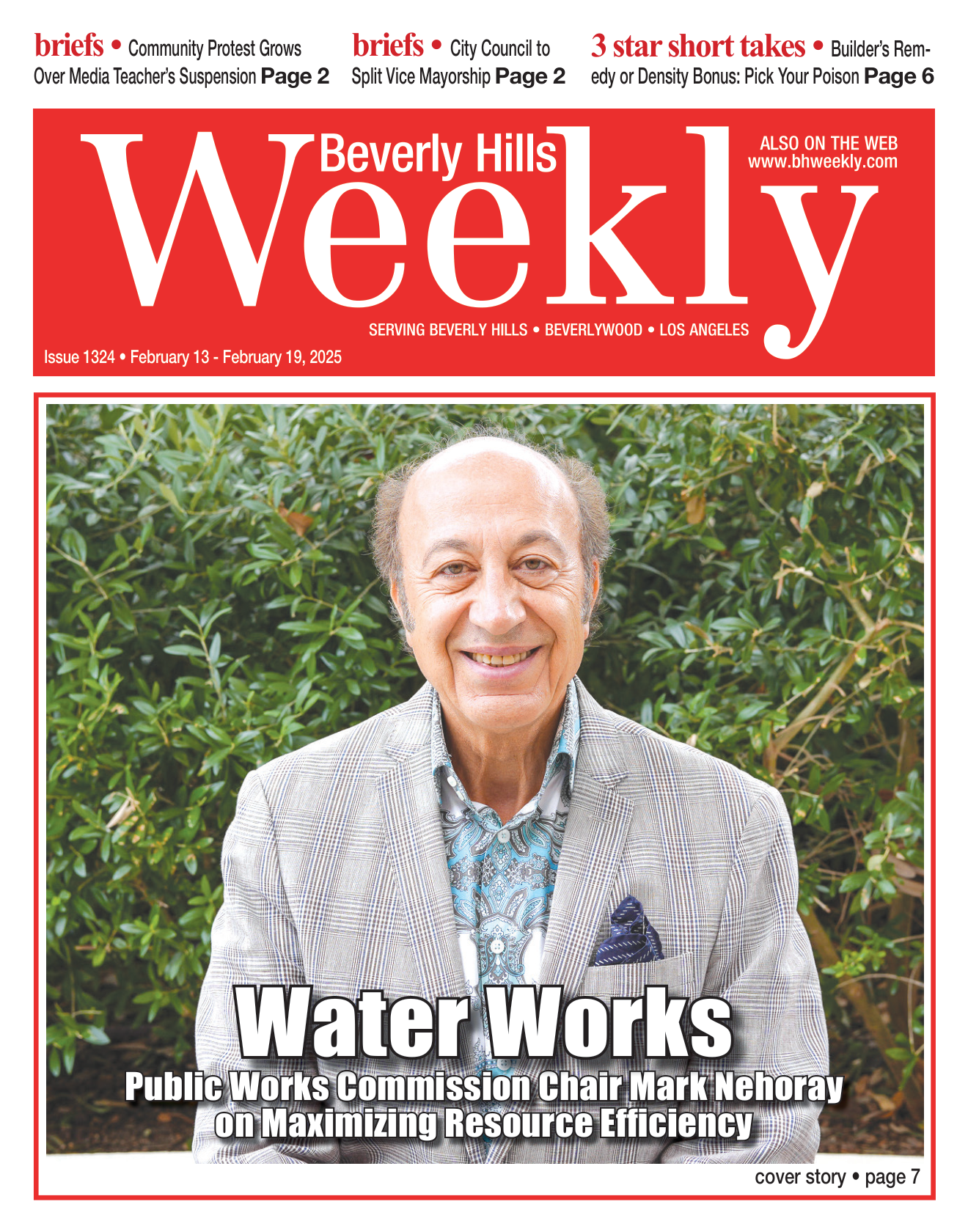
Builder’s Remedy or Density Bonus: Pick Your Poison
The article discusses the City Council's dilemma regarding the approval of multi-family housing projects that exceed local zoning laws due to California's Density Bonus and Builder’s Remedy policies. As the Council considers offering streamlined approvals to negotiate smaller projects, it faces pressure from the state to meet affordable housing quotas, which could significantly alter the character of the city while only providing a limited number of affordable units.