Peter Ostroff
A Voice for Beverly Hills — Past, Present, and Future
An Approach to Rebuilding
Peter Ostroff emphasizes the need for comprehensive planning in the wake of the devastating fires in the Palisades and Altadena, arguing that this presents a unique opportunity to rethink and redevelop the affected areas for better housing and safety, rather than merely restoring what was lost. He advocates for the State of California to utilize its power of eminent domain to facilitate this redevelopment, ensuring that future communities are designed to minimize risks from natural disasters while addressing the ongoing housing crisis.
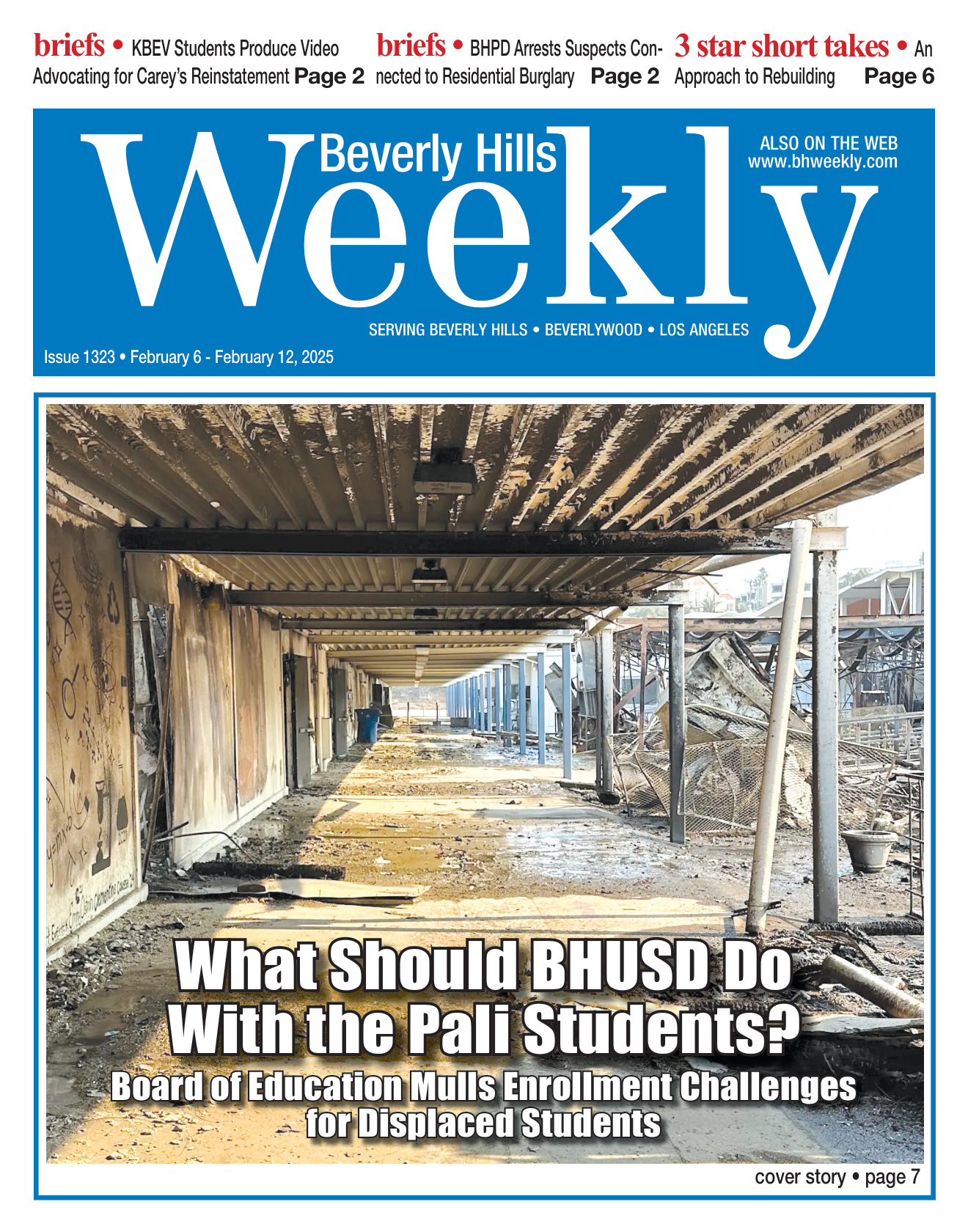
An Approach to Rebuilding
In Beverly Hills, we were most fortunate not to have personally experienced the horrendous and tragic fire events that occurred largely in the Palisades and Altadena. While the fires, particularly the Sunset Fire, which prompted evacuation warnings very close to our homes, caused some stress in our neighborhood, it was nothing compared to what the Palisades and Eaton fires inflicted on the residents of those areas. This time, we dodged a bullet.
I have great sympathy for and understanding of the grief and sadness for the families whose neighborhoods, homes and schools were destroyed. But now the question for our region is what should be done in those areas?
⸻
Two guiding principles come to mind:
First, it is said that there are five stages of grief:
1. Denial
2. Anger
3. Bargaining
4. Depression
5. Acceptance
Second, to paraphrase a number of leaders from Winston Churchill to Rahm Emanuel, never let a serious crisis go to waste. In other words, a crisis can present a unique opportunity to do things that could not have been done before.
It shall soon be time to invest some thoughtful attention to what the future holds for the vast tracts of land in prime locations now largely cleared of structures by the Palisades and Eaton fires. While the stages of grief are not necessarily linear or the same for everyone, it is important to bear in mind that the political forces that have arisen in the immediate aftermath of the unimaginable tragedy could evolve as time passes and denial and anger resolve inevitably into acceptance.
Specifically, the reality is that the neighborhoods and communities that have been destroyed are gone and cannot be magically restored in short order. For better or worse, this will not happen. No irrevocable decisions should be made until this reality has been accepted.
Once this has occurred, it is vitally important that we look forward to what could be, not backward to what was. I suggest that these centrally located highly desirable areas provide a once in a millennium opportunity for comprehensive planning of sections of one of the world’s most important cities. In my mind this opportunity outweighs the value of trying to reconstruct structures on an ad hoc basis as thousands of individual owners may see fit.
The objectives of comprehensive planning would include minimizing the prospect of future fire damage, seismic problems and other perils AND ensuring that substantially more housing, market and affordable, be created in the now empty (but for toxic and other debris) tracts.
Comprehensive planning can best be done by the State of California through use of its power of eminent domain to acquire much or all of the devastated areas. While there are Constitutional limits on the exercise of this power, the state could lawfully take privately owned property for planned redevelopment provided that it pays just compensation to property owners. In a 2005 United States Supreme Court decision in Kelo v. City of New London, the Court held that community revitalization through acquisition and sale of previously privately owned property by a state to private developers was a public purpose that allowed for acquisition by eminent domain. (It was a 5-4 decision in which the then conservative minority was on the losing side. What the Court as currently constituted would do with this issue is beyond the powers of my crystal ball. For now, I assume that Kelo is good law.)
⸻
The scope and the opportunity
Prior to the fires, these now destroyed areas were very attractive communities of approximately 40,000 people with homes, largely single family, schools, places of worship, and substantial commercial activity. While some areas remain with minor damage, many are gone entirely. They may be replaced in some fashion but they will not be replicated. Ad hoc efforts to rebuild on an individual basis will be chaotic. Without voluntary coordination, likely unattainable, the process of debris removal on a lot by lot basis, let alone construction, will be a nightmare.
Together, the amount of devastated land area in the Palisades and Altadena is in excess of 40,000 acres or more than 60 square miles. That is the area of Washington, D.C. and 150% of the area of the city of San Francisco. Both of those cities have populations of around 1,000,000 residents within the city limits.
I understand that much of the damaged acreage is in mountainous terrain or otherwise in areas that cannot be developed. However, there are large contiguous areas that can be redeveloped. Properly planned, there is undoubtedly ample room for substantially more residents in areas very attractive for a number of reasons.
⸻
A bold solution for California’s housing crisis
Undeniably, California has a severe shortage of housing and affordable housing. That shortage is the result of the fact that for decades California population and job growth has vastly exceeded construction of residential housing units, perhaps among other causes. The State of California continues to struggle, largely unsuccessfully, to address this issue effectively. As a result of the shortage and consequent lack of affordable housing, sprawl of metropolitan areas and construction of housing in high fire risk areas continues unabated.
With proper planning, the now devastated land areas could support many times more residential units than the housing that has been lost. Plans could require community design and construction that would minimize, to the extent current technology and foresight allows, risk of loss due to fire, seismic and other hazards. The State could adopt provisions to expedite the entitlement process given that by definition all construction must be consistent with the overall comprehensive plan.
With a reasonable combination of single family and multi family units, the land available could accommodate many, many more residents and all of the schools, places of worship and commercial areas (and jobs) to service them.
While Washington DC and San Francisco are far from optimally planned, both include large numbers of government structures, monuments, public spaces, enormous parks (such as Rock Creek Park in DC and Golden Gate in S.F.) and numerous sports stadiums. The possibilities for comparably sized urban “blank slate” land are infinite. Of course, a reasonable percentage, say 20-25%, of the new residences should be “affordable” as currently defined and/or a bit below market.
⸻
Reality check and timing
These thoughts would not be complete without an acknowledgment of the political realities. In the short term, while we are in the denial and anger stage, politically, the idea that the state would acquire the fire ravaged properties and then plan their redevelopment is a non-starter. Our leaders are falling all over themselves to pander to the grief-stricken Palisades and Altadena residents’ wishes to restore their homes and neighborhoods as they were and do it at warp speed.
While this restoration cannot and will not happen, pretending that it can and taking actions such as “eliminating red tape” and facilitating some immediate efforts to restore what has been destroyed could create facts on the ground that would preclude comprehensive planning once denial has evolved into acceptance. Notably, if eliminating red tape involves relaxing building standards, that is exactly the wrong thing to do in a fire zone or where there are earthquake faults.
Beyond that, there remain other threshold issues including cost and limitations of California law. The costs would be recouped by resales to persons who would effect the comprehensive plan(s). Federal and California tax laws that might apply to gains realized by property owners when their property is purchased through eminent domain can be modified. Zoning limitations could be changed to facilitate the Plan(s) and allow redevelopment to “pencil out.”
I recognize that developing an optimal plan is complex. But decisions can and should be made without undue handwringing. It will take time, but that is true whether we attempt to restore what was or strive for something better.
While one “door” has closed, another “door” has opened. Let’s not waste the opportunity to do what is best for our region and state.

Peter Ostroff is a long-time Beverly Hills resident of over 50 years who retired in 2017 after a 50-year career as a trial lawyer. He was born in Washington, D.C. in 1942. He graduated from Washington University (St. Louis, Mo) in 1964 with a B.A. degree in political science and economics. He graduated from the University of Chicago Law School in 1967 with a J.D. degree. He taught law at Monash University Law School in Melbourne, Australia in 1968. He became a member of the Illinois Bar in 1967 and the California Bar in 1969, He clerked for Hon. Shirley M. Hufstedler of the United States Court of Appeal 1969-70, practiced law with Nossaman, Waters, Scott, Krueger & Riordan and successor firms from 1970 to 1980 and with Sidley Austin from 1980 until 2017. During his full time law practice years he was a Committee Chair and Member of the Council of the American Bar Association, Litigation Section and was President of the Association of Business Trial Lawyers. Since 2018, he has served on the Beverly Hills Planning Commission. In addition to his work on the Commission, Peter has chaired the BHUSD 7-11 Surplus Property Committee and contributed to planning efforts for the District Offices site on S. Lasky Drive and future uses of the Hawthorne School property. He also served as Co-Chair of the Citizens Advisory Committee for the City's Climate Adaptation and Action Plan. He has been married to Anne Y. Ostroff since 2002, has two children, Nick Ostroff and Natalie Anne Cookson and has two grandchildren, Elliott Cookson and Emma Anne Cookson. Some family information is collected under Family Tree in this website. Since April 2024, he has written a weekly column for the Beverly Hills Weekly The columns are collected in this website.
petero@ostroff.laMore from the Archive
Builder’s Remedy or Density Bonus: Pick Your Poison
The article discusses the City Council's dilemma regarding the approval of multi-family housing projects that exceed local zoning laws due to California's Density Bonus and Builder’s Remedy policies. As the Council considers offering streamlined approvals to negotiate smaller projects, it faces pressure from the state to meet affordable housing quotas, which could significantly alter the character of the city while only providing a limited number of affordable units.
BHUSD Shocker / Homeless Count
The article discusses the unexpected resignation of BHUSD Superintendent Dr. Michael Bregy, highlighting the need for the Board of Education to address the circumstances surrounding his departure while focusing on finding a suitable replacement to improve the district's academic performance. Additionally, it covers the annual Los Angeles Homeless Count, where volunteers, including the author, found a surprisingly low number of unhoused individuals in their assigned area, raising questions about the effectiveness and scientific accuracy of the counting process.

Beverly Hills Expenditures
Beverly Hills is facing a significant financial challenge, with projected expenditures set to exceed revenues, leading to anticipated deficits starting in the 2026-27 fiscal year. To address this issue, there is a call for an independent committee to explore expenditure cuts and ensure the city's long-term financial health, rather than relying solely on increasing taxes or revenues.