Peter Ostroff
A Voice for Beverly Hills — Past, Present, and Future
2024 Beverly Hills Year in Review
The 2024 Year in Review for Beverly Hills highlights a year marked by political divisiveness, significant developments in local governance and education, and ongoing challenges related to crime and housing. Despite initial concerns, the year concluded with a sense of optimism, underscored by successful elections and important community initiatives.

2024 Beverly Hills Year in Review
There is a famous ancient curse: “May you live in interesting times.” With this in mind, we can safely observe that 2024 was a very interesting year. The most “interesting” aspects were a heightened level of divisiveness and insecurity about crime and other things about both the present and future.
Let’s take a look at some of the month by month Beverly Hills highlights. In hindsight, as an eternal optimist, I think that it is fair to observe that the actuality was not nearly as bad as the anticipation.
⸻
January
I experienced this month in Beverly Hills only virtually because we spent the month onboard the National Geographic Endurance cruising the west coast of Antarctica. This was a great trip but hiking in snowshoes on frozen snowy windswept terrain is not what it used to be.
Back in the US, this month was marked by the fact that political campaigns, local for City Council, regional and national, were getting into full swing. On the local level, it was now certain that we would have a wide choice of 10 candidates, mostly outstanding, for only two open seats. With a level of prescience that I can only admire and envy, the Weekly featured, at the top of the front page of the first issue of the year, photos of Craig Corman, Alissa Roston and Mary Wells. They turned out to be the top three vote getters.
In California, we had some interesting choices for an open U.S. Senate seat. Many viewed the national election with trepidation verging on alarm.
⸻
February
This was a milestone month for retail and residential development in the City. The new Saks Fifth Avenue store opened on Wilshire where Barneys used to be and the One Beverly Hills project broke ground for its extensive construction project.
⸻
March
This was a significant month for the City Council. Lester Friedman was to be sworn in as Mayor. Corman and Wells were elected to the City Council to replace retiring long time council members Lili Bosse and Julian Gold.
In mid-March, the City Council adopted the City’s third amended General Plan Housing Element. This provided for over 3,000 new housing sites for development over the next five to seven years.
A personal note: My first Weekly column, an analysis of the Council election, appeared in the March 4 edition on March 14. This, in turn, provoked the first unfriendly letter to the editor.
A residential project was approved for 9229 Wilshire that was the first development to take full advantage of the City’s mixed use ordinance and State Density Bonus for development that provided affordable housing. This allowed for a building with a height of 83 feet in an area where the zoning laws permitted only 45’ and involved waivers of other City zoning laws. An appeal to the City Council and litigation were unsuccessful. This was of great concern to some residents in the immediate vicinity of this project. However, without use of both the mixed use ordinance and the state density bonus evidenced by this development, the City would have likely been required by state regulators to zone for much more density in all of our single family neighborhoods.
⸻
April
A zone change. Subsequently, the developer, which had filed preliminary applications for several other Builder’s Remedy projects in the City, filed its own lawsuit. These are unresolved at present.
⸻
May
BHUSD was central to the news this month. U.S. News & World Report ranked BHHS as 157th best high school in the Los Angeles area, 344th in California and 2,488th in the U.S. By way of comparison, 20 years ago, US News ranked BHHS 267th in the U.S., 2,271 places higher than now.
Also, at the beginning of the month, the state certified the city’s General Plan Revised Housing Element, shutting the door on new applications for multi-family residential projects that were not compliant with the General Plan or zoning rules.
⸻
June
By this time, developers had filed applications to build a total of sixteen projects that were far larger than what the General Plan or zoning rules allowed. These are so-called “Builder’s Remedy” projects.
⸻
July
In what will likely be the first of substantial litigation over development against the City, an organization called “Californians for Home Ownership” sued the City over the failure to allow a 19 story project on Linden Drive to go forward without applications for a General Plan Amendment or a zone change.
⸻
August
The beautiful new El Rodeo Elementary School campus reopened after major construction and renovation. It welcomed students for the first time since the work began in 2019. Hawthorne Elementary School was closed. Rich Waters, who taught at El Rodeo many years ago, became the principal of Beverly Vista Middle School.
The new BreastLink Comprehensive Women’s Imaging Center opened.
⸻
September
At BHHS 1,174 students were enrolled. In 2008, 2,412 students were enrolled, more than twice what we have today. This decline is undoubtedly attributable to many factors, not just changing demographics. It is time to step up work on improving academics as well as giving serious consideration to a more robust and well-designed Permit program.
Beverly Hills AYSO celebrated its 50th Anniversary. My children, Nick and Natalie Anne, took advantage of this fantastic program for 15 years collectively.
⸻
October
This was a month of intense political campaigning on both the local level (Board of Education) and regional (District Attorney) and national. This left little oxygen for anything else except…..
How about those Dodgers!!!!
⸻
November
We elected two new members to the Board of Education, Russell Stuart and Sigalie Sebag, and re-elected Amanda Stern, Ed.D. They have their work cut out for them. And Mr. Stuart was badly injured by a stolen car driven by an out of control car-jacking criminal.
BHHS graduate Nathan Hochman, class of 1981, was elected Los Angeles District Attorney and he promptly named his BHHS classmate, Steve Katz, as his Chief Deputy. Hopefully, they can make a difference in dealing with the actuality and perceptions of increased criminality in our community.
On the national level, my only observation is that things are rarely as good or as bad as we think they are. Also, the City issued an RFP for a Citywide micro-transit system. I will have more to say about that in the weeks to come.
⸻
December
In early December, the city hosted the 2024 Mayors Summit Against Antisemitism. It was attended by representatives.
This month belongs to Beverly Hills City Attorney Larry Wiener and not just because we share the same December 15 birthday. Last year, building owner Douglas Emmett cancelled a lease of a suite of medical offices to DuPont Clinic. DuPont had planned to operate a controversial facility that would offer, among other reproductive care, late term abortions. DuPont sued the City alleging among other things that the City had pressured Douglas Emmett to cancel the lease and was liable for tortious interference with contract, fraud and other things.
At Larry’s direction, the City’s lawyers filed a motion to dismiss the lawsuit. Some, including me, were skeptical about the City’s chances of success. Larry stood his ground (not that he pays much attention to me) and in early December, a Los Angeles Superior Court judge dismissed the case. This put to rest a case that could have exposed the City to liability for substantial damages and also will allow for recovery of the City’s legal fees.
To put icing on our holiday cake, also in December, another Los Angeles County Superior Court judge dismissed a case challenging the City’s designation of certain City owned property as “surplus.” We can enter the new year with confidence that our City’s legal affairs are in good hands.
LATE BREAKING NEWS: At the very end of the year, former President Jimmy Carter died at the age of 100. He left an impressive over four decade post-Presidential legacy. I remembered that I had met then Georgia Governor Carter in 1975 when he had just announced that he was running for President. I was fortunate to have been invited to a breakfast to meet him. We met in a conference room in the old Ambassador Hotel (where RFK had been assassinated in 1968). There were only five or six of us and we had a lengthy chat. These were the Watergate years; President Nixon had resigned only a few months earlier in late 1974. We had been lied to for years by top levels of government about what was happening in Vietnam. We were starved for leadership that we could like and respect. Carter was entirely unknown at the national level and, of all things, a peanut farmer from Plains, Georgia. I remember nothing of the substance of the conversation that morning. But I distinctly recall my reaction: Here was a very nice, forthcoming and apparently sincere man – a peanut farmer of all things – who, astonishingly, could become President of the United States of America BECAUSE he was a very nice, forthcoming and apparently sincere man.
HAPPY NEW YEAR!!
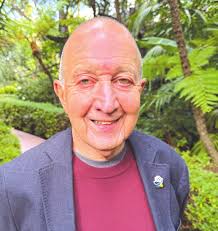
Peter Ostroff is a long-time Beverly Hills resident of over 50 years who retired in 2017 after a 50-year career as a trial lawyer. He was born in Washington, D.C. in 1942. He graduated from Washington University (St. Louis, Mo) in 1964 with a B.A. degree in political science and economics. He graduated from the University of Chicago Law School in 1967 with a J.D. degree. He taught law at Monash University Law School in Melbourne, Australia in 1968. He became a member of the Illinois Bar in 1967 and the California Bar in 1969, He clerked for Hon. Shirley M. Hufstedler of the United States Court of Appeal 1969-70, practiced law with Nossaman, Waters, Scott, Krueger & Riordan and successor firms from 1970 to 1980 and with Sidley Austin from 1980 until 2017. During his full time law practice years he was a Committee Chair and Member of the Council of the American Bar Association, Litigation Section and was President of the Association of Business Trial Lawyers. Since 2018, he has served on the Beverly Hills Planning Commission. In addition to his work on the Commission, Peter has chaired the BHUSD 7-11 Surplus Property Committee and contributed to planning efforts for the District Offices site on S. Lasky Drive and future uses of the Hawthorne School property. He also served as Co-Chair of the Citizens Advisory Committee for the City's Climate Adaptation and Action Plan. He has been married to Anne Y. Ostroff since 2002, has two children, Nick Ostroff and Natalie Anne Cookson and has two grandchildren, Elliott Cookson and Emma Anne Cookson. Some family information is collected under Family Tree in this website. Since April 2024, he has written a weekly column for the Beverly Hills Weekly The columns are collected in this website.
petero@ostroff.laMore from the Archive
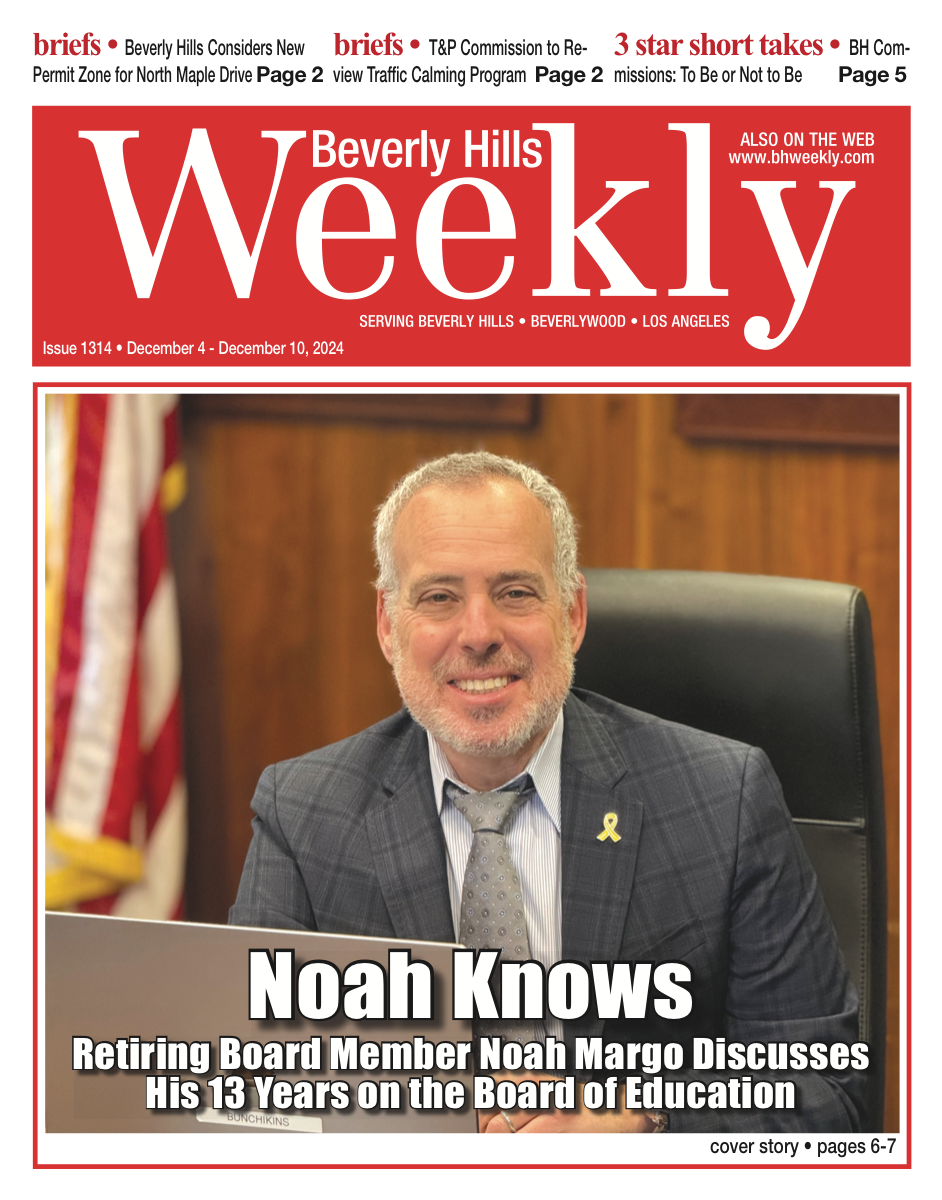
Beverly Hills Commissions: To Be or Not to Be
The article critiques the Beverly Hills Council's proposal to merge several commissions for efficiency, arguing that the Council shows little regard for these bodies, undermining their role as independent advisors. The author suggests that if the Council does not value the commissions' input, they should be disbanded entirely, as their potential benefits to community engagement and informed decision-making are being ignored.
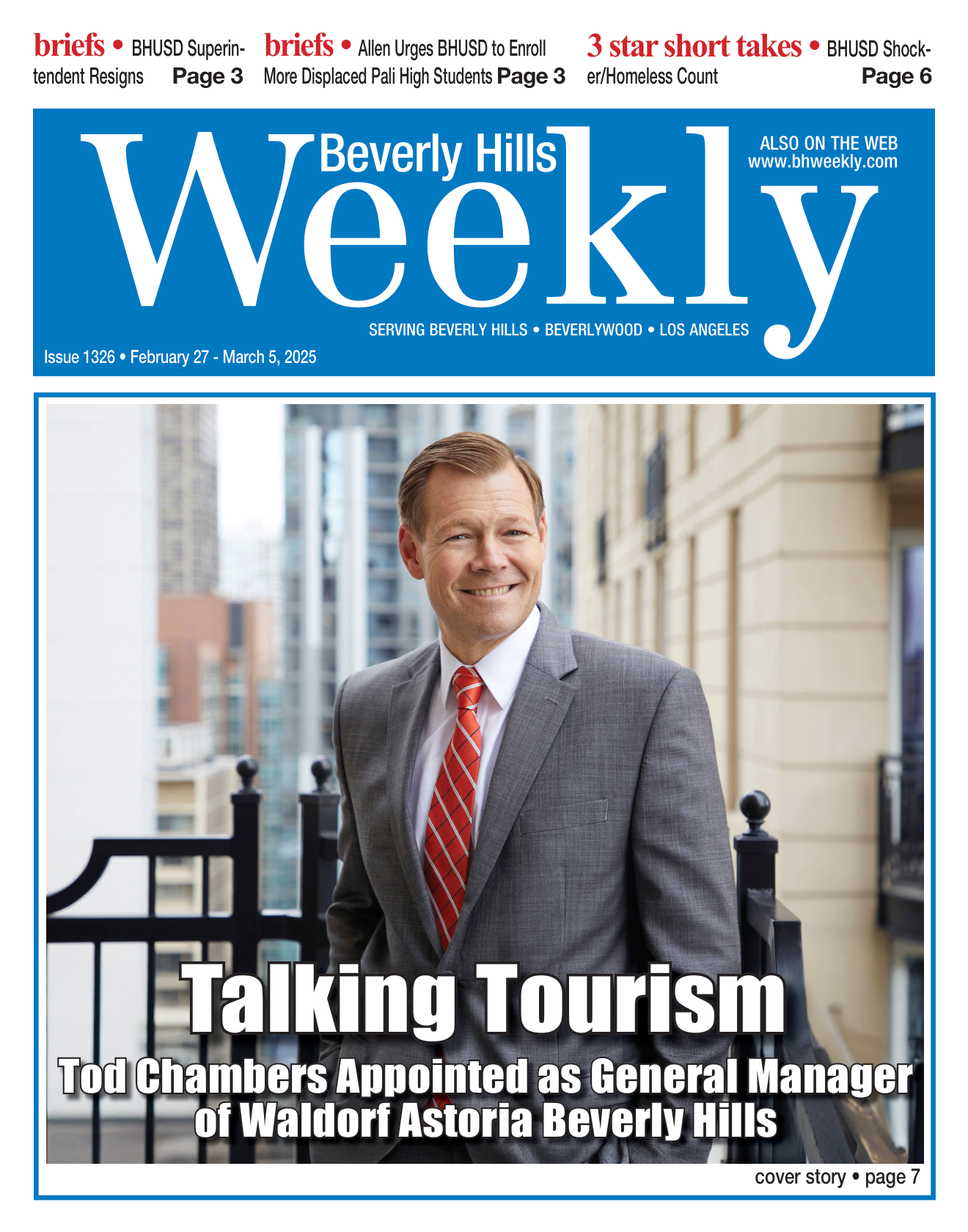
BHUSD Shocker / Homeless Count
The article discusses the unexpected resignation of BHUSD Superintendent Dr. Michael Bregy, highlighting the need for the Board of Education to address the circumstances surrounding his departure while focusing on finding a suitable replacement to improve the district's academic performance. Additionally, it covers the annual Los Angeles Homeless Count, where volunteers, including the author, found a surprisingly low number of unhoused individuals in their assigned area, raising questions about the effectiveness and scientific accuracy of the counting process.
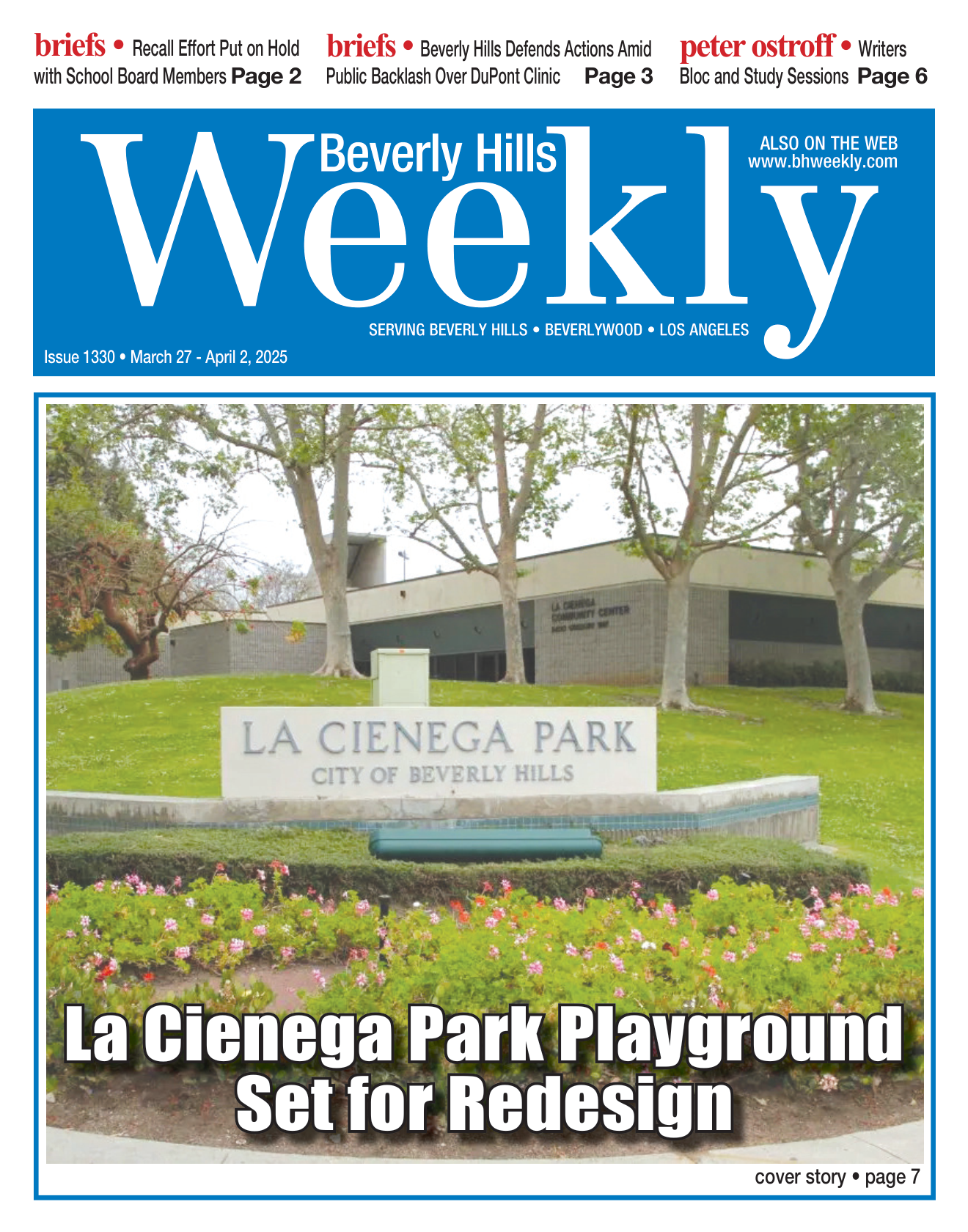
Writers Bloc and Study Sessions
Andrea Grossman, a long-time Beverly Hills resident, has significantly enriched the local cultural scene through her non-profit Writers Bloc, which hosts literary events featuring prominent authors and public figures. Meanwhile, the Beverly Hills City Council is debating procedural changes for their afternoon Study Sessions, with discussions focusing on the appropriateness of taking action during these meetings, while the Board of Education has opted to select a former principal as Superintendent without a comprehensive search process.