Peter Ostroff
A Voice for Beverly Hills — Past, Present, and Future
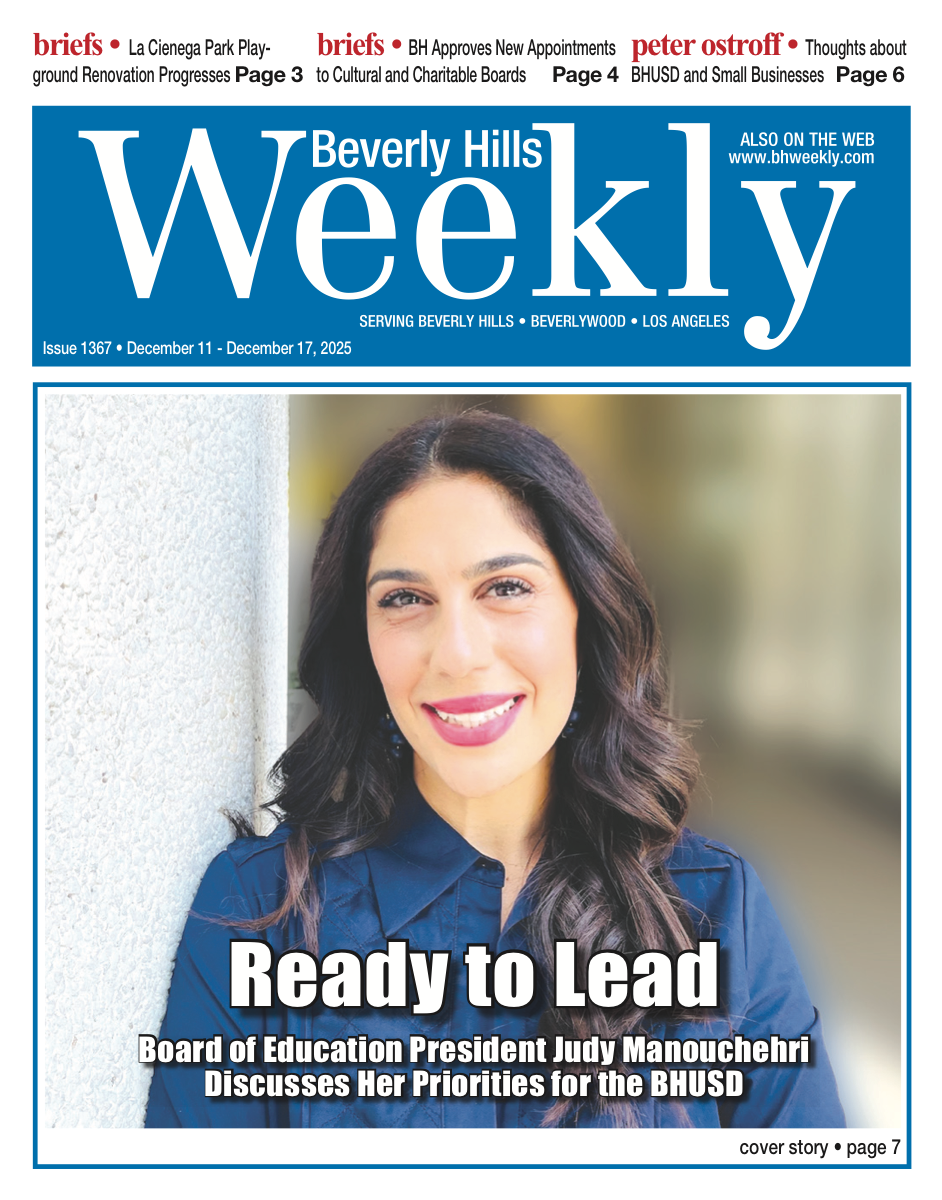
Thoughts about BHUSD and Small Businesses
The article discusses two key issues facing the Beverly Hills Unified School District: the potential redevelopment of surplus District property into workforce housing and the underutilization of school facilities due to declining student enrollment. The author advocates for a proposal to build a multi-family dwelling that includes affordable units for District employees and suggests expanding permit programs to attract out-of-district students to improve academic performance.
I want to weigh in on two issues affecting the Beverly Hills Unified School District as we enter a new year.
Both of these issues are closely related to the fact that the District has approximately 3000 students in the high school, the middle school and two elementary schools. Twenty-five years ago, the District had approximately 5300 students (almost twice as many) in the high school and four elementary schools.
There are presumably a number of reasons for this dramatic reduction including the fact that there are fewer children living in the District (its boundaries are the same as the City boundaries), a reduction in the percentage of children living in the District who attend the District schools (reflected in what is called the “capture” rate) and far fewer students from outside the District who attend through a permit program.
Workforce Housing may be on its Way
The first issue is what to do with the
District Offices building on S. Lasky Drive. Over five years ago, a “seven-eleven” committee (the “Committee”) was formed to address what to do with “surplus” District property. This is a committee required by state law and the name derives from the fact that the committee must have at least seven but not more than eleven members drawn from the District. I was named chair of the Committee and, consequently, have some memory of what occurred.
There were three properties that were potentially considered surplus – the District offices site, the Elm Drive faculty parking lot and the Hawthorne School campus. We focused on the District offices site because the Elm Drive property did not offer much development potential and Hawthorne School was still needed during the construction at
El Rodeo School. Further, the District offices site was poorly designed for the purposes it was inefficiently serving and required substantial maintenance costs.
In reasonably short order, the Committee had, with the help of an outside consultant, done a feasibility study.
The study demonstrated that the District could contract with a developer who would construct and then manage a multi-family dwelling on the site and enter into a ground lease that would pay substantial funds to the District over a period of many years. A Request for
Proposals was issued and approximately ten responsible proposals were received.
And, when the Committee finished its work and my service ended, the District was on the verge of identifying the winning proposal. That was three years ago and, after many years working in the private sector, I learned that life in the “public sector” is different. The difference, in a “word”, is that things in the public sector take longer. Much longer.
As we proceeded through this process,
I had my own wish list for the site. In short, my vision was that the developer would seek and obtain entitlements to build a relatively tall building (say, twelve to fifteen stories) and provide approximately 200 rental units of which approximately 100 would be “workforce housing” for our District employees and first responders at rates that would be substantially below market but still substantially above so-called state defined “affordable” rental rates. My wish list was quickly modified as members of the Board of Education, perhaps for political reasons, felt that the District should be more sensitive to the immediate neighbors who occupied apartments that were in buildings between two and four stories tall.
I am pleased to report that the Board of Education soon will be considering a scaled back version of my wish list.
Sources tell me that the proposal being considered will involve a building of no more than six or seven stories and will contain approximately 100 units of which approximately 20% will be principally reserved for teachers and City first responders at rates substantially below market. While this may not satisfy the most ambitious of my wishes, it will be very helpful in attracting and retaining the type of residents who otherwise might have to live far from our borders.
Notably, no one gets everything that they want.
***
Permits to Attract Out of District Students
I have some thoughts about using permits for improving the academic focus of our students.
I should start by acknowledging that use of permits does not appear to be a priority for either
District administration or the Board of Education.
So these are my ideas. I start with the premise that our District’s school facilities are underutilized (with a student population down 2500 in recent years) and that the current student body is underperforming on state standardized tests. To some degree, this underperformance may be a result of the fact that an increasing number of our graduates aspire initially to attend a community college and are aware that they will be admitted without regard to their high school performance. Thus, they may see no purpose in working hard in high school. This is both regrettable and counter productive.
I recognize that there are residents who feel that their property taxes should not be spent educating the children of non-residents. I regard this attitude to be incorrect (non-residents pay property taxes also) and a bit short sighted.
The District currently does have a permit program that provides for 70 students who are children of District employees, 50 grandchildren of City residents (this program is capped at 100 students but we have not utilized half of the spaces) and 25 children of City employees. The latter are required by the Joint Powers
Agreement between the City and the District.
As much as we may want to selectively admit students who are high academic or athletic achievers, this is not allowed,
Under California law, districts cannot use academic performance, athletic ability, physical condition or English proficiency as a basis for admission. Districts can, however, use family relationships or specific programs to attract students who do not live within the District boundaries.
Therefore, I offer for your consideration the possibility of offering permits to a broader category of relatives of residents (for example, nieces and nephews) and, for permits at the high school level to children attracted by our outstanding academic pathways programs. If either of these ideas make sense to you, let your Board of Education members know.
***
Our small, often “mom ‘n pop”, businesses are the lifeblood of our City. Places we have been patronizing and where we have generated family memories for generations.
For numerous reasons including “the pandemic”, the tariffs, on line shopping and others, our small businesses are enduring a very challenging environment.
On South Beverly Drive alone we have recently lost Walter’s, Upper Crust Pizza, Istanbul and my favorite neighborhood sushi place, Kiyono. Needless to say, the loss of these spots affect our quality of life directly.
This raises the question of what our
City can do to help. Then I saw a BHPD
Alert seeking donations for something called “Operation Gift Drop” soliciting contributions for children of the Compton Unified School District. While undoubtedly well-intentioned the solicitation goes on to suggest that gifts be purchased through the BHPD Amazon Registry. Seriously? What about our local shops which offer a wide selection of appropriate and affordable gifts?
This suggests to me a lack of sensitivity to the needs and circumstances of our own merchants. Tara Riceberg, the owner of Tesoro aka “Best Gift Store
Ever.com” on N. Canon Drive, believes that a focus on our small businesses is a “triple kindness.” This is because when we support local businesses we support individual neighbors, not remote big box owners, we generate local sales tax revenues and these are used to support our City services.
What are your ideas? And, by the way, please patronize our local merchants.
***
I was extremely pleased to see that
Cindy Gordon (See brief on page 7) has been named Assistant Director of Community Development and City Planner after a nationwide search.
I have known and worked with Cindy since my first foray into the thicket of
Beverly Hills land use. In 2016, I had newly moved into my home on Lago Vista Drive and learned that a developer (who turned out to be the moving force behind a land use ponzi scheme) was trying to obtain entitlements to build a massive structure on our street. Cindy was the planner evaluating the application and we had extensive interactions.
Ultimately the application was denied.
I learned a lot from Cindy (and her then-mentor Ryan Gohlich [whatever became of him?]) and have watched with admiration as her expertise has grown and her responsibilities have expanded.
A terrific choice.
People Mentioned

Peter Ostroff is a long-time Beverly Hills resident of over 50 years who retired in 2017 after a 50-year career as a trial lawyer. He was born in Washington, D.C. in 1942. He graduated from Washington University (St. Louis, Mo) in 1964 with a B.A. degree in political science and economics. He graduated from the University of Chicago Law School in 1967 with a J.D. degree. He taught law at Monash University Law School in Melbourne, Australia in 1968. He became a member of the Illinois Bar in 1967 and the California Bar in 1969, He clerked for Hon. Shirley M. Hufstedler of the United States Court of Appeal 1969-70, practiced law with Nossaman, Waters, Scott, Krueger & Riordan and successor firms from 1970 to 1980 and with Sidley Austin from 1980 until 2017. During his full time law practice years he was a Committee Chair and Member of the Council of the American Bar Association, Litigation Section and was President of the Association of Business Trial Lawyers. Since 2018, he has served on the Beverly Hills Planning Commission. In addition to his work on the Commission, Peter has chaired the BHUSD 7-11 Surplus Property Committee and contributed to planning efforts for the District Offices site on S. Lasky Drive and future uses of the Hawthorne School property. He also served as Co-Chair of the Citizens Advisory Committee for the City's Climate Adaptation and Action Plan. He has been married to Anne Y. Ostroff since 2002, has two children, Nick Ostroff and Natalie Anne Cookson and has two grandchildren, Elliott Cookson and Emma Anne Cookson. Some family information is collected under Family Tree in this website. Since April 2024, he has written a weekly column for the Beverly Hills Weekly The columns are collected in this website.
petero@ostroff.laMore from the Archive

Mrs. Marcus
The article pays tribute to Mrs. Rachelle Marcus, who has made significant contributions to the Beverly Hills Unified School District over her decades-long career as an educator and Board President, highlighting her commitment to improving educational opportunities and school performance. As she prepares to conclude her term, she reflects on her achievements and challenges while advocating for continued enhancements in academic standards and the responsible use of technology in education.

Suggestion for Board of Education
The article discusses concerns about the behavior of the Board of Education in BHUSD, suggesting that their conduct may deter residents from sending their children to local schools, and recommends minimizing meetings and fostering respect to improve community relations. Additionally, it highlights the launch of LoveLockDating.com, a new dating site for seniors aimed at preventing scams and ensuring safety, created by retired physician Dr. Barbara Finck after her negative experiences with online dating.
Use to Think About
The article discusses the challenges and changes facing Beverly Hills, particularly regarding new development projects and housing legislation that have sparked resident concerns about neighborhood transformations. It emphasizes the need for informed and accountable candidates in the upcoming City Council and Board of Education elections to navigate these issues effectively and engage the community in meaningful discussions.