Peter Ostroff
A Voice for Beverly Hills — Past, Present, and Future
The Next 100 Columns
In this 100th column, the author reflects on the topics to be addressed in future columns, emphasizing the upcoming elections for the City Council, Board of Education, and state Senate, as well as the need for improved accountability in local government. The author also plans to discuss ongoing community issues, including the aftermath of a recent fire that destroyed local businesses, land use and development concerns, and the impact of upcoming transportation projects on Beverly Hills.
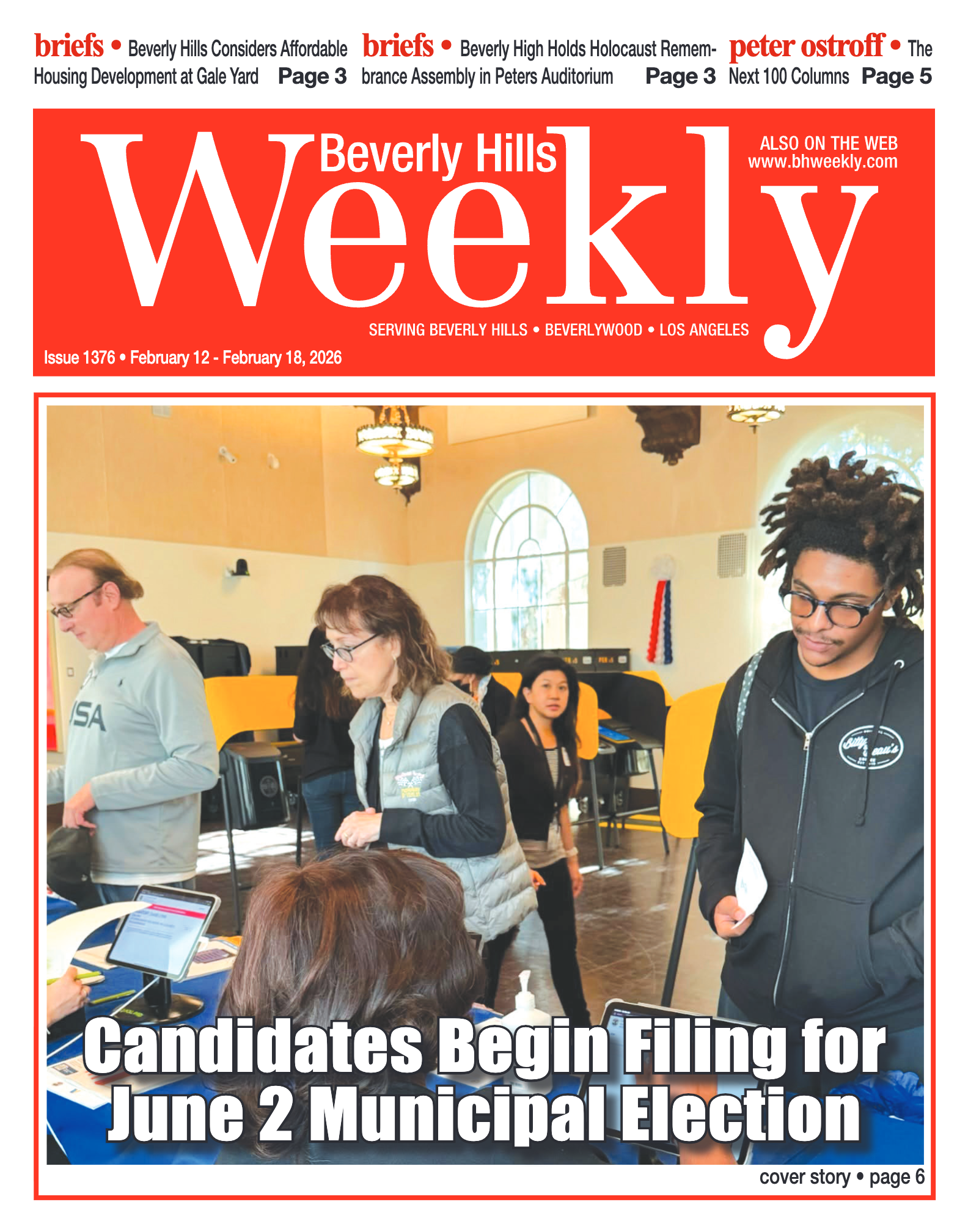
This column in the January 29 issue was my 100th column.
So now that requires that I give some attention to what the next 100 (good Lord willin’ and the creek don’t rise) will address.
My most important guiding principle is to inform and provide thoughts about issues that I think will be of value or assistance to the Beverly Hills bubble that we all, more or less, enjoy.
This is an election year so the selection of members of the City Council and Board of Education will be top of mind. In addition, we will select a new state Senator as our Senator Ben Allen from the 24th District has termed out. Also there will be a mayoral election in our neighboring City of Los Angeles.
I may weigh in on all of these likely by commenting on the qualities that we should be looking for rather than provide endorsements. On that score, the City Council and Board of Education are quite different. I can summarize the difference.
The City Council has been operating well in a responsible way that deserves our respect. The issue that I have with the City Council is that there is often a lack of follow up and little, if any, accountability. Lack of follow up and accountability is inherent in the committee form of government. I plan to address specific areas where this has been a real problem.
We will soon have a new Mayor, Craig Corman, and a new City Manager, Ryan Gohlich. I will try to convince both that some priority should be given to improving accountability.
At present, there are three announced candidates, Lester Friedman, Andy Licht and Sharona Nazarian in addition to John Mirisch whose eligibility will be determined by a court in a few days.
I am informed that there are several others who are likely to run. So, it is prudent to refrain from firm commitments to candidates until the entire field is set.
The Board of Education is far more problematic. The obvious shortcomings of some of the members in terms of their experience, qualifications and temperaments are an issue. Further, they have allowed themselves to be distracted from their only job, attempting to improve academics, and have let personal differences to lead them to dysfunction. I am hopeful that we will see a group of candidates who will appeal to residents who will say “We Have Had Enough” and change the composition and direction of the Board.
On that score, it is important to emphasize that there is a distinction between the toxic behavior of some of the Board members and the many good things that are happening at the schools. In my next column, I plan to discuss some of those good things such as the beautiful new performing arts facilities and the academic pathways.
On Christmas Day, very early in the morning, there was a fire that destroyed three long time Beverly Hills businesses on Canon Drive, the Umberto salon that has been a City icon for more than 40 years, the popular Porta Via restaurant, and Tesoro, the “Best Gift Store Ever.”
The questions that I will try to address are: 1) How did this happen two blocks from the headquarters of what many consider the best fire department in the world? and 2) what can we do to make certain that this does not happen to anyone else in the Bubble?
Of course, land use and development will continue to be an important concern.
During the year we will have much more visibility into whether the Builder’s Remedy or other outsized projects will actually be developed. I have expressed my view that few, if any, will actually go forward but, by the end of 2026, we will have a much better idea.
Of greater immediate concern to me is whether the “Saks Project” will actually go forward or be materially delayed or ended given the challenges that are presented by the bankruptcy of the retail stores that could be central to this development. Some project or projects on the key retail areas on the South side of Wilshire will be very important to the commercial centers of our city. We shall be keeping our eyes on that. The efforts to develop the Kate Mantillini/Gibraltar Savings site on Wilshire and Doheny seem to be coming back to life and that could be important.
On a longer term, we are now nearing the end of the current RHNA cycle and a new Housing Element will be required for the period starting in 2029. There is no – ZERO - chance that building permits will be issued sufficient to construct the 3104 housing units projected for the current cycle that ends in 2028.
The Community Development Department, the Planning Commission and the City Council should attempt to understand the consequences of whatever shortfall may exist and what will be required going forward. Notably, the principal strategy of our state government has been to impose on all local governments to bear the burden of the housing shortage and to try to grease the skids to entitlement approval by eliminating local rules. Any way you slice it, this strategy and its feckless execution has been a failure. It will be interesting to see what comes next and try to be prepared. This will not be easy.
Probably the most impactful developments in 2026 will be the opening of the La Cienega station and the continued construction of the Beverly Drive station. Although the much delayed opening of the La Cienega station may not happen in the first quarter of 2026, it is likely that it will open sometime in 2026. (I won’t hazard a guess about the opening of the Beverly Drive station.)
And the question is whether we are ready for it. From a security standpoint, my strong sense is that we will be ready.
Certainly the BHPD and their support system will be ready. We cannot and should not depend on Metro for anything other than to ensure that only fare paying passengers can exit the La Cienega station. It does not appear that we will be ready to entice Beverly Hills residents to use the subway. There will be little to no parking proximate to the station and there is no system to transport us from our homes to the subway and back again. A proposed “microtransit” project remains under discussion.
We have a number of trips planned for 2026 after I recover from Australia jet lag.
These include Sri Lanka, Slovenia, Alaska, Mongolia and Slovakia. I may report on some of those as well as on our San Francisco visits (where we have a contentious HOA Board election coming up).
***
So, wish me luck as I endeavor to survive and conjure up the next 100 columns and give me your suggestions of topics to cover.
People Mentioned
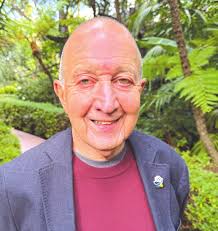
Peter Ostroff is a long-time Beverly Hills resident of over 50 years who retired in 2017 after a 50-year career as a trial lawyer. He was born in Washington, D.C. in 1942. He graduated from Washington University (St. Louis, Mo) in 1964 with a B.A. degree in political science and economics. He graduated from the University of Chicago Law School in 1967 with a J.D. degree. He taught law at Monash University Law School in Melbourne, Australia in 1968. He became a member of the Illinois Bar in 1967 and the California Bar in 1969, He clerked for Hon. Shirley M. Hufstedler of the United States Court of Appeal 1969-70, practiced law with Nossaman, Waters, Scott, Krueger & Riordan and successor firms from 1970 to 1980 and with Sidley Austin from 1980 until 2017. During his full time law practice years he was a Committee Chair and Member of the Council of the American Bar Association, Litigation Section and was President of the Association of Business Trial Lawyers. Since 2018, he has served on the Beverly Hills Planning Commission. In addition to his work on the Commission, Peter has chaired the BHUSD 7-11 Surplus Property Committee and contributed to planning efforts for the District Offices site on S. Lasky Drive and future uses of the Hawthorne School property. He also served as Co-Chair of the Citizens Advisory Committee for the City's Climate Adaptation and Action Plan. He has been married to Anne Y. Ostroff since 2002, has two children, Nick Ostroff and Natalie Anne Cookson and has two grandchildren, Elliott Cookson and Emma Anne Cookson. Some family information is collected under Family Tree in this website. Since April 2024, he has written a weekly column for the Beverly Hills Weekly The columns are collected in this website.
petero@ostroff.laMore from the Archive
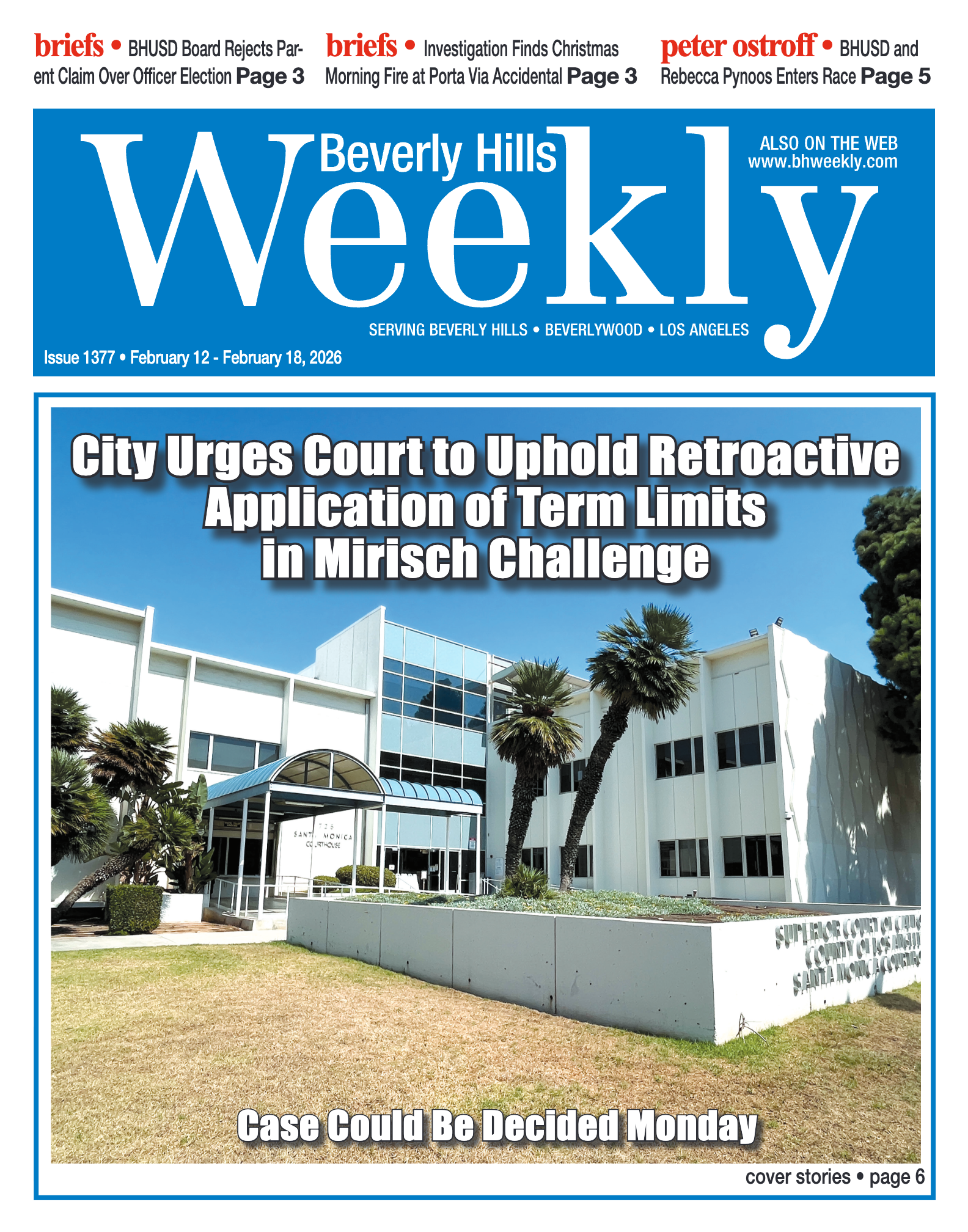
BHUSD and Rebecca Pynoos Enters Race
Beverly Hills Unified School District (BHUSD) has made significant upgrades to its facilities, including the newly renovated Salter Family Theater and K.L. Peters Auditorium, which will enhance student productions and assemblies, alongside the introduction of a diverse curriculum through the Academic Pathways program aimed at exposing students to various fields. Additionally, Rebecca Pynoos has announced her candidacy for the Beverly Hills City Council, emphasizing her commitment to public safety, support for local businesses, and a transparent approach to leadership amidst the city's evolving challenges.
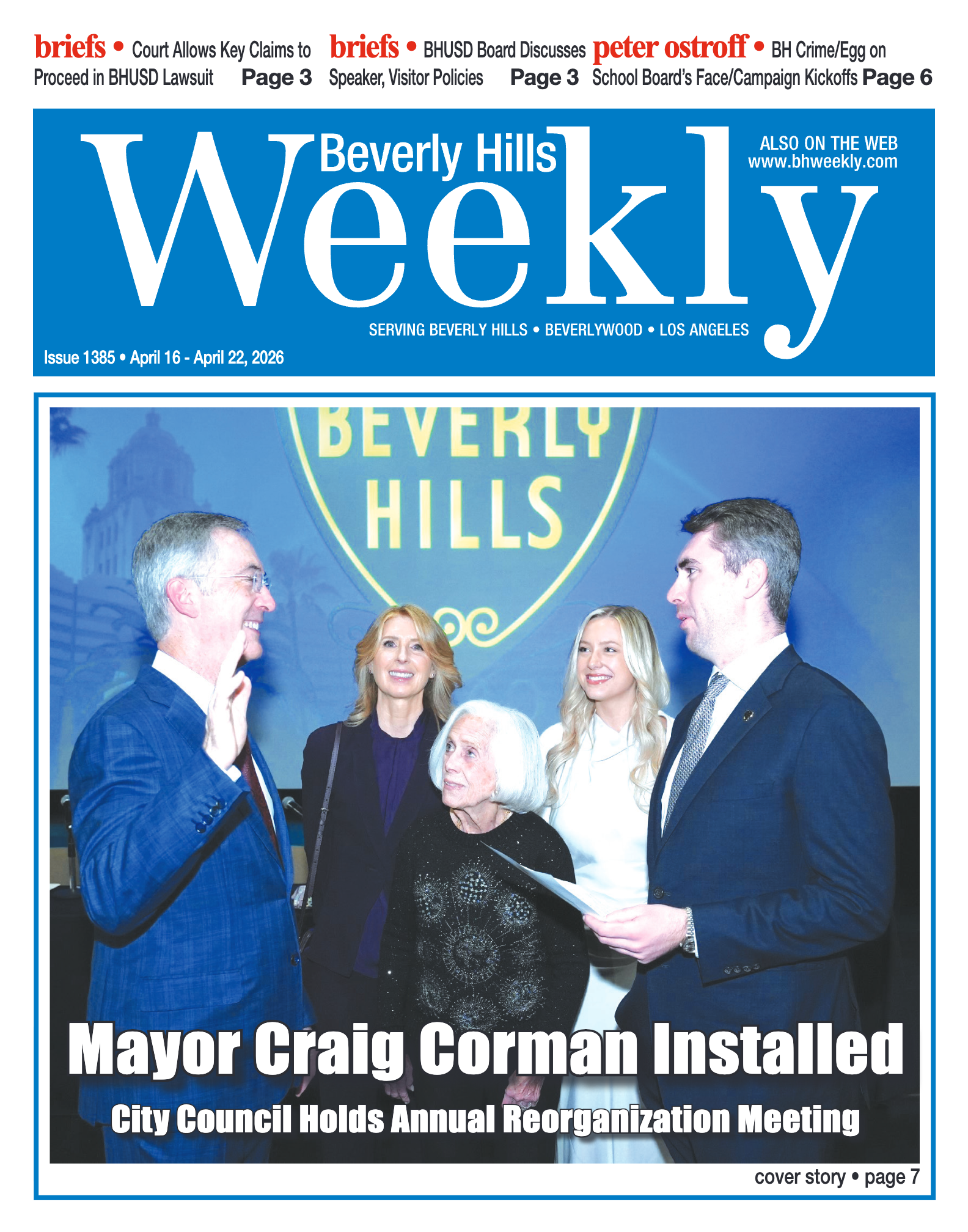
BH Crime / Egg on School Board's Face / Campaign Kickoffs
The article covers the campaign kickoffs for four City Council candidates, highlighting their different atmospheres and community support, particularly noting Sharona Nazarian's enthusiastic event. Additionally, it discusses ongoing legal issues within the Board of Education regarding a disputed Vice Presidency and refutes fear-mongering claims about public safety, emphasizing the success of the Beverly Hills Police Department in reducing crime rates.
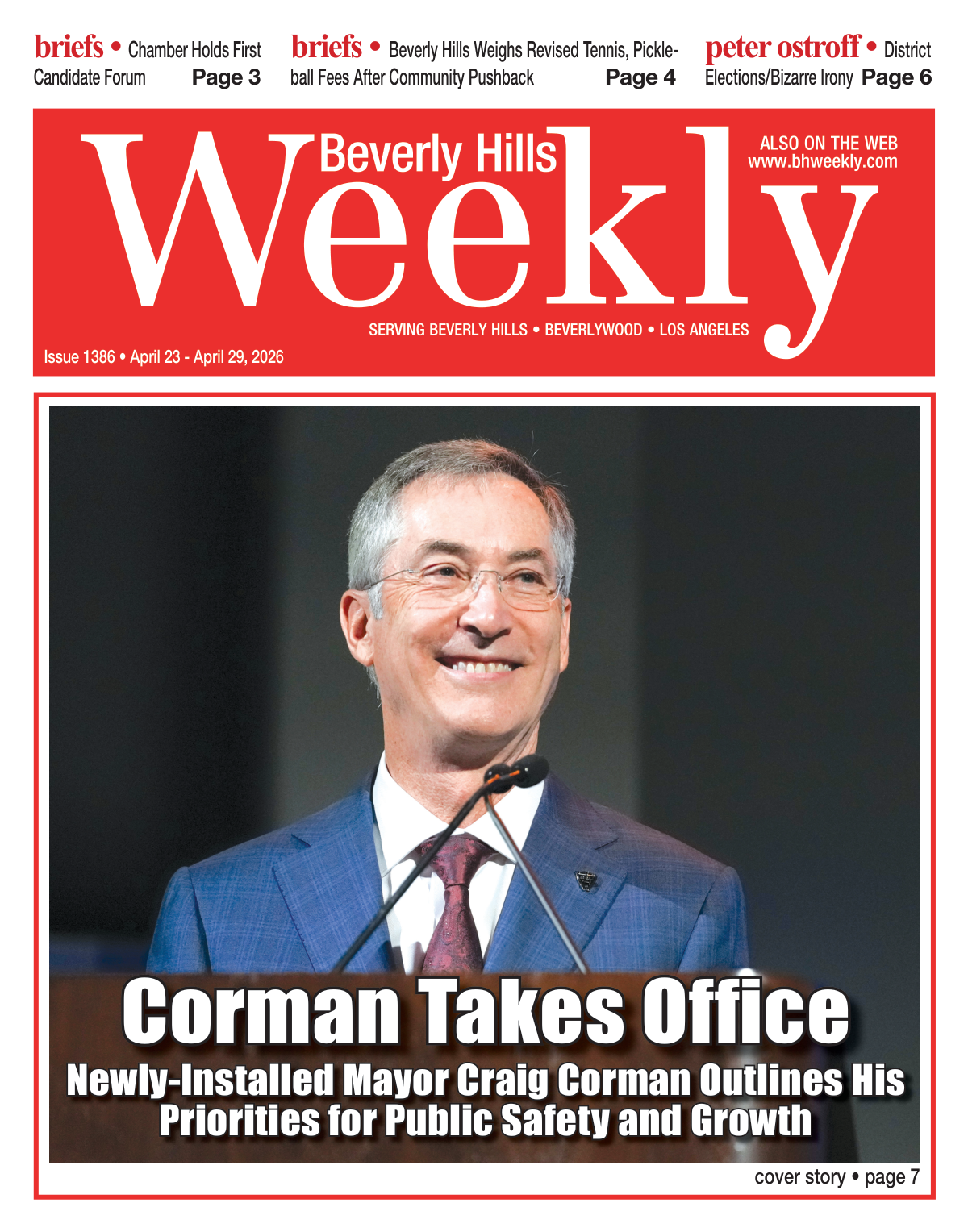
District Elections/Bizarre Irony
There is growing interest among residents in Beverly Hills, particularly in the South, to shift from at-large City Council elections to district-based elections, as many feel their area has been overlooked by current representatives. The article outlines the legal processes available for such a change, while also discussing the implications of district elections and the ongoing debate about their necessity and potential impact on governance.