Peter Ostroff
A Voice for Beverly Hills — Past, Present, and Future
Willie Mays and Anouk Aimée — In Memoriam
In 2024, the world lost two legendary figures, Anouk Aimée and Willie Mays, who profoundly influenced the realms of romantic cinema and baseball, respectively. Both icons, who passed away on June 18, 2024, embodied hope and grace, leaving behind a legacy that enriched their art and inspired generations.

Willie Mays and Anouk Aimée — In Memoriam
In 2024, we have lost many outstanding people including people who starred in two forms of entertainment most important to me, baseball and chick-flicks/romantic movies.
Great people lost from the world of baseball include Pete Rose and Fernando Valenzuela. Great losses from the film world include Mitzi Gaynor and Maggie Smith.
Two icons from each world who were my personal favorites of mine passed away on the same day: Anouk Aimee, a great embodiment of glamor and romance and Willie Mays, the oldest living MLB Hall of Famer and the embodiment of baseball excitement.
Anouk Aimee was born on April 17, 1932 in Paris, France. Willie Mays was born less than a year earlier on May 6, 1931 in Westfield, Alabama (a world away from Paris). Both achieved great fame on the world stage. Both died on the same day, June 18, 2024. She was 92 and he was 93. Both were forever young and it is hard to imagine the world without them.
Both came on to the world stage in the 1950s. Both had a great impact on their worlds.
You may know that Anouk Aimee was the star of one of the greatest movies ever, “A Man and a Woman”. But there is much much more to her story.
She was named Nicole Francoise Florence Dreyfus when she was born. Her father was Jewish, her mother Catholic. She was raised Catholic. During the war, because of her Jewish father, she was taken to live outside of Paris. Much later, she converted to Judaism. There is some speculation that Aimee was related to French army Captain Alfred Dreyfus. His court martial in the late 19th Century was thought to be the result of anti-semitism in the French military.
In 1947, after the war and liberation of France, a then famous French director, Henri Cadet, saw young Ms. Dreyfus walking in Paris with her parents. He asked whether they would consent to her appearing in a movie that he was directing. They consented and she appeared in a movie called “La Maison Sur La Mer” (The House Under the Sea.) She played a character named “Anouk” and took that as her first name. She then later took “Aimee” (“beloved”) as her surname.
The name “Anouk Aimee” was as exotic as it was memorable and it was her. My introduction was to her very romantic 1966 movie “A Man and A Woman”. Jean Louis Trintignant was the Man and Anouk was, of course, the Woman. It was filmed in black & white with color only for flashbacks. There was little dialogue and was mostly filmed through windshield wipers in the rain with the characters riding together and alone in a classic Ford Mustang. The sound track was mostly samba music. Who can forget the melodic “Da Da Da DaDa DaDa Da Da Da Da DaDaDaDa Da”?
For me, there has never been a more evocative movie. Ms. Aimee was nominated for the Academy Award for Best Actress in 1967. The award was won by Elizabeth Taylor for “Who’s Afraid of Virginia Wolff.” That was a depressing movie but an emotional one. Interestingly, Ms. Taylor was born on February 27, 1932, about six weeks before the birth of Ms. Aimee.
Ms. Aimee made two more movies with co-star Jean-Louis Trintignant (distinguished in my mind only by the facts that his name is impossible to spell and that he and Anouk had remarkable chemistry), “A Man and a Woman Twenty Years Later” in 1986 and “The Best Years of a Life” shortly before Trintignant died in 2019. “Twenty Years Later” wasn’t very good and “The Best Years of a Life” was never released in the US. It is very difficult to catch lightning in a bottle twice.
But there was much more to Ms. Aimee’s career. She made more than 80 movies including classics such as “8 ½” and “La Dolce Vita.” She appeared in films directed by the best including Robert Altman, Bernardo Bertolucci, Marcello Mastroianni and Federico Fellini as well as Claude Lelouch who directed “A Man and a Woman.” She was always alluring, enigmatic, photogenic and spell-binding.
Willie Mays captured my attention when I was only 8 or 9 and from then on, in my mind, personified what a baseball player should be. He was the “Say Hey” kid. There has been lots of debate about where that nickname came from and what it meant. I always took it to mean that he was a very happy guy who never met a person he didn’t greet warmly and enthusiastically.
While Jackie Robinson (number 42) was the first Black man to play major league baseball, Willie Mays (interestingly, number 24) is the one who integrated MLB. When Mays first joined the NY Giants in 1951 (after hitting nearly .500 with AAA Minneapolis), only five of the 16 major league teams (in pre-expansion, MLB, there were only 16 teams, eight each in the American and National Leagues), had Black ballplayers. Mays was simply too full of joy, not to mention talent, and too appealing to hate. And the barriers crumbled. Within a few years all the major league clubs had Black players. The Boston Red Sox were the last to integrate, bringing up Pumpsie Green, also from Minneapolis in 1959.
Mays captured worldwide attention with his over the shoulder catch of Cleveland Indians Vic Wertz’s drive to the deepest part of the Polo Grounds in the 1954 World Series. The Polo Grounds were the home field of the NY Giants and the distance from home plate to straight away centerfield was an astonishing 484 feet. Of today’s MLB stadiums, Coors Field in Denver has the deepest centerfield at 415 feet and that is at high altitude where baseballs travel much farther than they do at sea level. Most stadiums have far shorter dimensions. All baseball fans remember “the Catch” and likely millions claim to have witnessed it in person.
Mays could do everything – run, catch, throw, hit and hit for power. His first MLB manager, Leo Durocher, said, “If he could cook, I’d marry him.”
In their latter years, both transcended the careers that initially made them famous. Willie Mays was an ambassador for the game of baseball. Anouk Aimee, who had played a holocaust survivor in a movie called “The Little Meadow of Birch Trees”, was seen as an icon of world peace and reconciliation.
In 2024, we lost both icons.
⸻
WILDFIRE POSTSCRIPT:
Our Westside community and other communities in Southern California have endured and continue to endure horrendous conditions during the past week. While Beverly Hills has not been directly impacted so far our hearts and support go out to our family and friends and neighbors who have lost their homes and histories and neighborhoods and so much more.
As bad as things have been, they would have been far worse without the astonishing bravery of our first responders or the preparations of our civic leaders. This is not the time for recriminations or premature decisions about rebuilding the neighborhoods and communities that have been lost. That is for the future. For now our attention and support should be directed to those brave first responders and other leaders who are protecting us.
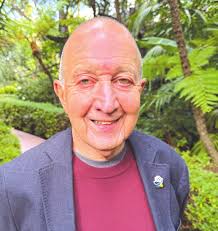
Peter Ostroff is a long-time Beverly Hills resident of over 50 years who retired in 2017 after a 50-year career as a trial lawyer. He was born in Washington, D.C. in 1942. He graduated from Washington University (St. Louis, Mo) in 1964 with a B.A. degree in political science and economics. He graduated from the University of Chicago Law School in 1967 with a J.D. degree. He taught law at Monash University Law School in Melbourne, Australia in 1968. He became a member of the Illinois Bar in 1967 and the California Bar in 1969, He clerked for Hon. Shirley M. Hufstedler of the United States Court of Appeal 1969-70, practiced law with Nossaman, Waters, Scott, Krueger & Riordan and successor firms from 1970 to 1980 and with Sidley Austin from 1980 until 2017. During his full time law practice years he was a Committee Chair and Member of the Council of the American Bar Association, Litigation Section and was President of the Association of Business Trial Lawyers. Since 2018, he has served on the Beverly Hills Planning Commission. In addition to his work on the Commission, Peter has chaired the BHUSD 7-11 Surplus Property Committee and contributed to planning efforts for the District Offices site on S. Lasky Drive and future uses of the Hawthorne School property. He also served as Co-Chair of the Citizens Advisory Committee for the City's Climate Adaptation and Action Plan. He has been married to Anne Y. Ostroff since 2002, has two children, Nick Ostroff and Natalie Anne Cookson and has two grandchildren, Elliott Cookson and Emma Anne Cookson. Some family information is collected under Family Tree in this website. Since April 2024, he has written a weekly column for the Beverly Hills Weekly The columns are collected in this website.
petero@ostroff.la