Peter Ostroff
A Voice for Beverly Hills — Past, Present, and Future
Undocumented Residents – An Over Reaction to a Manufactured "Crisis"
In his article, Peter Ostroff argues that the current immigration crisis is largely a manufactured issue, fueled by inflammatory rhetoric from political figures like Donald Trump, which has led to aggressive enforcement actions against undocumented residents that are often disproportionate and harmful. He advocates for a more humane approach, suggesting that offering amnesty to long-term, law-abiding undocumented individuals, coupled with better border security, could be a more effective solution than the current punitive measures.

Undocumented Residents – An Over Reaction to a Manufactured “Crisis”
By Peter Ostroff
I have been reluctant to write about the issue of what, if anything, should be done about the presence of undocumented persons in our City, state and country because of the policy and political complexity. However, as sweeps by often masked federal agents have wreaked havoc throughout southern California and elsewhere, I concluded that it would be irresponsible to remain silent.
But what should I say?
Resort to two rules that have often helped did not.
Consider: “When in doubt, do the right thing?” But just what is the “right thing?” OR “When in doubt, read the rules?” But what if the rules are stupid?
But the more I thought about it, some conclusions emerged.
So, let’s start with the relatively recent event that was the genesis of the current turmoil.
When Donald Trump first announced his candidacy for President on June 16, 2015, at Trump Tower, he said: “When Mexico sends its people, they’re not sending their best. … They’re bringing drugs. They’re bringing crime. They’re rapists. And some, I assume, are good people.”
This statement was as preposterous as it was inflammatory for two reasons. First, Mexico never “sent” anyone. The reason that so many people, from Mexico, Central America, South America and elsewhere, have come to the U.S. over the decades is because they perceive that opportunities here are better than in their home countries. And these opportunities justify the risk and disruption in their lives to come here in violation of our “rules.”
Second, there is no indication that these immigrants are less law abiding than our citizens.
Rather, the laws of demand and supply are at work. It is the perception of opportunities that creates a supply of immigrants. And the appetite for lower cost workers, in factories, farms and in our households and backyards creates an insatiable demand. This has long been the case and it remains the case today. And, to be fair, it has worked pretty well.
But Trump’s inflammatory rhetoric resonated with a segment of voters so he stuck with it, preposterous as it is.
A few weeks later, in August 2015, Trump released a six-page memo titled “Immigration Reform That Will Make America Great Again” that outlined a six point plan:
1) End birthright citizenship
2) Use of a deportation force for mass deportation
3) Triple ICE and border patrol staffing
4) Mandatory detention at the border
5) Build the border wall
6) Enhance enforcement tools such as national e-verify for employers; seize remittances by undocumented workers
I do not intend to suggest that there are no immigration issues that we should address. I do believe that, as a crisis, immigration is a manufactured one.
Certainly it is not a recent one. Numbers from Pew Research and the Department of Homeland Security show a steady growth in the number of undocumented residents from approximately 8.4M in 2000 to a peak of approximately 12 million in 2007. Then the numbers reduced to approximately 10.5 million to 11 million and have remained at that level from 2008 to the present. During that time, the population of the US has grown by more than 32 million or nearly 11%.
Trump’s exaggerations that suggest that folks are suddenly flooding our borders are simply not true and certainly do not warrant the current level of supposed remedial action.
By way of example, we also have a problem with traffic fatalities caused by speeding or drunk driving. In the US, there are approximately 25,000 fatalities every year caused by speeding or drunk driving. Texas, which is the only state that tracks crimes by immigration status, in 2022 had 67 homicides committed by undocumented residents as compared with over 2600 deaths due to speeding or drunk driving.
Now the number of fatalities caused by speeding and drunk driving may be a real crisis. But it is not as politically attractive as contriving the notion that “other” people are somehow taking advantage of “real” Americans and the absurd promise that eliminating them will somehow make America great again.
Proportionality and common sense seem in short supply.
The sweeps that are occurring in lower income areas heavily populated by people from Latin America or Asia seem gratuitously cruel. I heard third hand that federal agents recently showed up at Holmby Park, arrested some nannies, subjected toddlers to their tender mercies and called the parents to pick up their children.
In June, immigration enforcement teams arrested more than 1,500 immigrants for deportation in Los Angeles and surrounding regions of Southern California. Arrests have involved controversial sweeps, roving patrols and chases. It appears that the majority of those arrested have no criminal convictions.
Many commercial areas have been severely harmed because some minorities are afraid to leave their homes.
While arresting law-abiding long term residents who may be undocumented seems consistent with the sentiments of those who voted for the current administration, this is a good example of “be careful what you wish for.” Promises to accomplish mass deportations are part of what got Trump elected. Now we must live with what it takes to fulfill those promises.
One alternative that offers some appeal to our more humane instincts is to offer amnesty to undocumented persons who have been in the U.S. for some number of years, and who have been law-abiding and gainfully employed. This would be coupled with greater border security. This approach was attempted during the administration of President Ronald Reagan. The Simpson–Mazzoli Act, officially the Immigration Reform and Control Act of 1986 (IRCA), was landmark legislation signed by President Reagan on November 6. It afforded amnesty for undocumented persons who had been in the US for a few years. Nearly 3 million people were granted permanent residency status. But, contrary to expectations, the number of people entering our country without permission increased rather than decreased over the following years. This may have been due to a belief that if the US would offer amnesty once, it may do it again in a few years.
At least arguably, a more humane approach, for better or for worse, increases the supply of undocumented residents.
Turning to the demand side, there are severe federal and state, civil and criminal penalties for those who employ undocumented persons. However, civil prosecutions of employers are rare and criminal prosecutions are even more rare. In California, for example, there have been none in the past five years.
And then there is the bizarre dynamic in which local law enforcement is pitted against federal officers. Local law enforcement generally does not inquire into immigration status for the understandable reason that fear of deportation will inhibit cooperation by witnesses to criminal activity or inhibit undocumented folks from seeking healthcare or other assistance. Thus, a local police force will keep at arm’s length or even impede the efforts of ICE or others attempting to enforce immigration laws.
The current efforts by the Trump administration, the hyper-aggressive attack on our undocumented neighbors, may have some success in the short run of deterring people from trying to cross our borders without permission. There have been historic low numbers of apprehensions at our southern border.
Certainly, we need a robust asylum court infrastructure and a humane detention center where asylum seekers can be held until their case is resolved.
But it is not unfair to wonder, what will be the next contrived crisis and what actions will be taken to address it with the ICE army.
Given the massive increase in funding for ICE and other deportation and border officers in Trump’s Big Beautiful grab bag of pork and punishment, and, “I assume, some good things”, the current turmoil and disruption of the lives of millions of our neighbors will continue.
For many reasons, the immigration and border security conditions of our country present unique challenges.
We cannot address those challenges without an objective analysis of just what the problem is. Contrary to the hysteria whipped up by Trump for political reasons, it is my sense that there is no crisis. The status quo was not perfect but pretty good for the undocumented, the employers they serve and the country as a whole. The need for the creation of an army of storm troopers escapes me. The dangers of creation of this private army are real and apparent.
One meaning of that insightful phrase is that if one cannot express a thought or idea or argument in writing, it is likely not a good thought or idea or argument. Another meaning is that the act of putting thoughts down in writing is itself often the best way to reach a coherent conclusion.
The expression of my thoughts above about the issues surrounding our undocumented neighbors is a good example of the latter. I started to write about the subject only because I thought that it was important, not because I knew where the process would lead me. The conclusion – that we are enduring a grotesque over-reaction to a false crisis – became clear to me only as I went through the process of reducing my random thoughts into a somewhat coherent expression. You can be the judge of whether I have succeeded.

Peter Ostroff is a long-time Beverly Hills resident of over 50 years who retired in 2017 after a 50-year career as a trial lawyer. He was born in Washington, D.C. in 1942. He graduated from Washington University (St. Louis, Mo) in 1964 with a B.A. degree in political science and economics. He graduated from the University of Chicago Law School in 1967 with a J.D. degree. He taught law at Monash University Law School in Melbourne, Australia in 1968. He became a member of the Illinois Bar in 1967 and the California Bar in 1969, He clerked for Hon. Shirley M. Hufstedler of the United States Court of Appeal 1969-70, practiced law with Nossaman, Waters, Scott, Krueger & Riordan and successor firms from 1970 to 1980 and with Sidley Austin from 1980 until 2017. During his full time law practice years he was a Committee Chair and Member of the Council of the American Bar Association, Litigation Section and was President of the Association of Business Trial Lawyers. Since 2018, he has served on the Beverly Hills Planning Commission. In addition to his work on the Commission, Peter has chaired the BHUSD 7-11 Surplus Property Committee and contributed to planning efforts for the District Offices site on S. Lasky Drive and future uses of the Hawthorne School property. He also served as Co-Chair of the Citizens Advisory Committee for the City's Climate Adaptation and Action Plan. He has been married to Anne Y. Ostroff since 2002, has two children, Nick Ostroff and Natalie Anne Cookson and has two grandchildren, Elliott Cookson and Emma Anne Cookson. Some family information is collected under Family Tree in this website. Since April 2024, he has written a weekly column for the Beverly Hills Weekly The columns are collected in this website.
petero@ostroff.laMore from the Archive

Inside the Conference & Visitors Bureau
The Beverly Hills Conference & Visitors Bureau (CVB) is the city's official organization for promoting tourism and enhancing economic vitality by attracting visitors to local hotels, restaurants, and attractions, primarily funded by hotel occupancy taxes. Under the leadership of CEO Julie Wagner and a board of directors from major local hotels, the CVB aims to boost visitor numbers, which have declined significantly since pre-COVID times, while also preparing for upcoming major sporting events in the Los Angeles region.
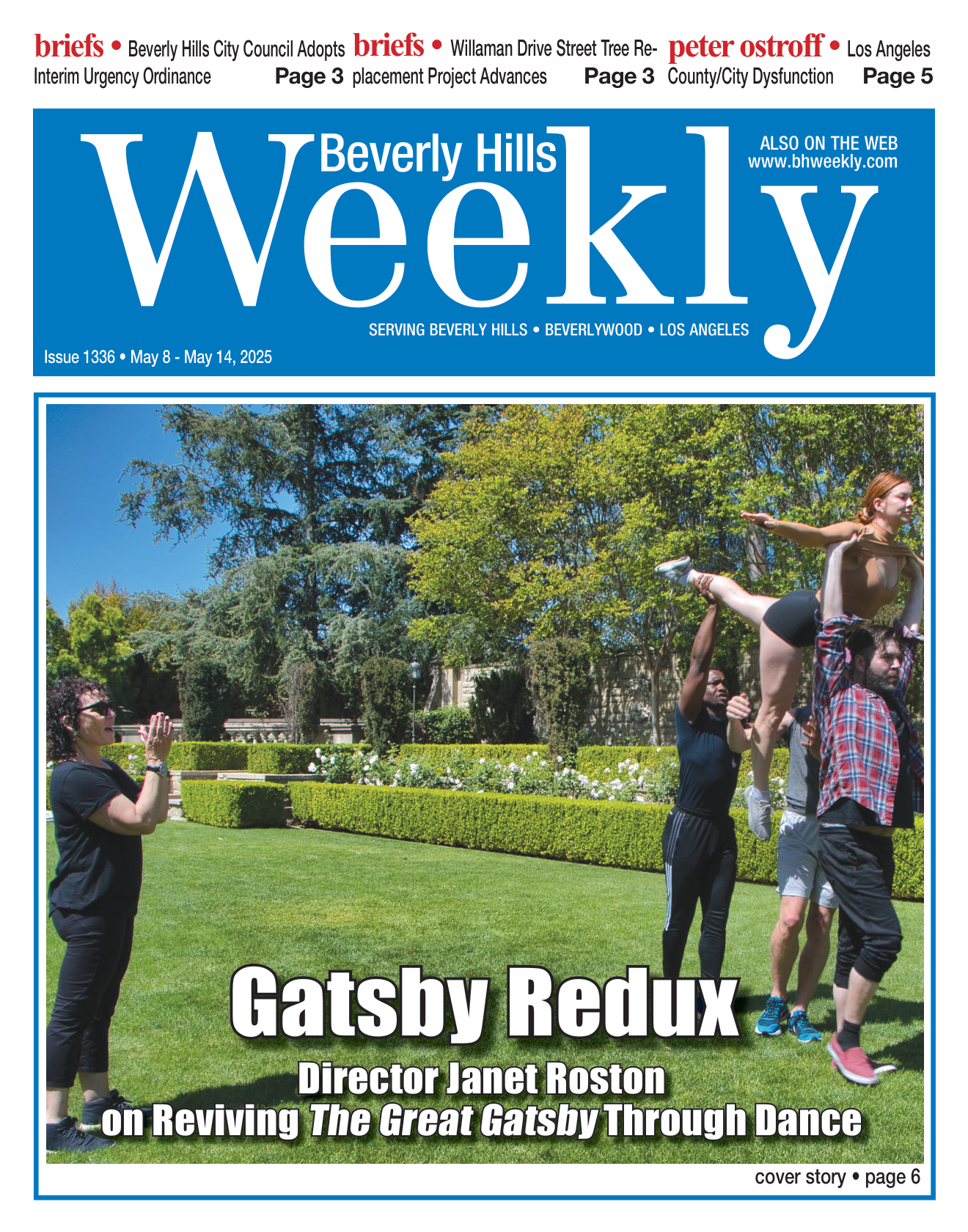
Los Angeles County/City Dysfunction
The article critiques the dysfunction between Los Angeles City and County officials, particularly highlighting their failure to effectively address homelessness and the aftermath of recent fires. It emphasizes the lack of accountability and transparency in the Los Angeles Homeless Services Authority, the resignation of its CEO amid controversy, and the chaotic recovery efforts following the Palisades fires, all exacerbated by personal conflicts among elected leaders.

Writers Bloc and Study Sessions
Andrea Grossman, a long-time Beverly Hills resident, has significantly enriched the local cultural scene through her non-profit Writers Bloc, which hosts literary events featuring prominent authors and public figures. Meanwhile, the Beverly Hills City Council is debating procedural changes for their afternoon Study Sessions, with discussions focusing on the appropriateness of taking action during these meetings, while the Board of Education has opted to select a former principal as Superintendent without a comprehensive search process.