Peter Ostroff
A Voice for Beverly Hills — Past, Present, and Future
School District Shame/Letter from Oz
The article recounts a trip to Australia by the author and his son, highlighting their experiences at various sporting events and reflecting on issues such as antisemitism and housing affordability in both Australia and the U.S. It also discusses a legal challenge by Daniel Lifschitz against the Beverly Hills School Board for alleged violations of bylaws, emphasizing the need for accountability and transparency in local governance.
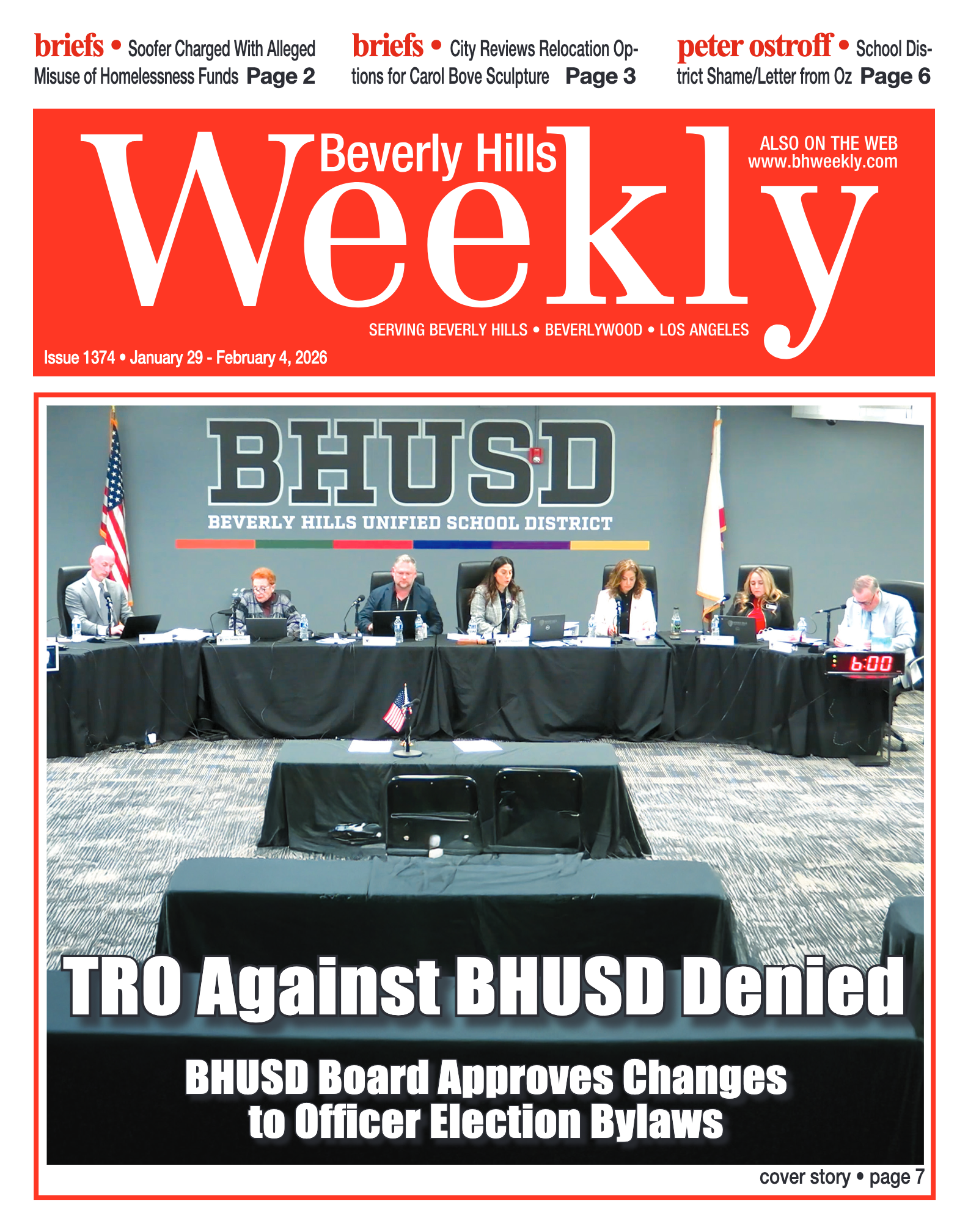
From January 4 to 19, my son Nick Ostroff and I visited Sydney and Melbourne, Australia (Oz). Melbourne was the scene of my numerous misadventures in 1968 when I taught tort and contract law at Monash University (still the only university named for a Jewish General of the Australian armed forces). In case you were wondering, both Sydney and Melbourne were named for British politicians.
This was a bit of a sports trip to watch the England v. Australia Cricket Test
Match (news flash — Australia retained the Ashes trophy), the Australia Sports
Hall of Fame at the Melbourne Cricket
Ground and the Australian Open Tennis tournament.
I have a number of impressions based on this visit and other visits over the last 50+ years.
But before I get to that, I want to tell you about Daniel Lifschitz, a BHUSD concerned parent and talented young lawyer at the Century City firm of Gipson, Hoffman & Pancione.
Mr. Lifschitz, like many others in the community, has been increasingly appalled by the behavior of a majority of the members of the Board of Education since the election of two new members.
When he observed the recent election of officers that disregarded express ByLaws of the District and any norms of decency and proposals by the Board to try to paper over their unlawful conduct, he decided to take action.
Specifically, earlier this week he went into Superior Court seeking immediate injunctive relief that would, among other things, preclude after the fact amendment of by laws and require compliance with the rules in effect at the time of the organizational meeting and install Dr. Stern as
Vice President and President Elect. The lawsuit was filed under Mr. Lipschitz’s own name, not in the name of his law firm.
The Superior Court judge who heard the matter on Tuesday morning January 27, declined to issue an emergency order prohibiting the after the fact amendment.
The court did not rule on the merits of the application and did not address whether the Board had acted lawfully. Rather, the court found that a full hearing on the issue in the near future would be needed and that any action that the board might now take could be undone if the court was persuaded that the board’s actions were unlawful or otherwise inappropriate.
Astonishingly, the District’s offices, without any apparent effort to seek approval by the Board as a whole, issued a statement gloating that the court was: “thus reaffirming that the Board conducts its business lawfully, transparently, and in full compliance with applicable law.“
The court did no such thing and I am certain that the judge would be as astonished as I am that the District would make such a statement.
While members of the board may claim a victory of sorts, any victory lap would be decidedly premature. On the contrary, the proposed amendment to the bylaws itself is undeniably a clear admission by the majority that their election of Ms. Sabag violated the bylaws then in effect.
To make matters even worse, someone at the Board of Education, I can only speculate as to who it was, directed a district employee to send a copy of the totally false press release to every lawyer in the law firm that employs Mr. Lifschitz.
This causes me to wonder why the District would see fit to publish a false report and then, having done so, attempt to undermine the employment relationship of a young lawyer. Is this what we want our school district leaders to be doing? Does this vindictive conduct somehow improve District academics? I will leave it to you to reach your own conclusions and decide what can and should be done about it.
Mr. Lifschitz’s courage and willingness to invest substantial amounts of his time and energy should serve as an example for all of us who care about the direction of the School District.
***
Now, I shall turn to Australia, a country that shares many of the issues with the U.S. including a rise in anti-semitism, increasing attention to diversity and a love of sport.
Let’s start with anti-semitism. Australia has a Jewish population of only around 120,000 out of a total population of around 28 million or .4%; the U.S. has a Jewish population of around 7.5 million out of a population of around 350 million or between 2% and 3% of the total. The Jewish population of Australia is concentrated in Sydney and Melbourne. In those cities, there is increasing concern about anti-semitism.
This concern has accelerated after the attack that killed 15 people at a Chanukah celebration at Bondi Beach, Sydney. Notably, a prominent Australian said it’s not a gun problem, it’s an antisemitism problem. The brother of a non-Jewish policeman who was killed said: “why can’t it be two things at once? … an antisemite without a gun is just a hate filled person; an antisemite with a gun is a killer.” I believe this reasoning applies also to those gun advocates who argue: guns don’t kill people; people kill people. In all fairness, people with guns kill people.
***
On January 8, the Prime Minister of
Australia formed a Royal Commission on antisemitism to investigate the prevalence of antisemitism in Australia, help law enforcement tackle antisemitism, examine the circumstances surrounding the Bondi Beach terrorist attack that killed 15 and injured more than 100 persons and make recommendations that could strengthen social cohesion and counter the spread of extremism. A final report is due by the end of 2026. The Commission will be conducted by Virginia Bell, a retired Justice of the High Court of Australia (Australia’s highest court), who was the first openly gay person to serve on the court.
One could argue that the need for such an examination is even more acute in the
U.S. But this is far too much to expect from a government led by a Divider in Chief and his imitators who believe that cohesion is appropriate only to the extent it supports their views.
An Australian commentator, Michael Koziol, the North American correspondent for the Sydney Morning Herald, put it this way when reporting on the ICE agent killing of Renee Good in Minneapolis on January 7: “You would think serious responsible people would want an investigation before they jump to conclusions. But that is not a feature of today’s
America, where it is more important to prosecute the politics than nail the facts, and imperative to play the politics as hard as possible.”
***
In Melbourne, I had an experience that underscores the fact that print newspapers are dying everywhere. On my first morning I went to the hotel front desk and asked “Where can I get a copy of “The
Age” ( Melbourne’s world famous daily newspaper)?
Concierge: “What’s that?”
Me: “The Age daily newspaper.”
Concierge: “Let me check” as he went into a back office. He returned after a minute or two.
Concierge: “Try the 7-11 on the next block.”
I did, with success, but what a message about print media!
***
And even 8,000 miles away from Los Angeles, there is no escape from housing affordability issues. It seems that Australia, like California and other places perceived as desirable to live, has a housing affordability issue. In order to meet the National Housing Accord target of 377,000 new homes in the State of New South Wales (population nearly 9 million) of which Sydney (population nearly 6 million in the metro area) is the capital, the state government has enacted low rise and mid rise planning reforms that override local controls.
These reforms are not unfamiliar to those knowledgeable about California’s feckless and unsuccessful efforts to deal with housing unaffordability issues. For example, the state has mandated in residential neighborhoods of one and two story homes, within 800 meters (slightly more than ½ mile) of a transport hub or town center (typically a small shopping center or shopping street), residential buildings, and apartment buildings of up to six stories are now permitted. And a 20 to 30 % increase in floor space and building height is allowed as an “uplift” bonus if 10% of the gross floor area is dedicated to affordable housing for 15 years.
The reaction has been mixed. Many residents of the beautiful single family neighborhoods on the many bays along the magnificent Sydney harbor express outrage at the destruction of their way of life. However, in a harbinger of what could occur in the wake of SB79 and the like, homeowners of adjoining properties are combining their properties to capitalize on huge increases in the values of their land triggered by the rezoning changes.
Councilmember John Mirisch will not be surprised as he has often characterized such incentives as FSD- Free Stuff for Developers (except that Mr. Mirisch does not use the word “stuff.”)
***
All in all a great trip with Nick who, through it all, listened politely to most of my stories. I will discuss the sports aspects in a future column
***
An update on the Mirisch efforts to proceed with a re-election campaign.
In 2021, the City Council put an initiative on the ballot proposing a three term limit for members of the City Council and proposing that terms served and completed prior to the effective date of the initiative would count towards that three term limit. The state law that allows general law cities such as Beverly Hills to impose term limits specifically provides that term limit enactments be “prospective only.” Nonetheless, the City’s term limit enactment provides that terms served prior to the enactment count and the City has refused to accept nomination papers from Mr. Mirisch.
Now, Mr. Mirisch is challenging that refusal in a lawsuit brought by Eric George (BHHS Class of 1986). A hearing that should resolve the issue will likely be scheduled for the week of February 23.
People Mentioned

Peter Ostroff is a long-time Beverly Hills resident of over 50 years who retired in 2017 after a 50-year career as a trial lawyer. He was born in Washington, D.C. in 1942. He graduated from Washington University (St. Louis, Mo) in 1964 with a B.A. degree in political science and economics. He graduated from the University of Chicago Law School in 1967 with a J.D. degree. He taught law at Monash University Law School in Melbourne, Australia in 1968. He became a member of the Illinois Bar in 1967 and the California Bar in 1969, He clerked for Hon. Shirley M. Hufstedler of the United States Court of Appeal 1969-70, practiced law with Nossaman, Waters, Scott, Krueger & Riordan and successor firms from 1970 to 1980 and with Sidley Austin from 1980 until 2017. During his full time law practice years he was a Committee Chair and Member of the Council of the American Bar Association, Litigation Section and was President of the Association of Business Trial Lawyers. Since 2018, he has served on the Beverly Hills Planning Commission. In addition to his work on the Commission, Peter has chaired the BHUSD 7-11 Surplus Property Committee and contributed to planning efforts for the District Offices site on S. Lasky Drive and future uses of the Hawthorne School property. He also served as Co-Chair of the Citizens Advisory Committee for the City's Climate Adaptation and Action Plan. He has been married to Anne Y. Ostroff since 2002, has two children, Nick Ostroff and Natalie Anne Cookson and has two grandchildren, Elliott Cookson and Emma Anne Cookson. Some family information is collected under Family Tree in this website. Since April 2024, he has written a weekly column for the Beverly Hills Weekly The columns are collected in this website.
petero@ostroff.la