Peter Ostroff
A Voice for Beverly Hills — Past, Present, and Future
Pickleball
The Recreation and Parks Commission in Beverly Hills will discuss the future of the city's popular Pickleball Pilot Program, which has seen significant growth in participation, with the main focus being whether to make it permanent and expand its offerings. The article critiques the lengthy bureaucratic process hindering timely decisions, emphasizing the need for the Commission to take decisive action and provide clear recommendations to the City Council.

On August 27, the Recreation and Parks Commission will discuss the city’s Pickleball Pilot Program to address the basic questions of whether to make the Pickleball program permanent and, if so, under what terms and conditions. [Spoiler alert: Pickleball participation in our community has exploded; there can be no serious debate about whether to make it permanent and, if at all possible, expanded. The only legitimate question is why this process has taken so long.]
I must acknowledge that today our world is a perilous and fractious place. We are facing an existential election accompanied by a frightening increase in the level of political violence. People are doing unspeakable things to each other in places such as Bangladesh, Gaza, Haiti, Israel, Lebanon, Myanmar, Sudan, Ukraine, Western China and Venezuela. At times like these, it may seem frivolous to expend precious column space on a subject such as pickleball. However, it is important to many of our residents for good reason and we must tend to the home fires.
While the state of the sport is a matter of intense interest to our rapidly growing Pickleball community, for the few remaining uninitiated (which includes me), some background may be helpful. Here are some questions and answers intended to provide that background.
What on earth is “pickleball”? Pickleball is a racquet (sort of) sport played with a paddle and a wiffleball on a court ¼ the size of a tennis court.
When did pickleball get its start? While most of us have only recently heard of this game, it was actually invented in 1965 by a small group of friends who lived on Bainbridge Island outside of Seattle, Washington.
Is it an overnight sensation? Not really. By 1990, it was played in all 50 states.
Has its popularity grown quickly recently? For sure. In 2015 the United States Pickleball Association (I am not making this up, there is such a thing) claimed that there were 2M players; by 2023, USPA said there were nearly 9M players.
How did this “sport” get its name? This is somewhat disputed but the most widely accepted version is that it was named for the “pickleboat” which is the boat in the sport of rowing filled by the rowers who did not get selected for any other team. The alternative explanation is that it was named for a dog named “pickles” but that dog was not born until the sport had been played (and named) for several years.
Why is pickleball so popular? Well, it is easy to learn, easy to play (except for me), does not require any particular skills such as strength, speed, agility or anything else and does not require much movement on the part of the players relative to other racquet sports. Remember, the four doubles participants are playing on ¼ of a tennis court. Seriously, I do not mean to diminish the physical and mental benefits of pickleball. Some level of exercise is way better than none and the social engagement aspects are also a good thing. Notably it is an article of faith (and inscribed into the Official Rules of Pickleball – you cannot make this up) that all players must be nice to each other. [Does John McEnroe play pickleball? You can NOT be serious.]
Actually, my brother Daniel is making a movie about a man who voluntarily goes into prisons to teach pickleball to inmates; and the inmates have a unique opportunity to compete with wardens and guards. The premise is that through socialization from pickleball the inmates will become better citizens and more likely to succeed after their release. I am convinced that this premise is a sensible one.
So, what are the Beverly HIlls facilities that are dedicated to this pilot program? There are currently two: La Cienega Park and Roxbury Park in locations formerly occupied by tennis courts. At La Cienega, two tennis courts have been turned into eight pickleball courts leaving ten tennis courts; at Roxbury, one tennis court has been turned into four pickleball courts leaving three tennis courts.
Pursuant to the Joint Powers Agreement between the City of Beverly HIlls and the Beverly Hills Unified School District a pickleball location was to be provided by BHUSD on the upper field at BHHS by the end of the 2023-4 academic year for drop in usage on weekends. I am told that there will be two courts but I am uncertain of the status.
How many Beverly Hills pickleball players are there? No one knows. And no one knows how many Beverly Hills tennis players there are. In order to book a court to play tennis or pickleball, residents and non-residents must buy a membership card but these members are not identified as tennis or pickleball players. (One would think that this could easily be remedied and we would have better data.)
How are courts reserved? Beverly Hills residents are allowed to book courts earlier than non-residents and residents pay lower fees. I am told that it is immensely challenging even for residents to reserve courts at desirable times. Where are we now on the quest for permanence of this unquestionably successful program? It’s anyone’s guess. I have watched about six or seven meetings of the Recreation and Parks Commission that have addressed this since the post-Covid resumption of the Pilot Program in 2021.
To be candid, I felt like I was watching Ground Hog day over and over. Here is how it goes: Staff makes a status report that is substantively identical to the report at a preceding meeting. The Commissioners regularly express frustration about how long this is taking. Staff responds by describing a number of steps that must precede action (e.g. a meeting of an ad hoc committee of the Commission followed by a meeting of the full commission followed by a meeting with the Council Liaisons to the Commission [who likely last met during the Eisenhower administration], followed by more “community outreach”, followed by another Commission meeting and so on...). But these steps are not required by any rule and, even if they were, none seem to happen.
When I sat down to watch these meetings from the video archives, I was expecting at best to see bureaucracy in action. What I saw was bureaucracy inaction. For example, since a meeting in March, 2024, staff has described month after month a search for consultants who will draft a survey. Say what? It is possible that such a proposed survey will be presented on August 27.
[As an aside, the practice of giving undue and unquestioned deference to staff is not unique to the Recreation and Parks Commission.]
Who needs another survey? The issues are quite straightforward. Should the BH pickleball program become a permanent program? If so, where and under what terms and conditions? Should efforts be made to better accommodate the demand for court time by looking for space for more courts?
Sure, there are a number of sub-issues but acceptable resolutions can and should be achieved without endless hand-wringing.
Ultimately, resolutions to these questions must be adopted by the City Council. The Council can reach sensible solutions only if the Recreation and Parks Commission will remove the shadows to end Ground Hog Day and fulfill its role. That role as established by the Beverly Hills Municipal Code is to be the advisory body to the Council regarding the matters within its purview (including the Pickleball Program in the City Parks). [BHMC 10-2-2-10022]
These words “advisory body to the Council” are important. The Commission is not the advisory body to the staff of the Community Services Department. The Commission is not the advisory body to the City Manager. The Commission is the advisory body to the Council.
Over the numerous meetings during the past 2+ years, a number of Commissioners expressed the same frustration that I experienced in watching the meetings. Former chair Myra Lurie, and commissioners Amie Sherry and J.R. Dzubak, all of whom are conscientious and well meaning, were particularly outspoken. But they appeared to think that they could do nothing more than accede to staff’s direction.
I believe that they can and should do more. All that it takes is the confidence to make decisions without the “support” of unnecessary process, consultants and superficial public outreach and then taking action or making recommendations to those empowered to take action.
In short, to perform its role as the advisory body to the Council regarding this subject, the Commission should gather all relevant information, consider it, discuss it and reach a conclusion. This process should be controlled by the Commission and no one else.
The Commission’s conclusion should consider everything presented but not feel constrained to follow what are always flawed and incomplete plebiscites in the form of surveys or petitions or the loudest voices at Commission meetings. These rarely yield much useful guidance.
And there is nothing in the Ten Commandments or state law or the Municipal Code that requires that the multi-step process proposed by staff be followed.
Once the conclusion is reached, the Commission, NOT staff, should prepare a written resolution/report approved by a majority of Commissioners that provides the Commission’s recommendations to the City Council. Notably, there is something about sitting down and thinking and then putting thoughts into writing that brings problems and then solutions to the forefront where they can be described, resolved and expressed.
Of course, the Council will do whatever it concludes is in the best interests of the City. The Council will certainly have the benefit of advice from the Departments and the City Manager.
But the Commission’s responsibility is to provide its own best advice clearly and directly without having that advice filtered through staff or other go-between. Only then will the Council have what it needs to reach the best conclusion for all concerned.
***
Every once in a while I experience aspects of our extraordinary city that approach perfection. This happened only a few days ago.
I had been at City Hall, making mischief as always, and on my way to the parking structure, I stopped off at the spectacular Beverly Hills Library to return a few books.
I should disclose that I visit the Library two or three times a week, so these thoughts are not newly formed.
While there, I decided to pick up a book or two on a subject that interested me. I was directed to a reference librarian who immediately escorted me to a stack that had just what I was looking for. She could not have been more knowledgeable and accommodating.
After picking two books, I decided to stop in at the only bookstore in Beverly Hills, the one operated by the Friends of the Beverly Hills Library and actually in the Library. While I love Book Soup, the Friends bookstore’s prices are much more reasonable and the parking is better.
Here, I purchased two more books but had to pay for these – a total of $7. What could be better? (And Kelly’s hot chocolate – hold the whipped cream – isn’t bad either.)
Seriously…Free! What a library! What a city!
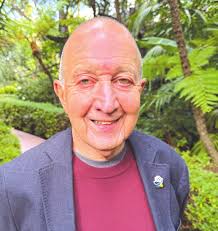
Peter Ostroff is a long-time Beverly Hills resident of over 50 years who retired in 2017 after a 50-year career as a trial lawyer. He was born in Washington, D.C. in 1942. He graduated from Washington University (St. Louis, Mo) in 1964 with a B.A. degree in political science and economics. He graduated from the University of Chicago Law School in 1967 with a J.D. degree. He taught law at Monash University Law School in Melbourne, Australia in 1968. He became a member of the Illinois Bar in 1967 and the California Bar in 1969, He clerked for Hon. Shirley M. Hufstedler of the United States Court of Appeal 1969-70, practiced law with Nossaman, Waters, Scott, Krueger & Riordan and successor firms from 1970 to 1980 and with Sidley Austin from 1980 until 2017. During his full time law practice years he was a Committee Chair and Member of the Council of the American Bar Association, Litigation Section and was President of the Association of Business Trial Lawyers. Since 2018, he has served on the Beverly Hills Planning Commission. In addition to his work on the Commission, Peter has chaired the BHUSD 7-11 Surplus Property Committee and contributed to planning efforts for the District Offices site on S. Lasky Drive and future uses of the Hawthorne School property. He also served as Co-Chair of the Citizens Advisory Committee for the City's Climate Adaptation and Action Plan. He has been married to Anne Y. Ostroff since 2002, has two children, Nick Ostroff and Natalie Anne Cookson and has two grandchildren, Elliott Cookson and Emma Anne Cookson. Some family information is collected under Family Tree in this website. Since April 2024, he has written a weekly column for the Beverly Hills Weekly The columns are collected in this website.
petero@ostroff.la