Peter Ostroff
A Voice for Beverly Hills — Past, Present, and Future
Metro Planning
Mayor Sharona Nazarian updated the community on public safety plans for the upcoming Wilshire/La Cienega Metro station, emphasizing security measures such as dedicated police presence and upgraded fare gates to deter fare evasion and enhance safety for residents. However, concerns remain about the feasibility of these security commitments and the timeline for a proposed Micro Transit system to facilitate transportation to the new stations, which may not be ready by their anticipated openings.
Metro Planning
On May 30, Mayor Sharona Nazarian sent a letter to the community providing updates on the City’s public safety plans for the opening of the Wilshire/La Cienega Metro station so I thought that it would be a good time to provide my current random observations and thoughts.
As I have written about both Metro and the City’s proposal to provide a Micro Transit system to facilitate transportation to and from the Metro station(s), this updates the proposal.
The starting point is the questions of when will service begin at the La Cienega station and when will service begin at the Wilshire/Rodeo station that has been projected to open approximately one year later. Metro has said for months that the service to La Cienega will commence in the “late fall” of 2025. As of now, no specific date has been announced and Metro has not set a date but most Metro and City folks think that it will be before December 31, 2025. As that is less than seven months from now, it is fair to be a bit skeptical that opening will occur in 2025. But almost certainly, within a year from now the trains will be running into and out of Beverly Hills.
Metro Security
By far the most important issue now in the minds of Beverly Hills residents is security. Specifically, what is being done to ensure that Metro passengers arriving in Beverly Hills will not threaten the persons or properties of Beverly Hills residents or businesses.
It is appropriate to remind ourselves that for many years the City has been served by numerous express and local bus lines who bring people into and out of the City and while the Metro may carry more passengers it is not as though the City was previously inaccessible to non-residents.
But we are now focused on Metro and Mayor Nazarian’s May 30 letter identifies a number of security steps that are being taken in anticipation of its arrival including, but not limited to, the following:
• Two police officers and one sergeant “exclusive” to the Beverly Hills stations 24/7;
• Two security officers at each station 24/7;
• A public safety structure on the above ground station plaza with Beverly Hills public safety staff present;
• Connection between the BHPD Real Time Watch Center and Metro’s cameras in the stations and on the trains;
• Upgraded physical security at the platform including the latest high security fare gates deployed on the Metro system.
There are other steps being taken including authorization to hire eight additional sworn police positions.
By far, in my judgment, for reasons that I will explain, the most important guarantors of security are entry and exit gates that ensure that only fare-paying passengers can enter or, most important for the security of our city, can exit.
The Metro system consists of more than 100 stations. Entry and exit by fare-evaders is very easy. At some stations, substantially more than half of the “passengers” entering do not pay fares. And fare-evaders are a huge problem. For the 2023-24 year, more than 94% of the people arrested for violent crimes on Metro were fare evaders.
Now Metro has started a program to install tall 7’ gates with sensors and locks that will ensure that only fare paying passengers can enter and they can be programmed to require that only fare paying passengers can exit. (The use of a paid ticket to “tap in” and “tap out.”)
Here is what Metro says about these new gates:
• They’re taller. Standing over 7 feet tall, it’s impossible for fare evaders to jump over the new gates. (The current faregates, by contrast, hover around 3 feet.)
• They’re more precise. The new faregates are equipped with additional sensors that detect motion more precisely than their predecessors. This has been proven to reduce the potential for non-paying riders “piggybacking” or “tailgating” behind paying riders.
• They’re sturdier: The new gates have special electromechanical locks, so determined fare evaders can’t force open the door by pushing them.
• They’re more user-friendly.
• They’re “smarter”: If a fare evader does manage to squeeze through the new gates, the sensors can record the incident, providing valuable data that will help us deploy our staff more effectively.
So far, these gates have been installed at only a few Metro stations out of more than 100 stations. Early results are very encouraging as two of the first stations where these were installed have seen increases in fare-paying passengers of 148% and 248% and a 75% reduction in reported incidents.
Metro has committed and a Metro spokesperson has assured me that such gates will be installed at all new stations including the Beverly Hills stations.
The most important thing that our City officials can do is to make certain that Metro does install and maintain these gates for entry and exit and apprehend promptly any fare-evaders. The other steps outlined are less likely to be implemented or, if implemented, less likely to be effective.
The one that caught my eye was the first one mentioned in Mayor Nazarian’s letter: “Two police officers and one sergeant per shift “exclusive” to the Beverly Hills stations 24/7”;
Deputy City Manager Keith Sterling told me that the two police officers and one police sergeant referenced in Mayor Nazarian’s letter are not BHPD personnel but, rather, from the new or planned Metro police force. Specifically, Mr. Sterling said: “The cost of providing this level of law enforcement (2 officers and 1 sergeant) will be the responsibility of Metro.”
But…
It strikes me as highly unlikely that Metro will provide police protection at this level that is “exclusive”, that is, dedicated to the Beverly Hills stations. (“Dedicated” is my word but I see no other reasonable interpretation of “exclusive” in this context.) Metro is only in the beginning stages of a five year plan to form its own police capabilities and is now facing a budget deficit of over $2B over the next five years. It would take a substantial number of officers to cover each Metro station at this level and, as Metro could not likely provide this dedicated or exclusive level of service to Beverly Hills and nowhere else, a substantial number would be needed to cover all of the Metro stations.
My review of the contract between the City and Metro did not leave me with a conclusion that Metro would provide two police officers and one police sergeant 24/7 or otherwise dedicated to the City’s Metro stations.
So, I asked Metro to confirm that it had made such a commitment. Metro spokesperson Maya Pogoda told me that: “Metro doesn’t usually publicly discuss deployment for security reasons” but did not respond to my specific request to state whether or not Metro will provide or pay the cost of the announced level of two police officers and one police sergeant 24/7 that will be exclusive or dedicated to the Beverly Hills stations.
I will believe that Metro will provide two police officers and one police sergeant whose duties will be exclusive to or dedicated to the Beverly Hills stations when I see it. I may have been born at night, but not last night.
I am pleased that the City Council has approved eight additional sworn BHPD officers but note that actually hiring new officers has become more and more of a challenge. At the City recent Council budget meeting, Chief Mark Stainbrook stated that BHPD was currently “down” 13 officers out of an authorized strength of 154 sworn officers. I do not know whether the 154 sworn officer authorization or being “down” 13 officers includes the eight new positions.
Notably, while these security measures will be useful in minimizing threats from Metro passengers entering the City, they will do nothing to improve the safety or attractiveness of riding the Metro. At a minimum, security on the trains will not improve until fare-evaders will be minimized throughout the system. Metro cars should be used only by those who are using them to travel to where they want to be, not as simply a place to be.
Microtransit
Turning to Microtransit, last year, the City’s Public Works Department announced that on November 15, 2024 it had published Requests for Proposals (RFPs) for the provision of turnkey “microtransit” services. This is for a flexible transit service for an 18-month pilot program in the form of mobility on-demand or microtransit services for general public use within the City of Beverly Hills and identified destinations. The objective was to have this service up and running by early summer, 2025 so that it could operate smoothly in time for the opening of the Wilshire/La Cienega Metro station.
As I had heard nothing further about this, I inquired about the status. Mr. Sterling advised me that a number of proposals had been received and that they would be presented to the Council Liaisons in July or August. No vendor has been selected and there is no provision for the cost of such a system in the budget for the 2025-26 fiscal year commencing July 1, 2025. Procedurally, there is a long way to go before this proposal comes to fruition or even comes before the City Council. My prediction is that this will not happen prior to the opening of either the Wilshire/La Cienega or the Wilshire/Rodeo stations, if ever.
A few bottom line conclusions:
Strong gates precluding fare evaders from entering the Metro from Beverly Hills or, more importantly, exiting Metro into Beverly Hills will go a long way to ensuring security. Together with the other measures, if and to the extent implemented, I am not alarmed by the prospect that our security will be impaired by the advent of the subway.
I do not anticipate that a Beverly Hills Microtransit system will be implemented in time to provide transport to and from the Metro stations when they are first open for business. However, unless and until Metro solves the problems of security on the trains and in its stations, there will be, regrettably, little demand from Beverly Hills residents for such a service.

Peter Ostroff is a long-time Beverly Hills resident of over 50 years who retired in 2017 after a 50-year career as a trial lawyer. He was born in Washington, D.C. in 1942. He graduated from Washington University (St. Louis, Mo) in 1964 with a B.A. degree in political science and economics. He graduated from the University of Chicago Law School in 1967 with a J.D. degree. He taught law at Monash University Law School in Melbourne, Australia in 1968. He became a member of the Illinois Bar in 1967 and the California Bar in 1969, He clerked for Hon. Shirley M. Hufstedler of the United States Court of Appeal 1969-70, practiced law with Nossaman, Waters, Scott, Krueger & Riordan and successor firms from 1970 to 1980 and with Sidley Austin from 1980 until 2017. During his full time law practice years he was a Committee Chair and Member of the Council of the American Bar Association, Litigation Section and was President of the Association of Business Trial Lawyers. Since 2018, he has served on the Beverly Hills Planning Commission. In addition to his work on the Commission, Peter has chaired the BHUSD 7-11 Surplus Property Committee and contributed to planning efforts for the District Offices site on S. Lasky Drive and future uses of the Hawthorne School property. He also served as Co-Chair of the Citizens Advisory Committee for the City's Climate Adaptation and Action Plan. He has been married to Anne Y. Ostroff since 2002, has two children, Nick Ostroff and Natalie Anne Cookson and has two grandchildren, Elliott Cookson and Emma Anne Cookson. Some family information is collected under Family Tree in this website. Since April 2024, he has written a weekly column for the Beverly Hills Weekly The columns are collected in this website.
petero@ostroff.laMore from the Archive
Microtransit
Beverly Hills is considering implementing a "microtransit" pilot program to improve transportation options for residents traveling to upcoming Metro subway stations, addressing the "first mile/last mile" challenge. The program, which seeks proposals for flexible, on-demand transit services, aims to launch by late summer 2025, although details regarding service costs and accessibility remain unclear.
Metro Adventure to Langer's
The article recounts a public transit journey taken by Beverly Hills Weekly Publisher Josh Gross and the author to Langer's Deli, highlighting the efficiency and affordability of using the bus and subway in Los Angeles compared to driving. It also touches on the contrasting experiences of different neighborhoods in the city and concludes with a note about a helpful city service for residents considering solar energy installations.
The Sensational South/Metro/Mr. Kole
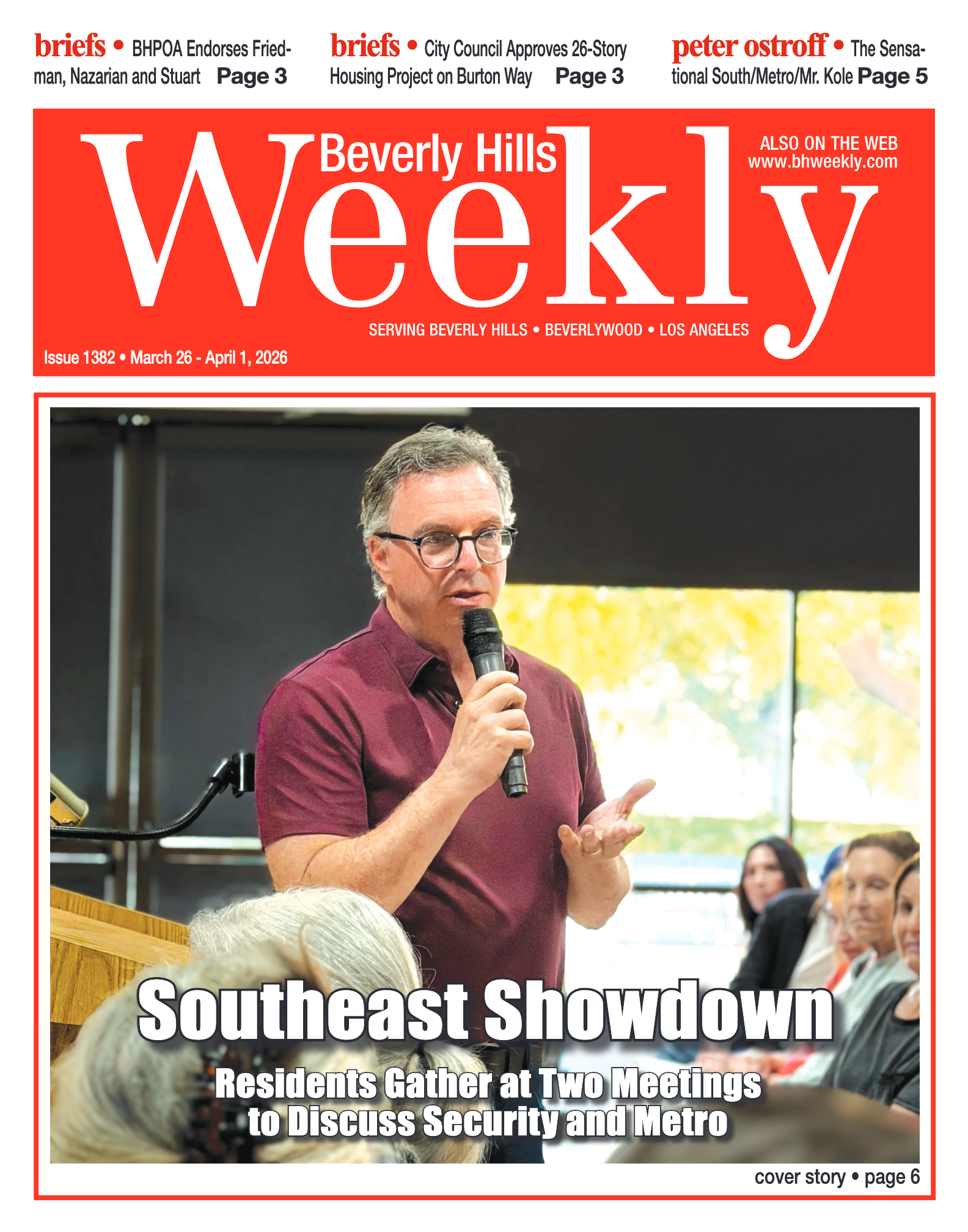
The article discusses a town hall meeting focused on zoning issues and proposed multifamily residential projects in Beverly Hills, highlighting community efforts to advocate for residents' interests in the "Sensational South." It also addresses the upcoming subway service and security concerns, while emphasizing the need for better transportation solutions and facilities to encourage local residents to utilize the new transit system.