Peter Ostroff
A Voice for Beverly Hills — Past, Present, and Future
Close Elections
As the national Presidential election approaches, the article reflects on the historical divisions in U.S. politics, emphasizing that past elections have often been decided by razor-thin margins and that the current climate is marked by deep partisan concerns. Despite uncertainty about the election's outcome, the author expresses confidence in the resilience of the United States, suggesting that the nation will endure regardless of the results.
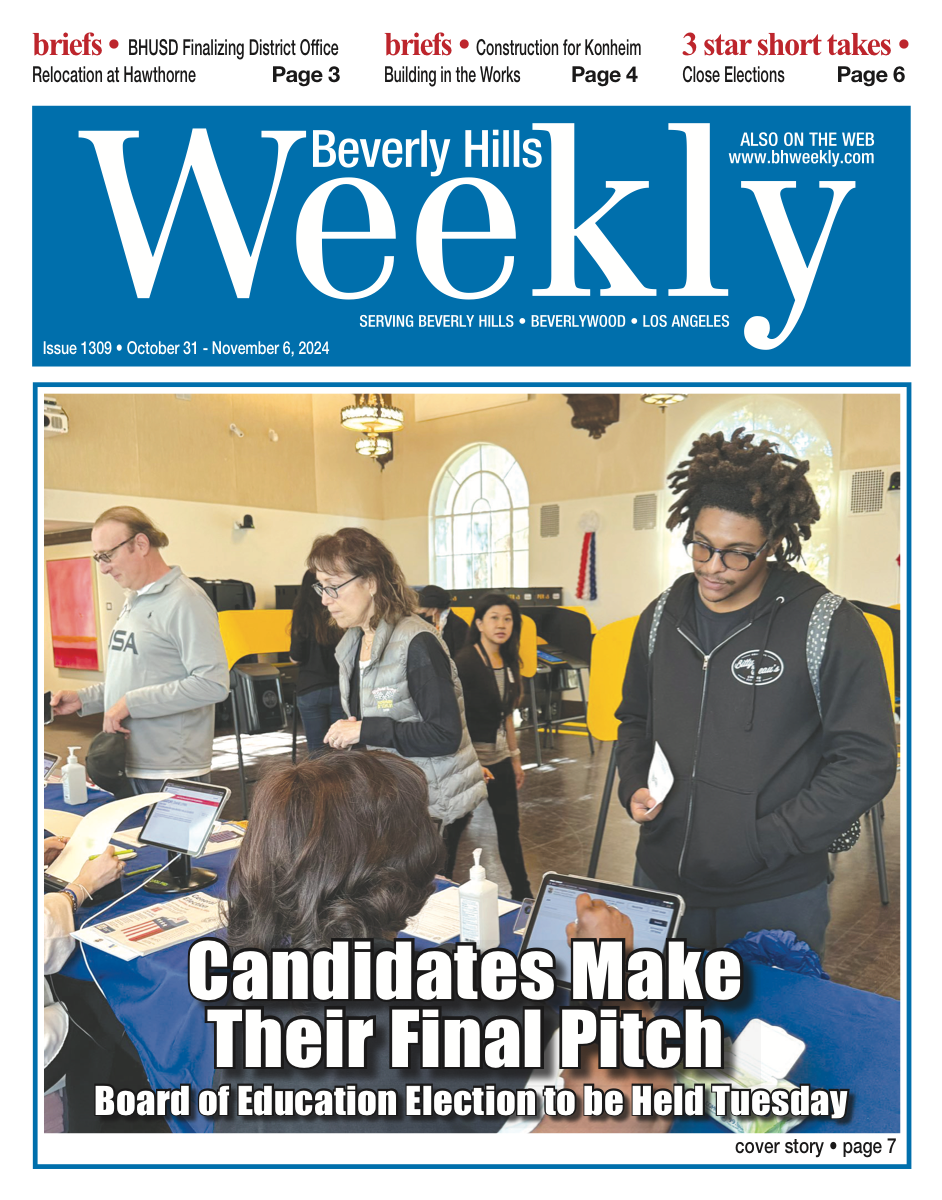
A national Presidential election is now being held and ballots are due next Tuesday.
I know that you want to know my answer to the question: Who will win? But I don’t know.
What I do know is that the polls are probably wrong and the race will probably be close.
The experts say that this is because the country is divided and many many people feel very strongly about the outcome.
Further, people of all political persuasions are greatly concerned about the extent to which we appear divided.
So let’s take a moment to put this in perspective. If we look at our history, it is fair to say that the United States of America quite often could be referred to as the Divided States of America at least when it comes to electing our Head of State.
Our two most recent elections, in 2016 and 2020, are illustrative.
In 2020, former Vice President Joe Biden took on the incumbent President, Donald Trump. The election was a very close one. Biden won the popular vote by 7,000,000 votes and he won the Electoral College vote 306-232, an apparently comfortable margin. But a shift of only 43,000 votes in Michigan, Pennsylvania and Wisconsin out of a total of more than 150,000,000 votes cast would have given then President Trump a return trip to the White House.
Similarly, in 2016, Donald Trump and Senator Hillary Clinton were the choices. Senator Clinton won the popular vote by approximately 3,000,000 votes but Mr. Trump won in the Electoral College 304-227, an even more comfortable margin than Biden’s in 2020. But a shift of only 78,000 votes in three counties in Michigan, Pennsylvania and Wisconsin would have given us our first woman President.
And there is nothing new about razor thin margins.
In 2000, Vice President Al Gore was challenged by former Texas Rangers President and Texas Governor W. Bush. Vice President Gore won the popular vote by more than 500,000 but then Governor Bush won in the Electoral College 271-266. A shift of less than 600 votes in Florida would have given the Presidency to Vice President Gore. Due to some issues relating to the vote counting and the closeness of the votes, a recount commenced. However, the recount was effectively halted by the United States Supreme Court. Most disturbingly, the Supreme Court vote was 5-4, five Republican Justices out voted four Democrat Justices. For me at least, this undermined the notion that our Judiciary at the highest level was totally removed from partisan politics.
Then we should recall the Presidential election of 1968 that occurred during one of the most turbulent years of modern times. That year started with the Tet Offensive in VietNam which revealed that our government (led by a Democrat, Lyndon Johnson) was lying to us about the progress of the war, followed by the assassinations of Martin Luther King and Presidential candidate Senator Robert F. Kennedy, riots in many of our cities and violence by the Chicago Police against anti-war protesters at the Democratic convention. Richard Nixon’s victory over Hubert Humphrey was the icing on a rancid “cake.” (Shortly before the campaign, Senator Kennedy spoke to a group of us at the University of Chicago Law School. I have never before or since been privileged to hear such an electrifying and riveting leader speak.)
In 1960, Senator John F. Kennedy faced then Vice President Richard Nixon. The fact that Senator Kennedy was a Roman Catholic (all prior Presidents had been Protestants) injected a disturbing tone to the campaign. The election was very close. Senator Kennedy won the popular vote by only 100,000 votes and won the Electoral College vote 303-219. However, a shift of only 18,000 votes in Missouri and Illinois would have changed the result.
Of course we shall debate until the end of time what would be different but for the assassinations of John and Robert Kennedy.
The 1948 election was contested between President Harry Truman and New York Governor Thomas Dewey. Governor Dewey was highly favored to win. But President Truman was re-elected in an upset. I mention this one because it is the first Presidential election about which I was old enough to be vaguely aware. I have a vivid recollection of my father showing me a picture of President Truman holding a copy of the Chicago Tribune with the headline “Dewey Defeats Truman” and telling me: “Don’t believe everything you read in the newspapers.”
Finally, we should recall the election of 1860, by far the most divisive. At that time, the issue of extension of slavery into territories divided the country. The anti-slavery Republican Party nominated a former one-term Congressman from Illinois, Abraham Lincoln. The Democrats split into two – the Democratic Party that nominated Senator Stephen Douglas of Illinois and the spin off Southern Democrats nominated Vice President John Breckinridge of Kentucky. The Constitutional Union Party nominated Senator John Bell of Tennessee. After a bitterly contested campaign, Abraham Lincoln won a majority of the Electoral College even though he won only 39% of the popular vote. Vice President Breckinridge was second in the electoral college vote as he carried 11 southern states. Seven of the states that Vice President Breckinridge carried seceded from the union before President Lincoln was inaugurated. The Civil War commenced and Breckinridge served as a Confederate General.
Four years and many lives lost later, the Union was restored. Presumably we have learned our lesson.
It is fair to conclude that to a greater or lesser extent from time to time, politically we have always been a “divided” country.
And here we go again with each side calling the other “a threat to democracy” and “the enemy” and each side predicting armageddon if the other side prevails.
So, while I do not know who will prevail this time, I do know this:
The United States of America is a great country and no matter the result of this election or any other, we will endure and prosper.
And remember: What goes around comes around!
Peter Ostroff is a retired attorney and former Beverly Hills Planning Commissioner.

Peter Ostroff is a long-time Beverly Hills resident of over 50 years who retired in 2017 after a 50-year career as a trial lawyer. He was born in Washington, D.C. in 1942. He graduated from Washington University (St. Louis, Mo) in 1964 with a B.A. degree in political science and economics. He graduated from the University of Chicago Law School in 1967 with a J.D. degree. He taught law at Monash University Law School in Melbourne, Australia in 1968. He became a member of the Illinois Bar in 1967 and the California Bar in 1969, He clerked for Hon. Shirley M. Hufstedler of the United States Court of Appeal 1969-70, practiced law with Nossaman, Waters, Scott, Krueger & Riordan and successor firms from 1970 to 1980 and with Sidley Austin from 1980 until 2017. During his full time law practice years he was a Committee Chair and Member of the Council of the American Bar Association, Litigation Section and was President of the Association of Business Trial Lawyers. Since 2018, he has served on the Beverly Hills Planning Commission. In addition to his work on the Commission, Peter has chaired the BHUSD 7-11 Surplus Property Committee and contributed to planning efforts for the District Offices site on S. Lasky Drive and future uses of the Hawthorne School property. He also served as Co-Chair of the Citizens Advisory Committee for the City's Climate Adaptation and Action Plan. He has been married to Anne Y. Ostroff since 2002, has two children, Nick Ostroff and Natalie Anne Cookson and has two grandchildren, Elliott Cookson and Emma Anne Cookson. Some family information is collected under Family Tree in this website. Since April 2024, he has written a weekly column for the Beverly Hills Weekly The columns are collected in this website.
petero@ostroff.la